


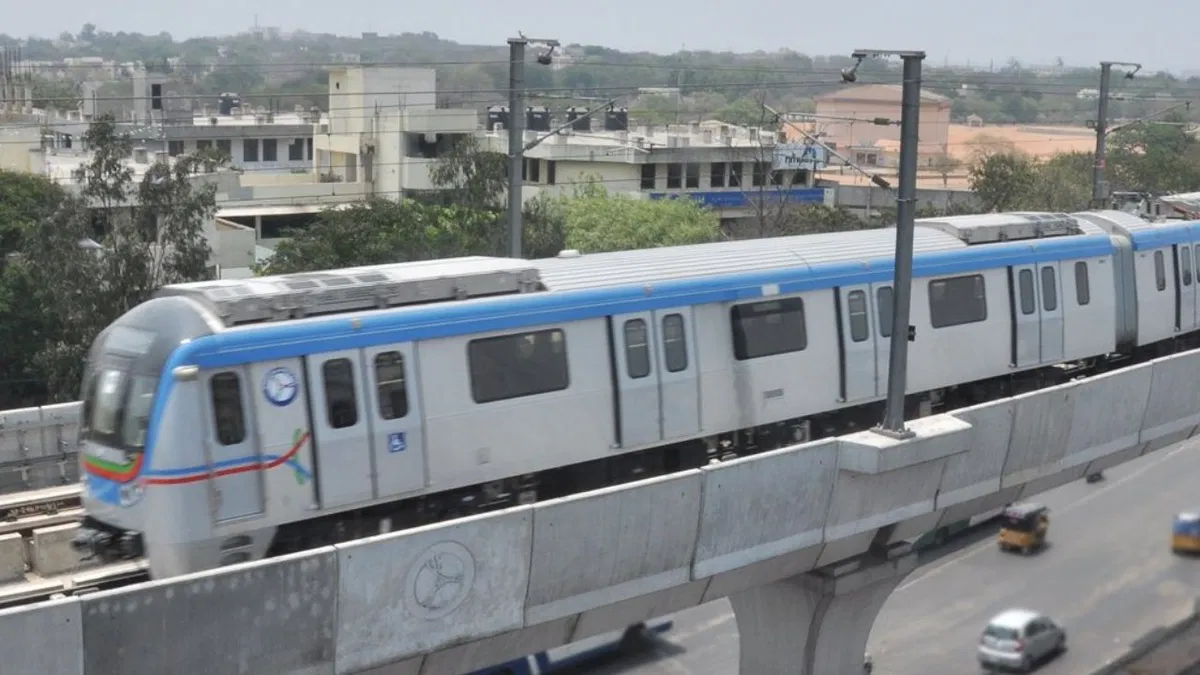
Hyderabad’s rapidly expanding IT corridor is undergoing a quiet but consequential street-level redesign, as traffic authorities introduce controlled pedestrian movement systems beneath the Raidurg Metro station — one of the city’s busiest transit nodes. The intervention reflects a growing attempt to reconcile high-density employment zones with safer, more predictable urban mobility, amid rising concerns over pedestrian fatalities and unmanaged road crossings.
The Raidurg stretch sits at the intersection of metro rail access, large technology campuses, commercial developments and informal transport activity. On a typical workday, thousands of commuters exit the station and disperse across arterial roads that were never designed to absorb such concentrated footfall. Until recently, pedestrians crossed wherever traffic gaps appeared, often stepping directly into fast-moving vehicles.Officials overseeing traffic planning say the newly installed barricades are intended to channel pedestrian movement toward defined crossing points rather than eliminate access altogether. By limiting spontaneous crossings, authorities aim to reduce collision risk and ease traffic turbulence on a corridor that already carries heavy peak-hour loads.
The move follows a concerning safety record. Traffic data from the area indicates a sustained pattern of pedestrian injuries and fatalities over the past year, reinforcing the urgency for structural rather than enforcement-led solutions. Urban planners note that in mixed-use employment districts like Raidurg, the absence of grade-separated crossings, refuge islands, or signalised pedestrian phases places disproportionate risk on walkers — especially during office rush hours.While the intervention has drawn online criticism for perceived inconvenience, transport experts argue that regulated crossings are a transitional step toward safer street design, particularly in high-speed, high-volume corridors. Similar measures have been deployed across Indian cities where metro infrastructure intersects with legacy road networks that prioritised vehicle throughput over pedestrian continuity.
However, urban mobility specialists caution that barricades alone cannot resolve deeper design gaps. Without shaded walkways, clearly marked crossings, universal access ramps and timed pedestrian signals, restrictive measures risk shifting inconvenience rather than eliminating danger. For technology-driven employment zones that depend heavily on public transport, last-mile walkability is increasingly seen as a productivity and equity issue, not merely a traffic concern.From a real estate and city-planning perspective, the Raidurg intervention signals a broader recalibration underway in Hyderabad’s infrastructure strategy. As commercial density rises along metro corridors, authorities are under pressure to retrofit streets for people-first movement — balancing safety, accessibility and economic efficiency.
Officials indicate that pedestrian flow patterns around the metro station will continue to be monitored, with scope for adjustments if congestion or accessibility issues persist. For a city positioning itself as a global technology hub, how it manages the everyday movement of its workforce may prove as critical as the infrastructure it builds.
Also Read:India Rail Strategy Expands High Speed Corridors
