


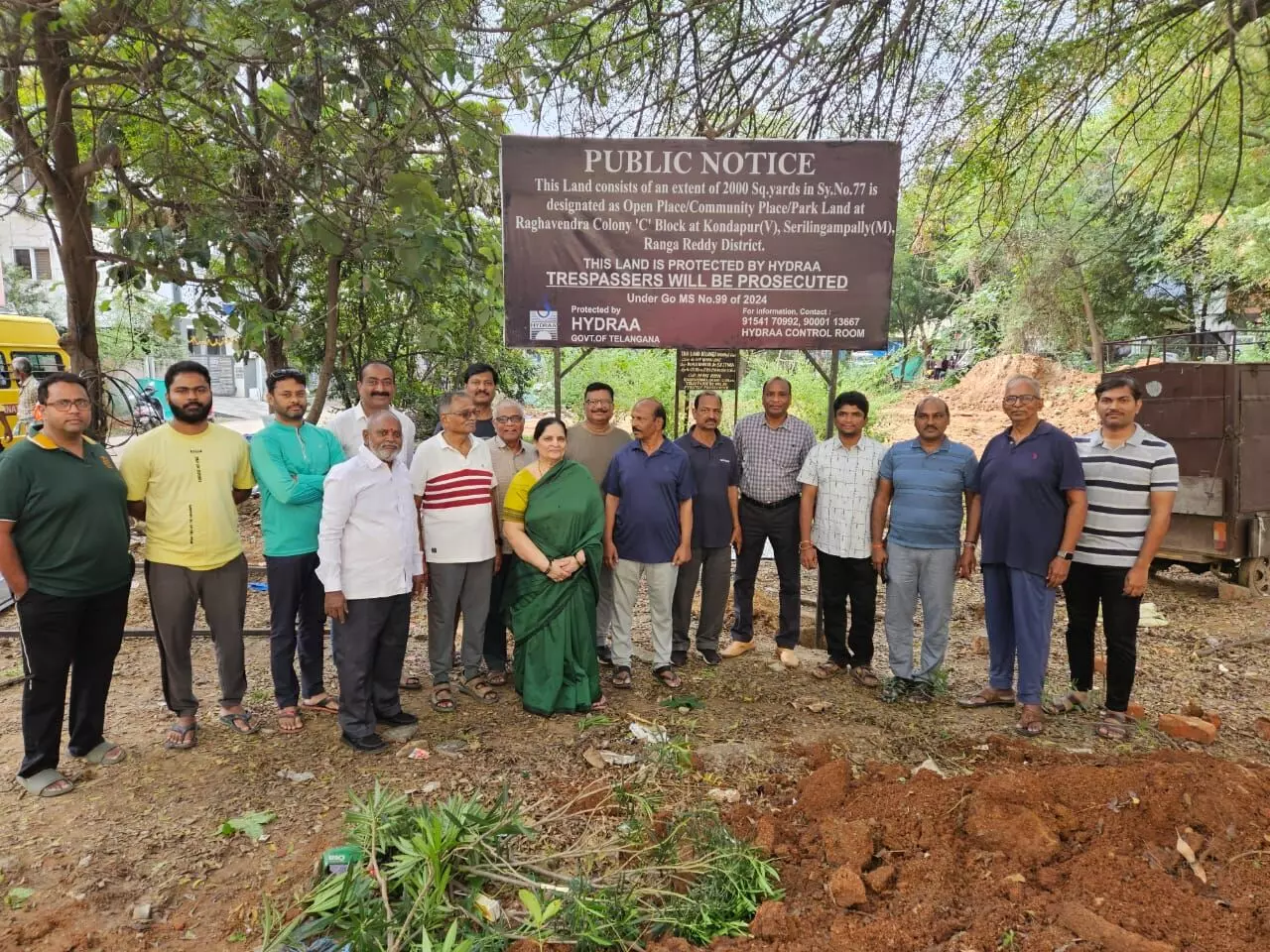
Hyderabad’s urban enforcement authorities have cleared alleged encroachments on nearly seven acres of government-designated land in Kondapur, a fast-growing residential and commercial pocket in the western corridor, in a move that underscores mounting pressure on public land in high-value urban zones.
Officials confirmed that the reclaimed parcel, estimated to be worth around Rs 1,400 crore at prevailing market rates, had originally been earmarked in the early 1990s for civic infrastructure including a junior college, a school, neighbourhood parks and a community hall. Over time, portions of the site were reportedly occupied by small commercial establishments and temporary structures.The clearance operation followed complaints raised by a local residents’ welfare association through a public grievance forum. The association questioned how plots reserved for public utilities were allegedly regularised under layout schemes despite falling within regulated land categories. Subsequent inspection by the enforcement agency determined that the land was being used in deviation from its original allocation.
Kondapur, located near the IT and financial districts, has witnessed rapid appreciation in land values over the past decade. Urban planners note that such appreciation often intensifies contestation over open spaces and institutional land, particularly in areas where residential demand outpaces planned civic infrastructure. The latest action highlights the role of enforcement agencies in safeguarding land designated for education, recreation and community use.Officials said the cleared land has been secured with fencing and will be redesigned for its intended public purpose. While detailed redevelopment plans are yet to be made public, planners suggest that restoring parks and educational facilities could ease infrastructure strain in surrounding colonies.
The episode also reopens debate over land governance frameworks such as the Urban Land Ceiling regulations and Layout Regularisation Schemes. Experts argue that ambiguity in land records and delayed enforcement can create conditions for informal commercialisation of public assets. Transparent digital land registries and real-time monitoring, they say, are essential to prevent similar disputes.For a city positioning itself as a global technology and services hub, protecting public land is closely linked to liveability. Access to neighbourhood schools, green spaces and community halls supports social cohesion and reduces dependence on private amenities. In climate-sensitive urban regions, preserved open spaces also function as heat buffers and improve stormwater absorption.
Urban economists caution that while enforcement drives may temporarily disrupt local businesses, long-term gains from restoring public land can strengthen equitable growth. The challenge lies in ensuring that reclaimed spaces are promptly developed and maintained, rather than left vacant and vulnerable to re-encroachment.As Hyderabad expands outward, balancing real estate growth with the protection of civic assets will remain central to sustainable urban planning. The Kondapur action signals a stricter stance on public land encroachments, but its lasting impact will depend on how effectively the restored land is integrated into the city’s broader infrastructure and community development strategy.
Also Read:Pune Premium Apartment Redefines Urban Comfort
Hyderabad reclaims public land in Kondapur
