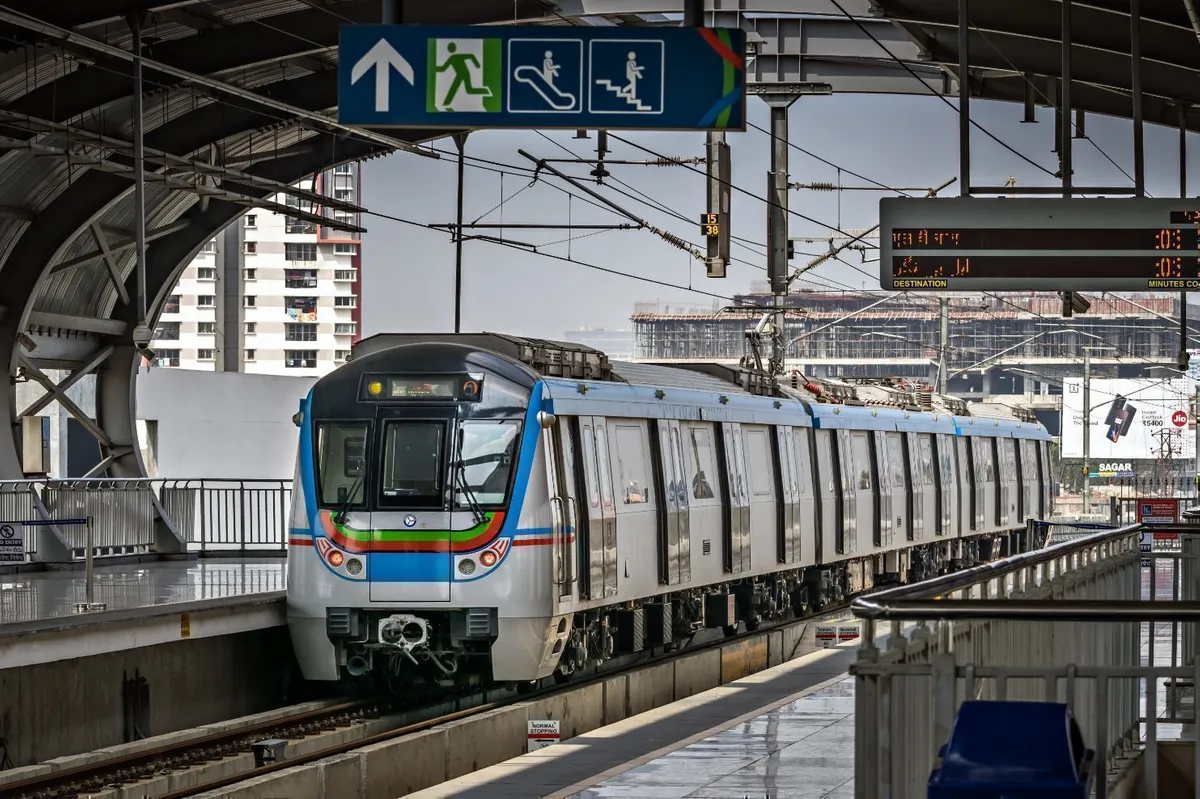
Hyderabad’s urban transport landscape is set for a significant operational shift as the city’s metro network moves closer to full public ownership, alongside plans to expand rolling stock to meet rising commuter demand. Hyderabad Metro Rail has initiated steps to procure 60 additional coaches, even as the Telangana government advances preparations to take over Phase I operations of the network from the private concessionaire.
The decision to expand the fleet reflects sustained passenger growth across the 69.2-kilometre Phase I system, which connects major residential, commercial and employment corridors. Transport officials familiar with the plan say the additional coaches will allow longer train formations and improved service frequency during peak hours, addressing crowding on high-demand stretches such as the IT and business districts. The proposed coach acquisition is being pursued independently of formal approvals for Phase II expansion, signalling a near-term focus on improving reliability within the existing network.
Once cleared by the state government, tenders for new six-coach train sets are expected to be issued, with deliveries aligned to projected ridership growth over the next few years. Running parallel to the capacity upgrade is the Telangana government’s plan to assume ownership and operations of Phase I by the end of the current financial year. The transition will mark a shift from a public–private partnership model to direct state control, a structure already in place in several other Indian metro systems. Officials overseeing the process have indicated that continuity of services remains the priority, with operational teams and systems expected to remain largely unchanged during the handover.
A detailed financial and technical review is currently underway to support the takeover. A financial advisory firm has been appointed to assess existing liabilities and revenue performance, while a separate technical audit will examine asset condition, maintenance practices and long-term operational requirements. The findings are expected to guide negotiations with lenders and shape a revised debt structure. Under the proposed arrangement, the state will assume outstanding project loans estimated at around ₹13,000 crore and make an additional payment to acquire full ownership of the infrastructure. Urban finance experts note that restructuring legacy debt will be critical to restoring financial sustainability, particularly as farebox revenues continue to recover after pandemic-era disruptions.
Beyond ownership and finances, the government is also looking to improve system integration. Planned measures include unified ticketing across transport modes, better pedestrian access around stations and enhanced upkeep of station precincts. These steps are increasingly seen as essential to maximise the metro’s role in reducing private vehicle dependence and supporting lower-carbon urban mobility. While Phase II, a proposed 162-kilometre expansion across multiple corridors, remains under technical appraisal at the national level, the immediate focus is firmly on stabilising and strengthening the existing network. For Hyderabad, the combination of additional coaches and a clearer governance structure could help align metro operations more closely with long-term urban growth, ensuring the system remains a backbone of inclusive and resilient city transport.
Hyderabad Metro Plans Fleet Upgrade Before Phase Two