


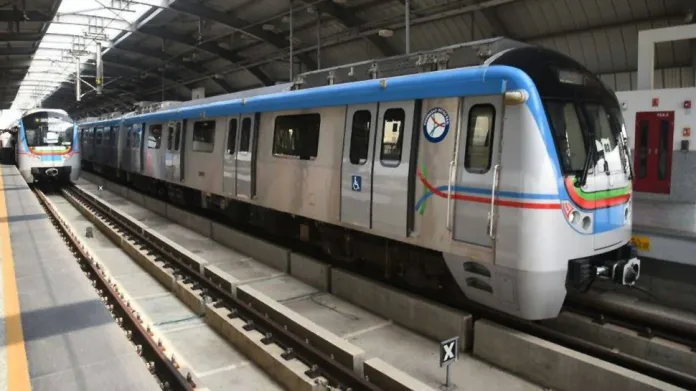
Hyderabad’s urban rail system is preparing for a major capacity upgrade as plans advance to introduce additional train sets designed to double passenger-carrying capability across its busiest corridors. The move reflects a growing recognition that the city’s rapid expansion now requires not just network growth, but deeper investment in existing infrastructure to sustain daily mobility and economic productivity.
Officials overseeing the metro system have outlined proposals to induct ten new train sets, a step that would allow the network to transition from three-coach to six-coach operations. Importantly, stations were originally designed for longer trains, enabling this shift without structural reconstruction a design choice now proving prescient as commuter volumes continue to rise. The focus keyword, Hyderabad Metro expansion, captures a broader recalibration underway in the city’s transport planning. Rather than adding routes alone, authorities are now prioritising throughput and reliability on established lines, particularly those connecting residential clusters with employment hubs and interchange terminals.
Across the three main corridors, the metro currently runs around 1,200 daily services, carrying nearly half a million passengers on an average weekday. During holidays and festivals, ridership often surges well beyond that mark, placing visible pressure on platforms and coaches during peak hours. Urban mobility experts note that prolonged crowding risks pushing commuters back towards private vehicles, undermining years of investment in low-emission mass transit. The decision to move towards longer train formations follows a delay that has drawn quiet concern within transport policy circles. Earlier capacity augmentation plans had not materialised, even as Hyderabad’s population and office footprint expanded rapidly in the western and northern suburbs. As a result, boarding during morning and evening rush hours has become increasingly difficult, particularly for women, elderly passengers and persons with disabilities groups for whom reliable public transport is critical to economic inclusion.
Financial considerations are also shaping the next phase of the Hyderabad Metro expansion. Each new six-coach train set is expected to require a significant capital outlay, placing the total investment in the range typically associated with medium-sized infrastructure projects. Parallel discussions are underway to restructure existing debt and refinance equity, potentially with multilateral support, signalling a broader attempt to stabilise the metro’s balance sheet while enabling growth.
From a sustainability perspective, expanding metro capacity offers returns far beyond fare revenue. Every shift from car or two-wheeler to rail reduces per-capita emissions, congestion, and local air pollution issues that increasingly define urban liveability rankings. Real estate analysts point out that reliable high-capacity transit also supports denser, more efficient land use patterns around stations, reducing the pressure for unchecked peripheral sprawl.
Manufacturing discussions with domestic rolling stock suppliers further align the project with national industrial and climate goals, strengthening local supply chains while avoiding long import cycles. As Hyderabad moves towards longer trains and higher capacity, the challenge will lie in ensuring that service frequency, station management and last-mile connectivity evolve in tandem. If executed holistically, this phase of metro development could mark a shift from merely building transport systems to shaping a resilient, low-carbon urban future one that keeps pace with both population growth and environmental responsibility.
