


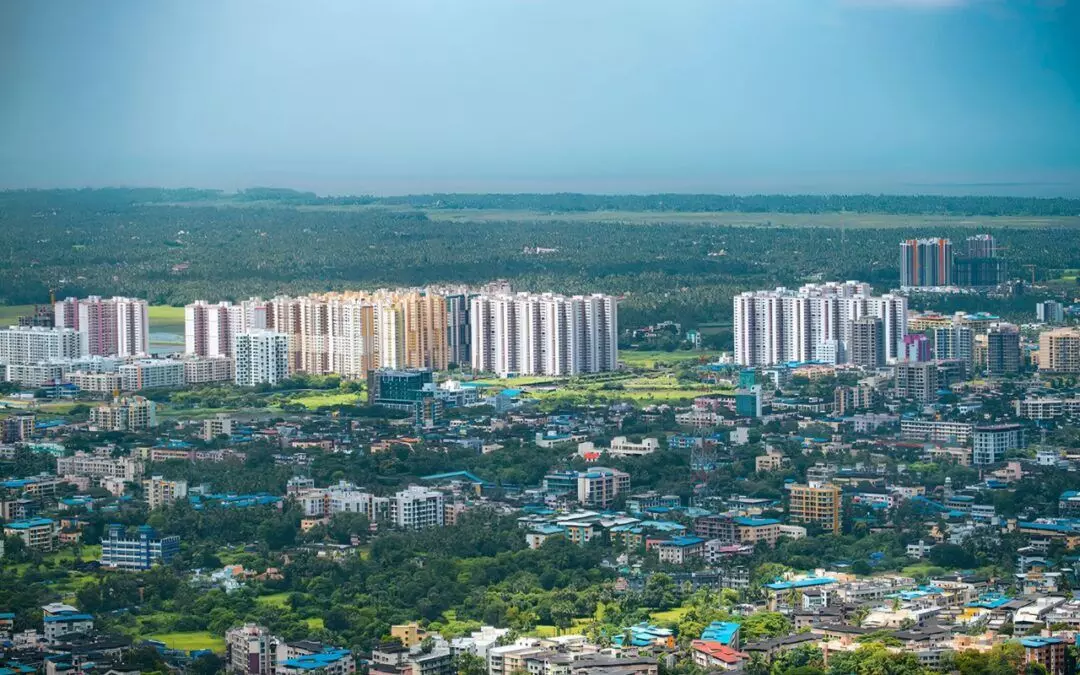
Hyderabad’s office market emerged as one of India’s strongest commercial real estate performers in 2025, recording its highest-ever annual leasing volume. The milestone reflects more than cyclical demand; it signals the city’s growing role as a long-term employment and innovation hub, supported by infrastructure-led planning, a deep technology workforce and sustained global interest.
Market data shows that office take-up during the year was driven largely by large-format occupiers, indicating confidence in long-term operations rather than short-term expansion. Industry analysts point out that Hyderabad’s commercial momentum has remained resilient despite global economic volatility, aided by comparatively stable costs, scalable office stock and predictable regulatory frameworks. A defining feature of the year was the rising presence of global enterprise operations. Overseas firms increasingly used Hyderabad as a base for advanced digital services, engineering functions and shared capabilities, rather than only back-office activity. This transition has widened the city’s employment base and strengthened demand for higher-grade office infrastructure, particularly projects with energy-efficient design and integrated transport access. The technology and business services sector continued to anchor demand, while financial services, flexible workspace providers and healthcare-related enterprises added diversity to occupier profiles. Urban economists note that this mix reduces market vulnerability and creates a more balanced employment ecosystem, benefiting the city’s wider economy. Spatially, leasing activity remained concentrated in Hyderabad’s established western corridors. Locations such as Madhapur and Gachibowli retained dominance due to their connectivity, proximity to residential clusters and availability of modern office campuses.
These districts also benefit from sustained public investment in road networks, metro connectivity and social infrastructure, reinforcing their attractiveness for both employers and employees. New office completions during the year were absorbed at a healthy pace, leading to a gradual tightening of vacancies in prime developments. The sharpest compression was visible in top-grade assets, suggesting occupiers are increasingly selective about quality, sustainability standards and operational efficiency. This trend has supported steady rental growth without triggering speculative price escalation. From an urban development perspective, the market’s performance highlights the importance of coordinated planning. As employment nodes intensify, the pressure on transport systems, housing affordability and civic services will increase. Planners caution that continued success will depend on aligning commercial expansion with transit-oriented housing, water security and climate-resilient infrastructure. Looking ahead, Hyderabad enters 2026 with a robust project pipeline and strong pre-commitment levels. However, experts underline the need for disciplined supply delivery to avoid future oversaturation.
The city’s challenge now is not attracting demand, but managing growth responsibly ensuring that economic expansion translates into inclusive opportunity, reduced commute burdens and a lower environmental footprint. If sustained with balance, Hyderabad’s office market trajectory could serve as a template for how Indian cities scale commercial growth while maintaining urban liveability.
Also Read: PRAGATI Platform Drives Housing And Infrastructure Execution
Hyderabad Leasing Surge Reflects Infrastructure Led Growth
