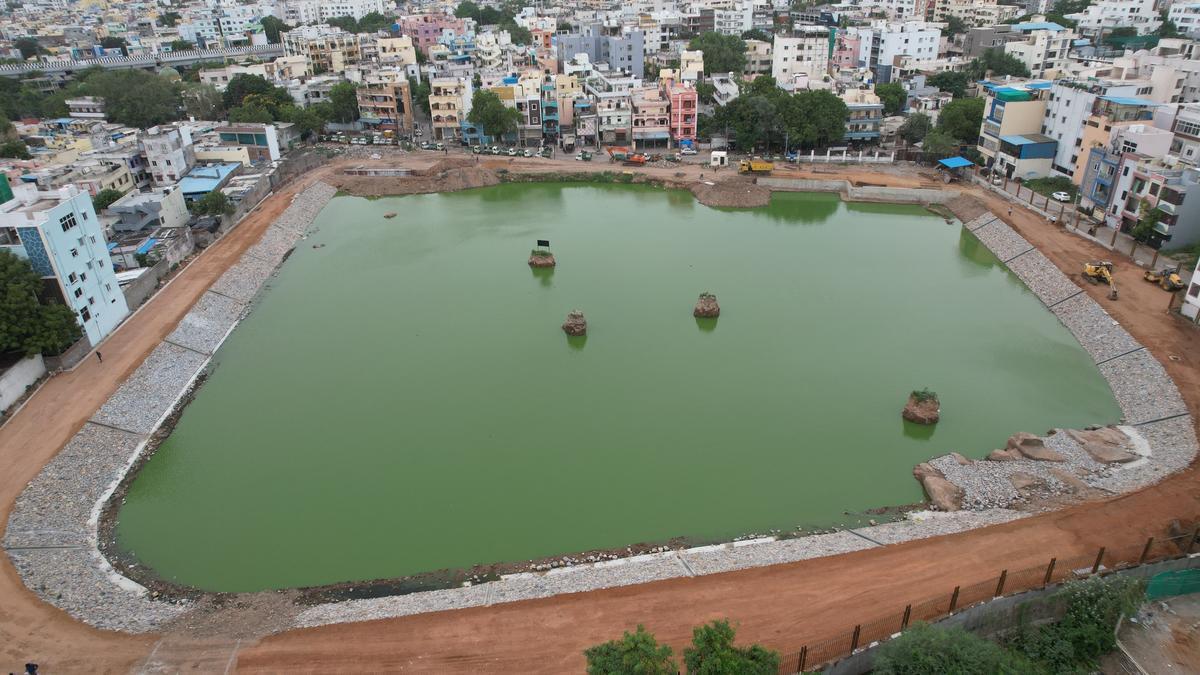
Hyderabad Lake Revival Gains Momentum as Bathukamma Kunta Begins to Fill After Decades
Hyderabad’s long-neglected Bathukamma Kunta in Amberpet is finally seeing water after over two decades of drought, neglect, and legal disputes. The Hyderabad Disaster Response & Asset Protection Agency (HYDRAA) has confirmed visible signs of revival at the site, where rejuvenation work began earlier this year.
The project, expected to conclude by September, is one of six lake restoration initiatives being spearheaded by HYDRAA, including Bam Rukn-ud-Daula, Thammidikunta, Sunnam Cheruvu, and two Nalla Cheruvus in Uppal and Kukatpally. The Bathukamma Kunta lakebed, once dismissed as a non-existent water body, began yielding ground water during excavation works earlier this year, prompting a legal dispute which HYDRAA won in April. Currently, the lake holds greenish, slimy water—mostly groundwater and stormwater from nearby localities. HYDRAA chief A.V. Ranganath clarified that sewage has been successfully diverted, and stormwater is now flowing in through a newly constructed inlet. The outlet drain connecting to the Musi River remains under construction, facing complications due to dense urban development in its path.
Constructed with embankments and a surrounding walking track, the restored portion appears artificially shaped, with only a section of the original lake being revived. According to Hyderabad Metropolitan Development Authority (HMDA) records, Bathukamma Kunta’s full tank level perimeter was estimated at 1.4 km during a 2013 survey. The original surveyed area exceeded 14 acres, though significant portions have since been lost to encroachments. Despite evidence from Survey of India maps affirming the historical presence of a lake, the site remained dry for over a decade, even during Hyderabad’s 2020 floods. Satellite images show major encroachments and blocked inlets and outlets, which stalled its natural restoration.
The final notification of Bathukamma Kunta as a protected lake is still pending from HMDA. Officials believe that once the outlet to the Musi is completed and stormwater circulation stabilises, the water body will start resembling a functioning urban lake, not just in name but in utility.