


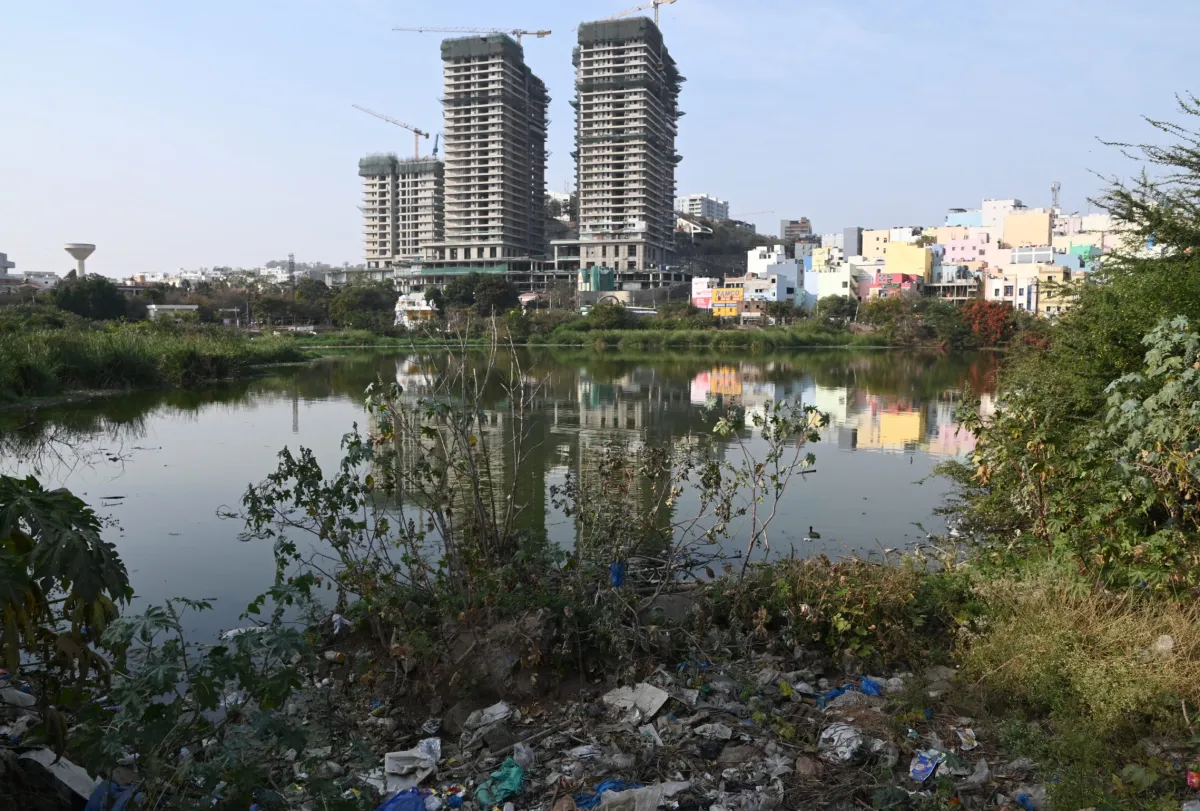
The restoration of Kudi Kunta in Hyderabad’s Kondapur locality has reached a defining milestone, with civic authorities and residents formally marking the completion of a decade-long ecological recovery effort. The Hyderabad lake restoration project has converted what was once a sewage-stressed water body into a managed urban ecosystem, offering a template for citizen-led climate resilience in rapidly urbanising corridors.
Situated in the high-density Masjid Banda neighbourhood, the lake had for years received untreated wastewater as apartment clusters multiplied across western Hyderabad. By the mid-2010s, inflows of domestic sewage had begun to outpace the lake’s natural regenerative capacity, shrinking water quality and reducing storage potential.Urban planners involved in the project confirm that the turning point came with the commissioning of a decentralised sewage treatment plant (STP) capable of processing more than seven million litres per day. Installed on government-allotted land away from the lake’s green buffer, the facility intercepts wastewater before it reaches the water body. Treated water is now channelled for landscape irrigation and groundwater recharge in surrounding public spaces.
Officials from the city’s water utility state that the intervention has improved holding capacity by roughly 40 per cent, strengthening the lake’s role as a flood buffer during intense rainfall. In a city that has witnessed repeated monsoon flooding linked to vanishing lakes and encroachments, the Hyderabad lake restoration demonstrates how wastewater management and hydrological planning can work together.The revival effort began with small-scale clean-up drives nearly ten years ago. Over time, structured engagement between resident groups, environmental volunteers and municipal departments resulted in technical studies, desilting, bund stabilisation and biodiversity planning. More than 60,000 fish have been introduced to support aquatic balance, while real-time sensors now track water and ambient air quality.
Importantly, the restoration model incorporates a financial sustainability mechanism. Apartment associations in the vicinity contribute a modest monthly fee towards maintenance, fisheries management and security. A lakeside community deck generates limited rental income for events, ring-fenced for upkeep. Urban governance experts say such hybrid funding models reduce dependence on irregular municipal budgets and encourage citizen accountability.For Hyderabad’s real estate market, functional lakes increasingly influence residential valuations in emerging micro-markets such as Kondapur. Environmental infrastructure is no longer seen merely as an amenity but as risk mitigation against water scarcity and flooding — both material considerations for lenders and homebuyers.
Environmental economists note that decentralised treatment plants reduce the carbon footprint associated with pumping sewage across long distances. When integrated with lake rejuvenation, they also lower downstream pollution loads, supporting broader basin health.As Hyderabad continues to expand, the Kudi Kunta experience underscores a key lesson: restoring urban water bodies demands both engineering rigour and sustained community stewardship. Replicating the Hyderabad lake restoration model across other degraded lakes could strengthen water security while improving urban liveability in one of India’s fastest-growing metropolitan regions.
Also Read:Ahmedabad Airport Improves Terminal 1 Traffic Flow
Hyderabad Lake Restoration Transforms Kondapur Ecosystem
