


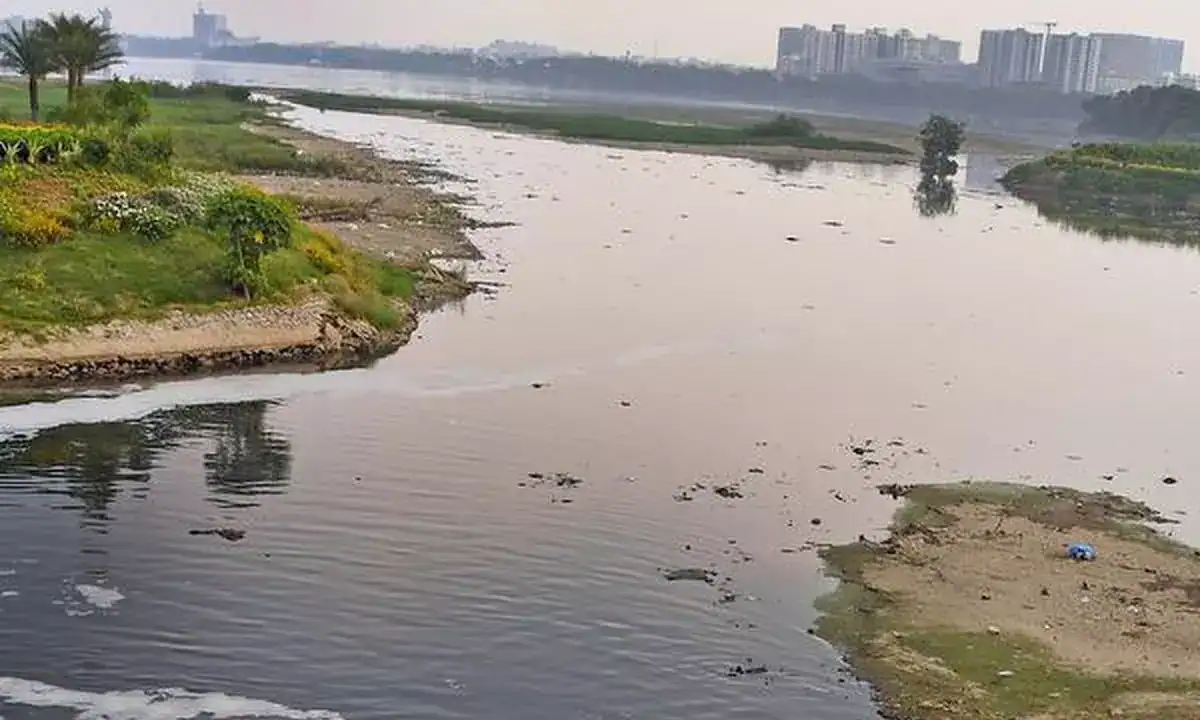
Hyderabad’s ambitious lake revival campaign is confronting a sobering reality: despite demolition drives, desilting works and beautification efforts, water quality across several urban lakes continues to deteriorate. The trend raises critical questions about whether current lake restoration strategies are addressing ecological systems or merely altering their appearance.
Over the past year, the city’s disaster response and asset protection agency has cleared encroachments across dozens of lakebeds and initiated restoration works in key water bodies including Durgam Cheruvu, Bathukamma Kunta, Sunnam Cheruvu and others. Official data indicates hundreds of acres have been reclaimed within notified full tank levels. Yet pollution indicators released by the state pollution regulator show dissolved oxygen levels in multiple lakes hovering near zero — a sign of biological stress caused largely by untreated or partially treated sewage inflows.Urban planners point out that lake restoration cannot succeed without comprehensive sewage management. While several sewage treatment plants operate across the metropolitan region, capacity gaps, pipeline blockages and poor inter-agency coordination continue to allow contaminated water to enter lakes. In some cases, diversion channels have merely shifted pollution from one water body to another.
The challenge is compounded by rapid land use change. Satellite assessments over the past four decades show a dramatic contraction in lake surface area, driven by real estate expansion, infrastructure corridors and informal settlements. In several neighbourhoods once buffered by water bodies, the disappearance of lakes has intensified heat island effects and urban flooding risks. Environmental researchers note that lakes act as thermal regulators and groundwater recharge systems — assets critical to climate resilience in a fast-growing city.Hyderabad Lake Restoration initiatives have also sparked debate over design priorities. Walking tracks, bund strengthening and landscaping have become visible symbols of progress. However, hydrologists caution that narrowing water spread through embankments or internal pathways can restrict natural flood absorption. Without restoring feeder channels and catchment integrity, they argue, restored lakes may struggle to perform their ecological function during extreme rainfall.
Recent enforcement actions — including demolition of villas, resorts and commercial structures within full tank limits — have underscored a tougher regulatory stance. Authorities have warned property buyers to verify whether developments are built on encroached nalas or lakebeds, signalling increased scrutiny of real estate transactions near water bodies. Such moves carry implications for developers, financiers and homebuyers alike, as environmental compliance becomes central to asset security.Meanwhile, civic groups are demanding real-time public disclosure of lake water quality data and independent audits of restoration works. They argue that Hyderabad Lake Restoration must prioritise sewage diversion, wetland regeneration and catchment protection rather than short-term visual upgrades.
For a metropolis positioning itself as a technology and investment hub, the health of its blue infrastructure is not a peripheral issue. Lakes influence flood management costs, public health outcomes, urban temperatures and land values. As restoration projects move into their second year, the next phase will likely determine whether Hyderabad’s water bodies regain ecological vitality — or continue to shrink behind fenced perimeters and landscaped edges.
Also Read:Ahmedabad Sports Enclave To Anchor Riverfront Growth
Hyderabad Lake Restoration Faces Governance Test
