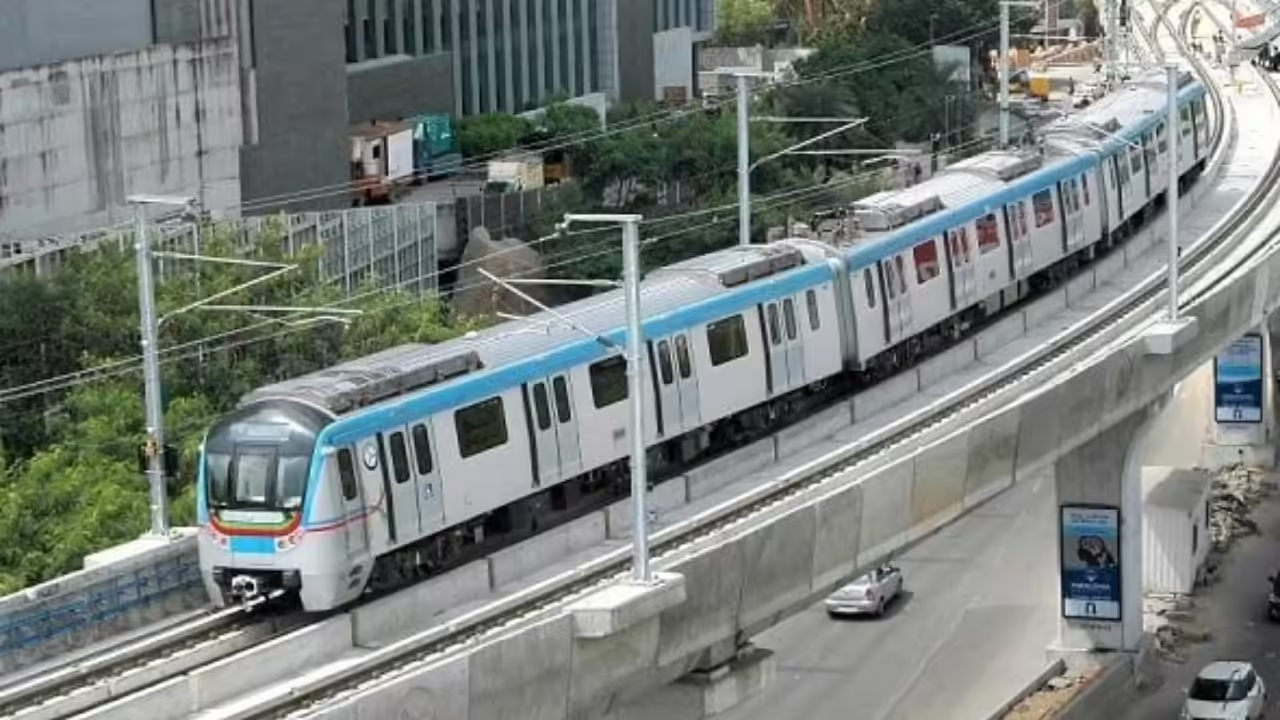
Hyderabad’s urban transport landscape is entering a decisive phase as the Telangana government moves to take full control of the city’s operational Metro network. The takeover of Phase I of the Hyderabad Metro Rail marks more than a financial restructuring; it reflects a strategic attempt to reposition mass transit as a tool for equitable access, environmental sustainability, and long-term urban integration in one of India’s fastest-growing cities.
The state has approved the acquisition of the private concessionaire’s equity at an estimated cost of ₹2,000 crore, alongside the assumption of outstanding debt of about ₹13,000 crore. Industry observers note that the decision follows years of operational stress under the public–private partnership model, which struggled to achieve financial viability amid lower-than-expected ridership and pandemic disruptions. With public ownership, officials believe the Metro can be aligned more closely with broader urban policy goals rather than narrow commercial metrics.
Phase I of the Hyderabad Metro spans roughly 72 kilometres across three corridors and has been operational since 2017. While it has eased congestion in key stretches, planners acknowledge that large sections of the Old City and emerging peripheral zones remain poorly connected.
A senior transport official said public control allows the Metro to function as essential civic infrastructure, enabling better access to employment centres, education hubs, and healthcare facilities across socio-economic divides.
The proposed Phase II expansion is central to this ambition. Planned across five corridors covering over 76 kilometres, the project carries an estimated cost exceeding ₹24,000 crore. The state has sought central support to develop the expansion as a joint venture, positioning it as a backbone for sustainable urban growth. Urban economists argue that extending high-capacity public transport into underserved neighbourhoods could reduce dependence on private vehicles while supporting more compact, transit-oriented development.
Environmental considerations also feature prominently. Metro systems are increasingly viewed as critical to lowering urban emissions by shifting commuters away from road-based travel. Experts point out that high-capacity rail can replace multiple lanes of road traffic, cutting fuel consumption and improving air quality an increasingly urgent concern for Hyderabad as it expands outward. Beyond infrastructure, the Metro’s evolution has social implications. Recent efforts to strengthen safety and inclusivity, including the induction of transgender personnel into security roles, signal a broader push to make public transport welcoming and accessible for all users. Officials note that women constitute a significant share of daily ridership, underscoring the need for visible safety measures and inclusive staffing.
However, the path ahead is not without challenges. Delays in central approvals and funding decisions have drawn criticism from state leaders, highlighting the political and administrative complexities of large-scale urban projects. Analysts warn that prolonged uncertainty could slow expansion at a time when population growth and traffic pressures are intensifying. As Hyderabad balances heritage neighbourhoods with high-tech corridors, the Metro’s future role is increasingly clear. More than a transit system, it is being positioned as an instrument to reconnect a fragmented city economically, socially, and spatially while steering urban growth towards a more sustainable and inclusive trajectory.
Hyderabad Government Takes Over Metro Phase One To Bridge Old City Hubs