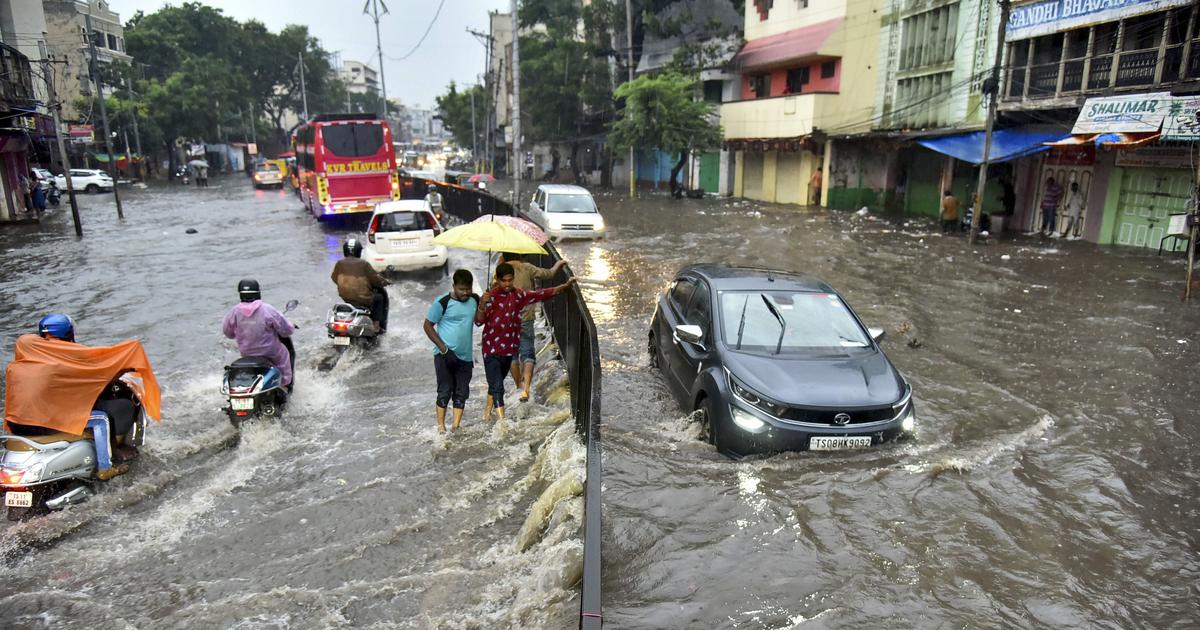
Nearly one-third of Greater Hyderabad now falls within zones of high flood exposure, underscoring the mounting costs of unplanned urban expansion and ageing civic infrastructure in one of India’s fastest-growing metropolitan regions. A recent city-wide vulnerability assessment indicates that accelerated construction, combined with failing stormwater systems, has sharply increased the likelihood of flooding across large parts of the Telangana capital.
The assessment shows that extensive land-use change since the early 2000s has altered Hyderabad’s natural hydrology. Built-up areas have expanded rapidly, replacing open land, wetlands, and catchment zones that once absorbed rainfall. As a result, a significant portion of the city now experiences rapid surface runoff during intense rain events, overwhelming drainage networks and flooding roads, homes, and commercial areas.
According to the findings, around 11% of Hyderabad’s geographical area faces very high flood exposure, while an additional 26% is categorised as highly vulnerable. Urban planners note that these zones are not limited to peripheral neighbourhoods but increasingly include established residential and mixed-use areas, raising concerns for property safety, infrastructure reliability, and insurance risk. The spatial pattern of vulnerability reveals deeper structural issues. Low-lying wards along the Musi river basin remain especially exposed during monsoon months, while several southwestern parts of the city show persistent flood susceptibility due to altered terrain and dense development. Central Hyderabad presents a fragmented risk profile, reflecting uneven infrastructure upgrades and legacy drainage constraints.
Experts point to the city’s stormwater network as a critical weakness. Large sections of the system are reportedly fragmented, poorly maintained, or functionally obsolete. Silted drains, encroached water channels, shrinking lake capacities, and solid waste accumulation have reduced the system’s ability to carry runoff during short, high-intensity rainfall spells events that climate scientists say are becoming more frequent. For Hyderabad’s economy, the implications extend beyond inconvenience. Recurrent flooding disrupts workforce mobility, damages housing stock, and strains public finances through repeated emergency repairs. Real estate analysts warn that flood exposure is increasingly influencing residential demand, commercial leasing decisions, and long-term asset valuations, particularly in older neighbourhoods with limited drainage upgrades.
Urban resilience specialists emphasise that engineering solutions alone will not suffice. Restoring interconnected drainage corridors, protecting remaining water bodies, and enforcing land-use regulations are viewed as essential to reducing future risk. Improved road gradients, dedicated stormwater channels, and temporary water diversion systems in vulnerable zones could offer immediate relief, while long-term planning must prioritise permeability and natural flow paths. As Hyderabad continues to grow as a technology and services hub, the study serves as a reminder that economic competitiveness is closely tied to climate resilience. Addressing flood vulnerability is no longer just a civic challenge it is central to safeguarding livelihoods, infrastructure investments, and the city’s long-term sustainability.
Hyderabad Flood Risk Rises With Rapid Urban Expansion