


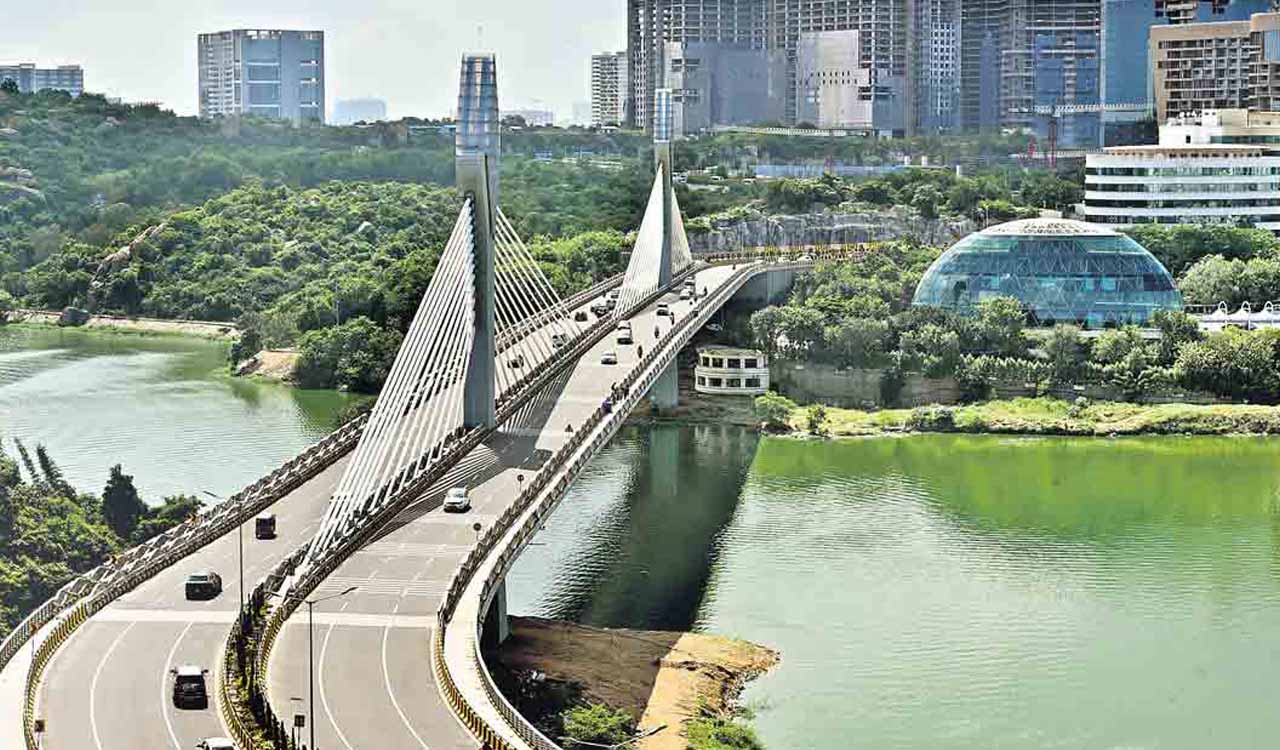
The Telangana government has initiated a coordinated enforcement and infrastructure plan to curb sewage inflows into Durgam Cheruvu, one of Hyderabad’s most visible urban lakes, following a high-level review of pollution risks in the Madhapur–HITEC City belt. The move underscores mounting pressure on city authorities to secure water bodies amid rapid commercial and residential expansion.
Senior officials from the Hyderabad Metropolitan Water Supply and Sewerage Board (HMWSB), Greater Hyderabad Municipal Corporation (GHMC), Hyderabad Metropolitan Development Authority (HMDA), irrigation and revenue departments jointly inspected the lake’s catchment and adjoining developments. The review focused on untreated wastewater inflow, construction-related discharge and monsoon flood management.At the centre of the Durgam Cheruvu protection plan is a directive that only treated wastewater from designated Sewage Treatment Plants (STPs) be reused for non-potable purposes such as construction curing, landscaping and gardening within major commercial zones including the Mindspace district. Authorities indicated that raw sewage diversion and reuse enforcement would be tightened in high-density IT corridors.
Currently, wastewater generated in parts of Madhapur and surrounding catchments is processed through two STPs near the lake with combined treatment capacities of 12 million litres per day. The treated output is channelled into the lake system to help stabilise groundwater recharge and maintain hydrological balance. However, intermittent overflows and stormwater mixing have raised environmental concerns.To address these vulnerabilities, engineers are laying a large-diameter pipeline to divert sewage from vulnerable stretches to interception and diversion points, reducing the risk of overflow into public park areas. In parallel, a dedicated transmission line is being planned to supply treated water directly to construction sites and landscaped campuses, lowering freshwater dependency.
Urban ecologists say the Durgam Cheruvu protection plan is critical as Hyderabad’s western growth corridor intensifies. Glass-fronted commercial towers, residential high-rises and hospitality projects have increased impervious surfaces in the lake’s vicinity, altering natural drainage patterns. Without careful management, seasonal runoff can carry pollutants into the water body.Climate resilience experts also note that urban lakes play a vital role in flood mitigation, groundwater recharge and micro-climate regulation. Protecting Durgam Cheruvu is therefore not merely a conservation issue but a broader urban sustainability imperative. Strengthening sewage interception and reuse systems can reduce eutrophication, protect biodiversity and support long-term water security.
Real estate stakeholders operating in the HITEC City zone are expected to face stricter compliance checks regarding wastewater reuse and discharge norms. Environmental compliance, analysts suggest, is increasingly becoming a determinant of project approvals and investor confidence.Authorities have indicated that monitoring mechanisms and inter-agency coordination will be intensified in the coming months. For Hyderabad’s fast-urbanising technology corridor, the success of the Durgam Cheruvu protection plan will test whether infrastructure growth can coexist with ecological stewardship in a climate-stressed urban future.
Also Read:Vedhee Kapoor Joins Runwal Realty Mumbai Luxury
