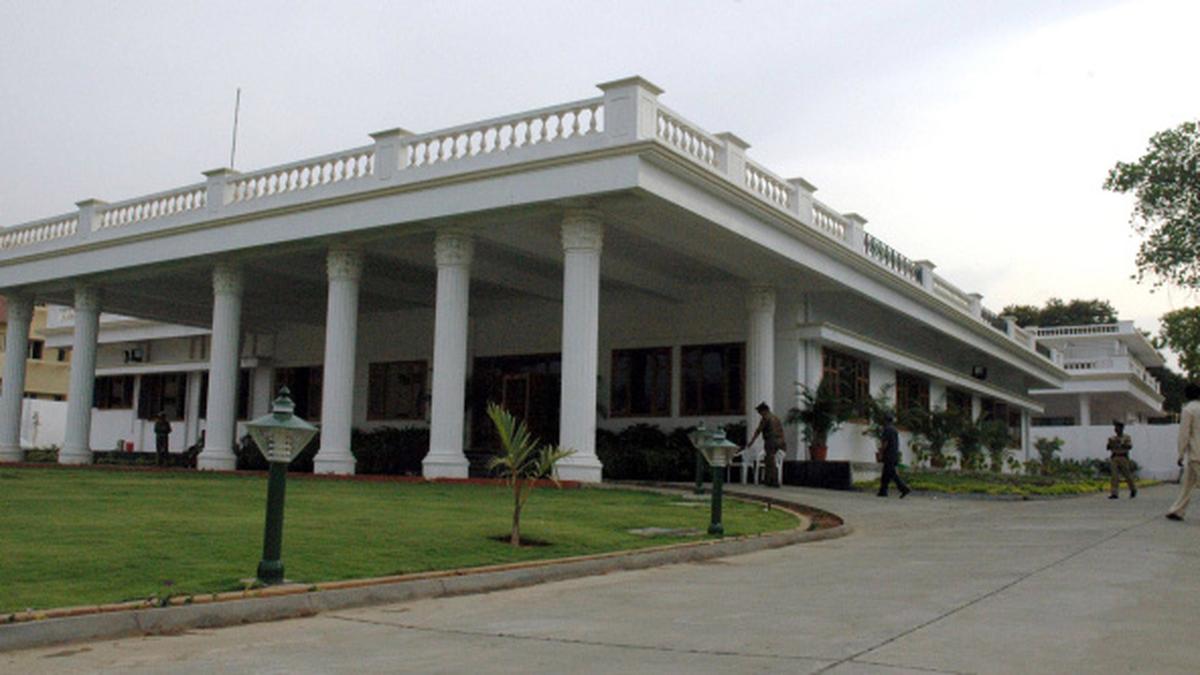
The Telangana government has issued tenders for camp office upgrades at the Dr MCR HRD Institute of Telangana campus in Hyderabad, allocating an estimated ₹9.08 crore for enhanced security and infrastructure works. The facility, primarily an administrative training centre, is occasionally used for official meetings by the state’s Chief Minister, placing it within the capital’s expanding high-security governance network.
According to tender documents reviewed by Urban Acres, the proposed camp office upgrades include construction of a reinforced compound wall topped with concertina wire, installation of watch towers, controlled entry gates, and additional security infrastructure. Internal works such as new furniture, improvements to access ramps and surfacing of an approach road leading to a VVIP guest house are also planned.The Dr MCR HRD Institute of Telangana, established in 1976, serves as a key training hub for state and central government officials. Over the decades, its role has expanded alongside Telangana’s administrative footprint. Urban planners note that as governance functions become more decentralised and security protocols tighten, hybrid campuses like this are increasingly adapted to accommodate both training and executive operations.
Officials indicated that the camp office upgrades are intended to standardise security arrangements rather than convert the institute into a permanent secretariat. However, the move reflects a broader trend in Indian cities where temporary or auxiliary government facilities are being retrofitted to meet evolving safety norms.Hyderabad has witnessed heightened investment in public infrastructure following the state government’s announcement of a ₹20,000 crore development push over two years. Several transport, civic and institutional projects are already underway. In that context, the camp office upgrades represent a relatively modest but symbolically significant expenditure, underscoring how governance infrastructure forms part of urban capital spending.
Security experts say reinforced perimeters and surveillance towers are now common features at facilities hosting high-level meetings. Yet urban design specialists caution that such measures must be balanced with accessibility and environmental sensitivity. Large boundary walls and hardscaped surfaces can affect drainage patterns and heat retention if not designed carefully, particularly in a city grappling with rising temperatures and seasonal flooding.The institute’s campus, set amid established institutional zones, also plays a role in Hyderabad’s knowledge economy. Investments in its infrastructure may indirectly support its core mandate of administrative capacity-building, especially as digital governance and climate resilience become central to public policy training.
For residents, the immediate impact will likely be limited to construction activity within the campus perimeter. Over the longer term, however, the camp office upgrades illustrate how cities are reconfiguring civic spaces to accommodate both democratic functioning and heightened security expectations.As Hyderabad continues to expand its administrative and economic profile, the challenge will be ensuring that investments in official infrastructure align with principles of transparency, efficient land use and climate-responsive design — priorities that increasingly define sustainable urban growth.