


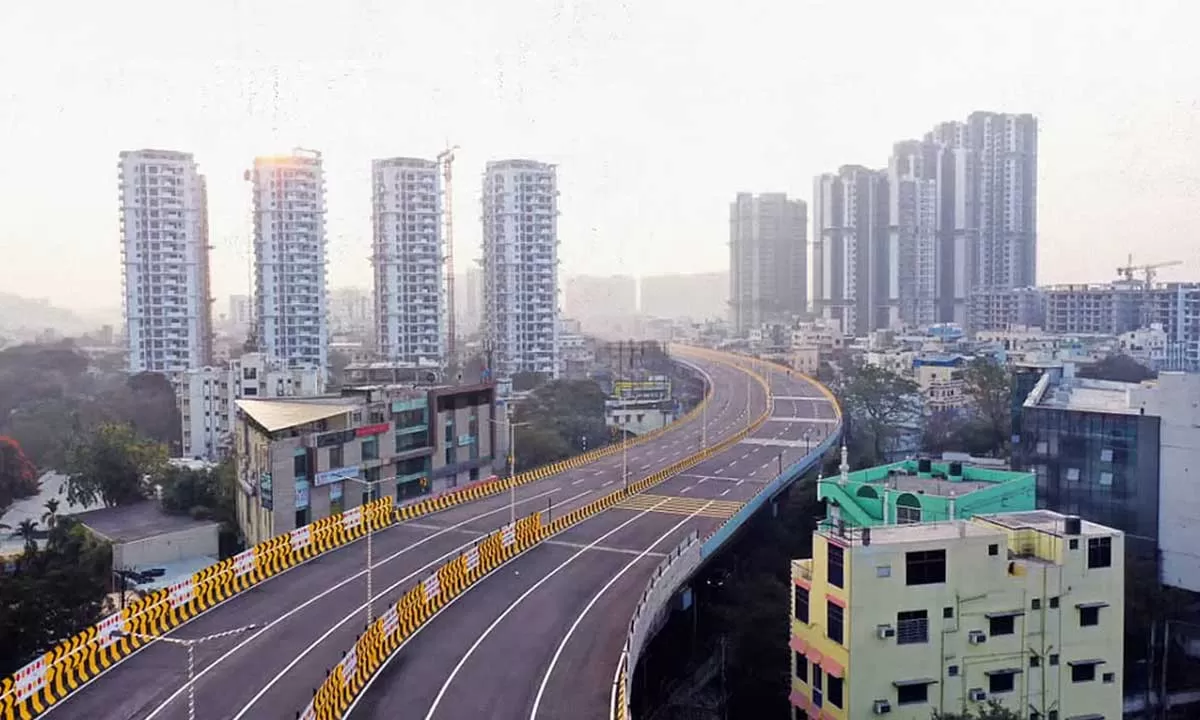
Hyderabad has commenced construction on a major grade-separated interchange at the IIIT Junction in Gachibowli, marking the start of a ₹500-crore effort to create a signal-free corridor in one of the city’s most congested technology hubs by 2028.The project, led by the Greater Hyderabad Municipal Corporation, targets smoother mobility across the Lingampally–Gachibowli–Financial District stretch, which carries an estimated 2.6 to 2.8 lakh vehicles daily. The junction also handles substantial traffic from ISB Road and DLF Road, making it a critical node in the western IT corridor.
Officials describe the design as a multi-tier interchange combining elevated flyovers and an underpass. A primary bi-directional flyover will link key arterial roads, while additional semi-circular ramps will ease turning movements that currently cause signal bottlenecks. An underpass connecting adjoining neighbourhoods is also planned, requiring significant excavation across the existing carriageway.Initial works have focused on erecting support pillars along wider road sections to minimise complete shutdowns. However, the most disruptive phase is expected during the underpass construction, when available lanes may be reduced and diversions introduced. Traffic police are preparing contingency routes through nearby localities to distribute peak-hour flow.
The IIIT Junction Flyover project highlights a recurring challenge in fast-growing urban corridors: synchronising road expansion with underground utilities and green cover. Authorities have begun relocating electrical lines and transplanting trees after securing regulatory approvals. Urban planners note that preserving mature tree cover and integrating sustainable drainage systems will be crucial in mitigating heat stress and runoff in the dense IT belt.Commuters in the area already report longer travel times as barricades and equipment narrow carriageways. Peak-hour delays of 10 minutes or more at the signals have been common even before construction, reflecting demand that has outpaced existing road capacity.
One structural constraint remains DLF Road, which narrows and misaligns near the junction, forcing staggered vehicle merging. Civic agencies are examining land acquisition and geometric corrections to address this bottleneck as part of the broader upgrade.Mobility experts argue that while the IIIT Junction Flyover may reduce signal delays once operational, long-term congestion relief will depend on complementary public transport investments. The Gachibowli corridor houses thousands of employees across IT parks, universities and commercial campuses. Without modal shift towards buses, metro extensions or last-mile electric mobility, grade separation alone may not fully resolve traffic pressure.
For now, motorists are bracing for phased disruptions expected to continue until the targeted completion in May 2028. If delivered as planned, the interchange could significantly streamline movement in Hyderabad’s western growth corridor, while also testing how large-scale infrastructure projects balance construction impact with sustainable urban design principles.
Also Read:Haryana unveils India tallest building plan
Hyderabad begins IIIT Junction Flyover works
