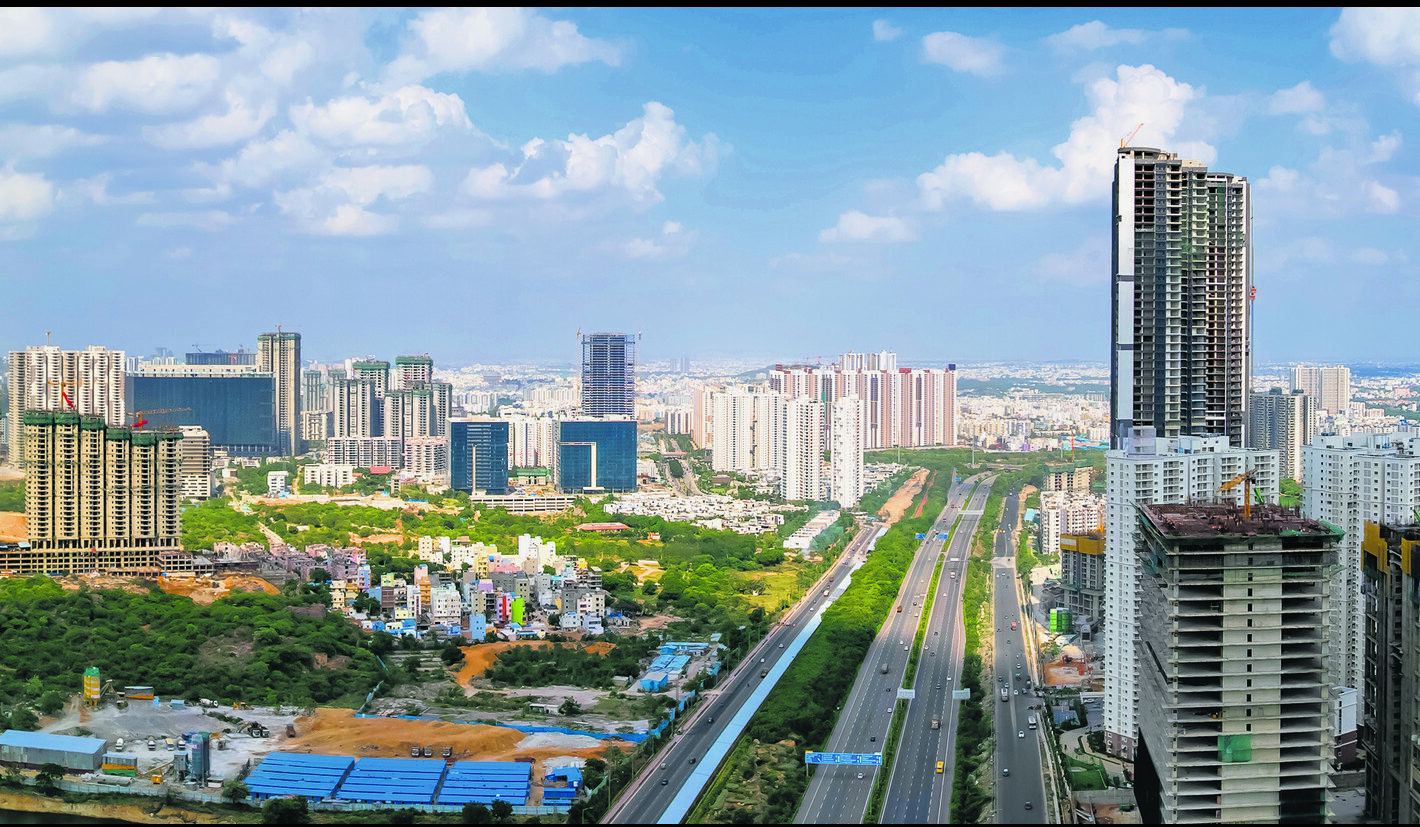
Greater Hyderabad is on course to become India’s largest municipal corporation by area and population following a proposed merger of 27 surrounding urban local bodies, a move that could significantly reshape governance, infrastructure planning and service delivery across the Telangana capital region. The expansion, currently under public consultation, marks one of the most ambitious urban restructuring exercises undertaken by an Indian city in recent years and carries long-term implications for sustainable metropolitan growth.
Under the proposal, the jurisdiction of the Greater Hyderabad Municipal Corporation (GHMC) would expand more than threefold, while the population under a single civic authority would increase substantially. The number of elected municipal wards is also set to double, reflecting the scale of administrative integration envisioned. Officials describe the plan as the foundation for a unified core urban region capable of coordinated planning across transport, housing, water and environmental services. According to a senior municipal official, the ward reorganisation has been based on a technical assessment conducted by a government-affiliated urban governance institution, with population distribution, service efficiency and future growth taken into account. Public feedback has been invited as part of the statutory process, with thousands of representations already received. The final notification is expected later this month, aligning the exercise with preparations for the next national census cycle.
City administrators argue that the Greater Hyderabad expansion will help reduce fragmented governance, a long-standing challenge in Indian metropolitan regions. Bringing peri-urban municipalities and panchayats under one authority is expected to support more equitable infrastructure investment, uniform service standards and integrated climate resilience planning. Urban policy experts note that such consolidation can enable better land-use management and lower per-capita emissions if paired with strong public transport and compact development strategies. However, the proposal has also triggered political and civic debate. Elected representatives across parties have questioned the pace and transparency of the delimitation process, calling for greater consultation and data disclosure. Some have sought extensions to the public objection deadline, while others have raised concerns about whether the process aligns fully with municipal legislation. These disagreements underline the complexity of balancing democratic participation with administrative urgency in fast-growing cities.
From a governance perspective, analysts say the success of the Greater Hyderabad expansion will depend less on scale and more on institutional capacity. Managing a mega-municipality of this size will require decentralised decision-making, digital service delivery and safeguards to ensure peripheral communities are not marginalised. Inclusive planning, gender-neutral public spaces and climate-sensitive infrastructure will be critical if the expanded city is to deliver on its promise. As Indian cities confront rapid urbanisation, climate stress and widening inequality, the Greater Hyderabad expansion is being closely watched. If implemented transparently and thoughtfully, it could offer a replicable model for building integrated, sustainable and people-centric metropolitan regions.
Hyderabad Becomes Indias Largest Municipal Body After 27 ULB Merger Expansion Move