


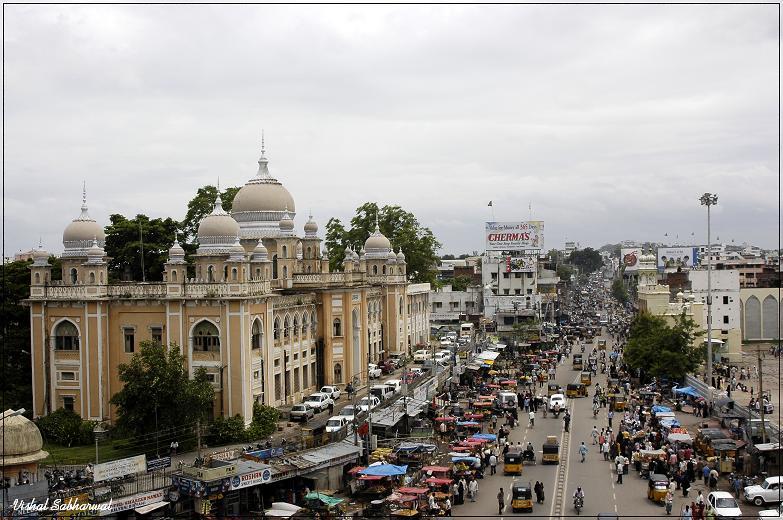
Hyderabad’s bustling Banjara Hills is at the centre of a growing debate as the government advances plans for two new flyovers and an underpass, projects estimated at ₹370 crore. While the proposed structures are aimed at easing traffic bottlenecks in one of the city’s busiest corridors, the environmental price could be steep. According to official assessments, 1,532 trees have been approved for felling, raising concerns over the shrinking urban green cover in an already congested zone.
The most prominent of the planned projects is a three-lane flyover connecting Jalagam Vengala Rao (JVR) Park to the TV9 junction, a stretch infamous for long traffic snarls. A second two-lane flyover is expected to link the NFCI area with Banjara Hills. Together, the flyovers are positioned as crucial to improving connectivity towards Jubilee Hills, Hitech City, Madhapur, and Gachibowli, all high-density residential and commercial zones.
Also Watch: An Exclusive Interview with Sanjeev Jaiswal (IAS), CEO MHADA
Data from the district forest authorities reveal that out of 1,942 trees around KBR Park and adjoining roads, the Tree Protection Committee has approved the cutting of 1,532. Another 380 are earmarked for translocation, while just 30 will be retained. Officials confirmed that at least 183 trees along Road Number 2 may be felled immediately to pave way for the JVR Park–TV9 flyover stretch.
Urban ecology experts warn that the large-scale removal of trees could further destabilise the city’s air quality and climate resilience. Hyderabad has witnessed rising temperatures and flooding episodes in recent years, issues directly linked to loss of tree cover and unregulated construction. They argue that projects of such scale should be accompanied by stronger environmental safeguards, including a more balanced ratio of translocation and compensatory plantation.
Officials from the Urban Biodiversity Division have stated that assessments on tree retention and translocation are ongoing, and final clearances are contingent on detailed environmental reviews. The zonal commissioner overseeing the project has indicated that coordination is under way to secure the necessary permissions, but added that traffic relief remains a pressing public demand in the city.For citizens and sustainability advocates, however, the question remains whether the city is trading away too much of its ecological wealth for short-term mobility gains.
Large flyover projects, while effective in easing congestion at specific points, often shift the traffic load further downstream rather than eliminating it. Without parallel investments in public transport and non-motorised mobility, experts warn, Hyderabad risks compounding both environmental and traffic challenges.
The project, still in the approval stage, underscores the city’s ongoing dilemma of balancing urban growth with ecological stewardship. As Hyderabad expands, the challenge is to reimagine infrastructure that eases mobility without eroding the very greenery that safeguards its livability.
