


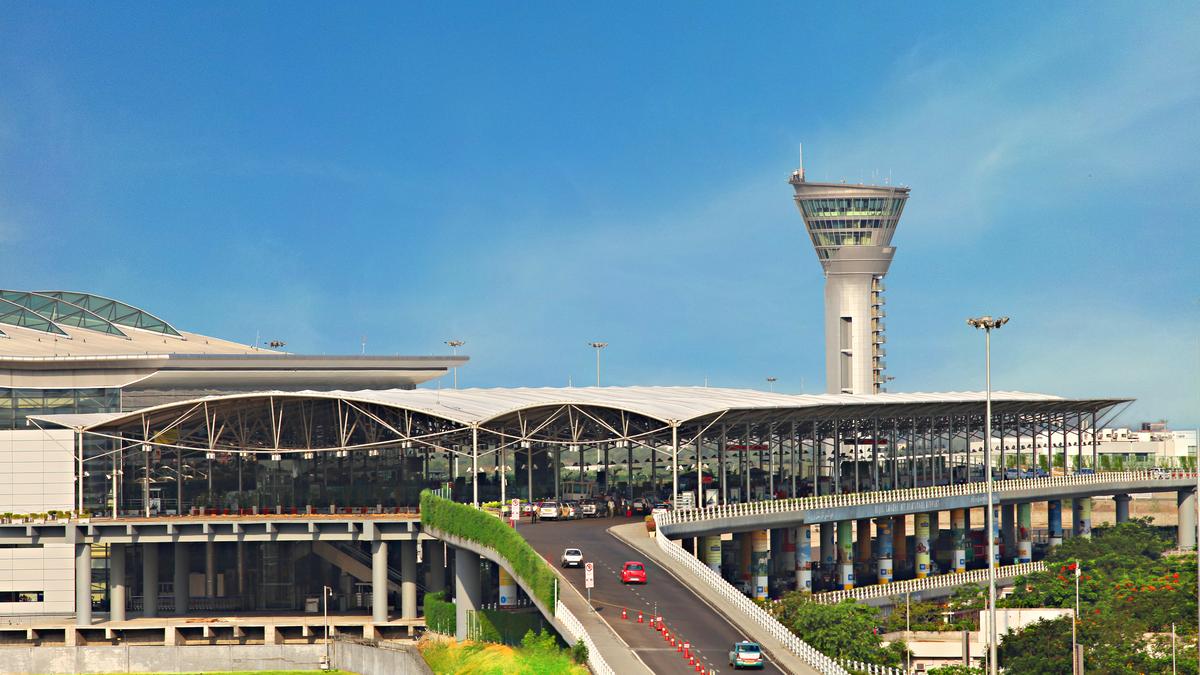
Hyderabad’s aviation gateway, Rajiv Gandhi International Airport, generated an estimated ₹68,000 crore in gross value added during 2024–25, reinforcing its position as one of Telangana’s most influential economic engines. The Hyderabad airport economic impact study, prepared by the National Council of Applied Economic Research, highlights the airport’s growing role in employment, trade and urban expansion.
The assessment indicates that airport operations supported roughly 3.5 lakh jobs across direct, indirect and induced categories. When the adjoining aerotropolis development is included, total contribution rises to about ₹75,000 crore in gross value added and over 4 lakh jobs — accounting for more than five per cent of the State’s economic output.The Hyderabad airport economic impact stems from multiple channels. Direct output includes airline operations, ground handling, retail and airport management. Indirect effects arise through supply chains — from fuel providers to logistics firms — while induced impacts reflect household spending by employees across the ecosystem. Together, these layers amplify the airport’s footprint far beyond its terminal buildings.
Passenger growth has been central to this expansion. The airport handled nearly 29.5 million travellers in FY25, with domestic traffic forming the majority. Long-term projections suggest volumes could nearly triple by FY38, driven by business travel, tourism and international connectivity. The airport currently links Hyderabad to dozens of domestic and global destinations, strengthening the city’s integration with global markets.Cargo operations have also emerged as a strategic asset. Hyderabad’s pharmaceutical and life sciences sectors rely heavily on temperature-controlled logistics, and the airport’s specialised cargo facilities have enabled consistent export flows to Europe, the Middle East and Asia-Pacific markets. Economists note that resilient air cargo infrastructure enhances competitiveness for high-value manufacturing clusters.
Urban development experts say the Hyderabad airport economic impact extends to real estate dynamics in southern corridors. Commercial parks, hospitality assets and residential townships around the airport have expanded in tandem with rising traffic. The adjoining aerocity project has catalysed mixed-use development, contributing to employment diversification beyond the city’s western IT hub.However, sustained growth will depend on infrastructure upgrades and climate resilience. As passenger numbers rise, investments in runway capacity, multimodal connectivity and sustainable energy systems will be critical. Airports globally are under pressure to reduce carbon intensity through renewable power adoption, efficient terminal design and green mobility integration.
The study’s long-term projections estimate that by 2037–38, the combined ecosystem could contribute over ₹2 lakh crore in gross value added and support close to 10 lakh jobs. For Telangana, this positions the airport not merely as a transport node but as a structural driver of economic transformation.As Hyderabad aspires to balance rapid expansion with environmental responsibility, the airport’s next phase of growth will test how effectively infrastructure, sustainability and inclusive employment can advance together.
Also Read:Kolkata Reviews Zeerut Bridge Safety Concerns
Hyderabad Airport Economic Impact Tops 68000 Crore
