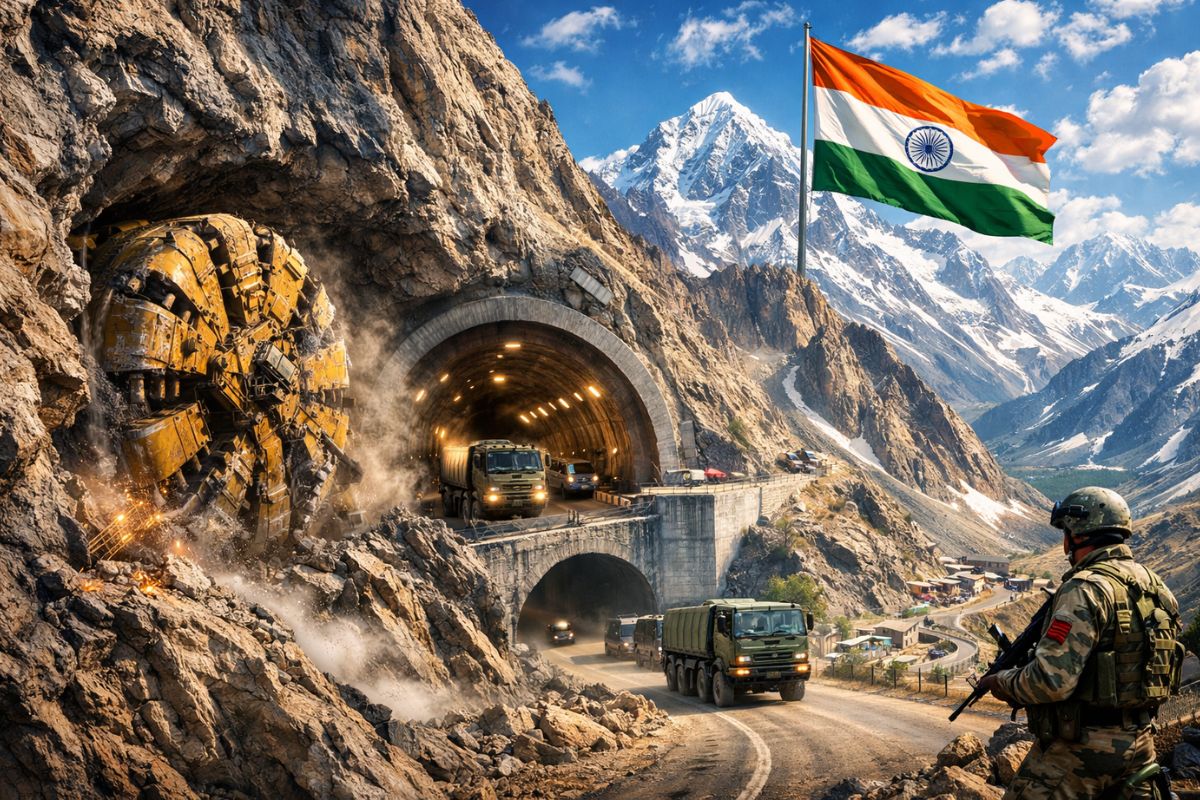
India has taken a decisive step towards year-round connectivity in the high Himalayas with the near-completion of the Zojila Tunnel, a critical road corridor beneath the Zojila Pass linking the Kashmir Valley to Ladakh. Built to bypass one of the most snowbound and unreliable mountain routes in the country, the tunnel marks a structural shift in how extreme geographies are integrated into national transport and logistics networks.
For decades, the surface road over Zojila functioned as Ladakh’s only dependable land link to the rest of India, yet remained unusable for nearly half the year due to heavy snowfall and avalanches. The seasonal closure disrupted civilian life, inflated freight costs, and forced prolonged stockpiling of essentials. The Zojila Tunnel addresses this vulnerability by converting a weather-dependent route into a permanent, all-season artery. Engineers involved in the project describe the tunnel as a response not just to snow, but to systemic isolation. Located at high altitude in a geologically young and unstable mountain system, construction required adaptive excavation techniques rather than continuous tunnel boring machines. Instead, progress was achieved through controlled drilling and blasting cycles, followed by immediate stabilisation using sprayed concrete, rock anchors, and steel supports. This approach allowed constant adjustment to unpredictable rock behaviour and groundwater seepage.
Working conditions added another layer of complexity. With oxygen levels significantly lower than at sea level, project planners redesigned labour practices to prioritise safety, including shorter shifts, acclimatisation cycles, on-site medical facilities, and independent power systems. These measures were essential to maintain productivity while reducing health risks in sub-zero temperatures.
Beyond excavation, the tunnel has been equipped as a complete transport system. Integrated ventilation, lighting, surveillance, and emergency response infrastructure ensure safe operation under heavy traffic and adverse conditions. Advanced monitoring systems allow operators to manage air quality and respond quickly to incidents, reinforcing the tunnel’s role as resilient infrastructure rather than a simple road shortcut.
The economic implications are substantial. Travel time across the pass is expected to drop from several hours to under half an hour, improving supply-chain predictability for fuel, food, and construction materials. Industry experts say this reliability will lower logistics costs, support tourism without seasonal spikes, and enable more balanced regional development. Strategically, the Zojila Tunnel also strengthens mobility in a sensitive border region, allowing uninterrupted movement of personnel and supplies throughout the year. However, urban and environmental planners emphasise that the tunnel’s long-term success will depend on careful traffic management and climate-sensitive maintenance to prevent secondary ecological stress in fragile mountain ecosystems.
As climate volatility increases and snowfall patterns become less predictable, the Zojila Tunnel stands as a model of infrastructure designed for resilience rather than reaction. It demonstrates how engineering, when aligned with long-term regional planning, can convert natural constraints into stable connections reshaping life and opportunity at the top of the world.
Himalayan Zojila Tunnel Reshapes Ladakh Connectivity