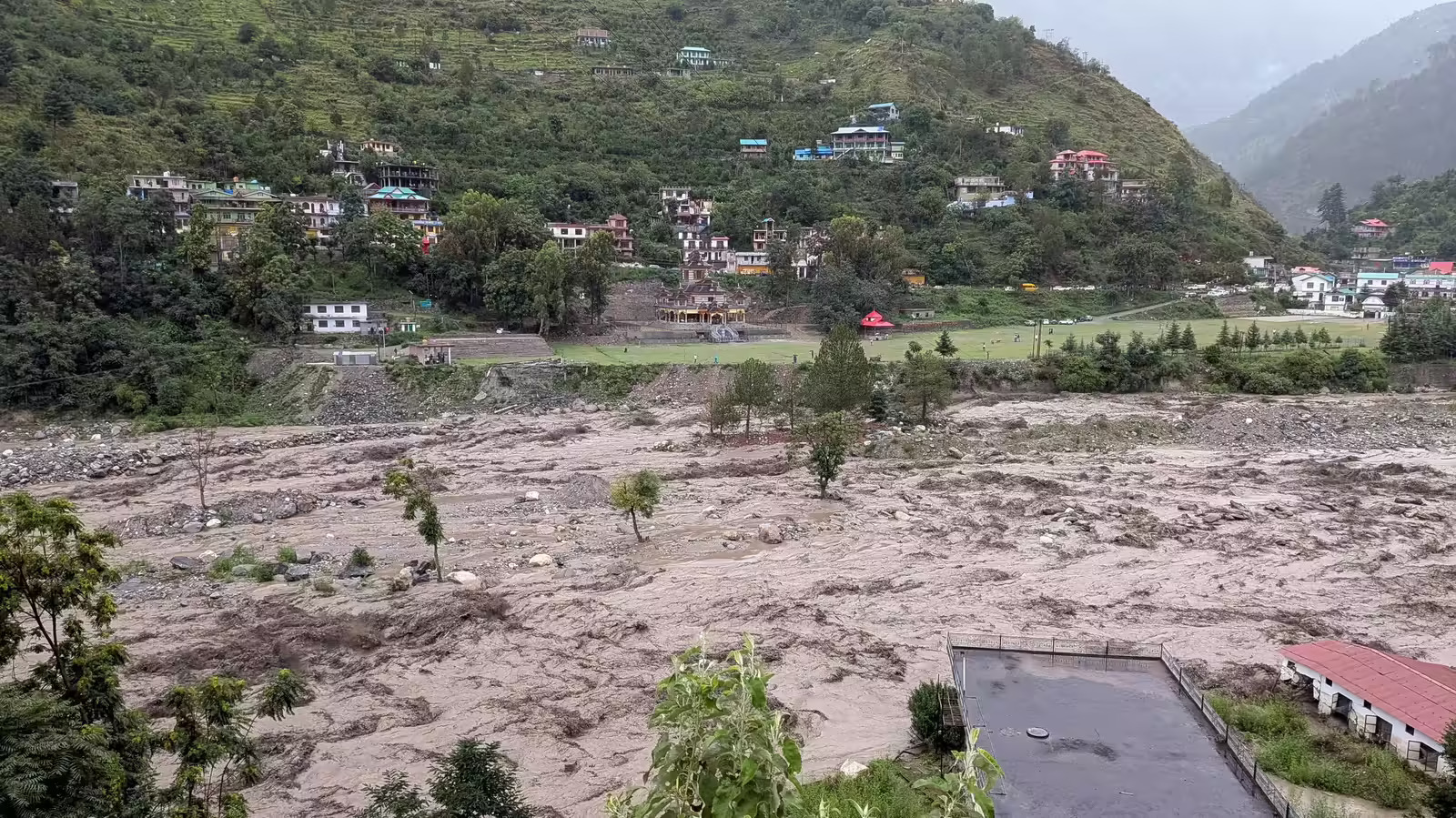
Himachal Pradesh witnessed another grim episode of monsoon fury on Wednesday as violent cloudbursts triggered flash floods across Dharamshala and Kullu districts, leaving two confirmed dead and up to 20 individuals feared missing near a hydroelectric project. The disaster has reignited alarm over increasingly extreme weather events in the fragile Himalayan region.
The flash flood struck a private hydropower site in Khanyara near Manuni Khad, where nearly two dozen workers were stationed in makeshift shelters close to the riverbank. A sudden torrent unleashed by the cloudburst overwhelmed the area, sweeping away the structures and the people inside. As of late Wednesday, two unidentified bodies had been recovered, with rescue teams continuing operations in challenging terrain to locate the missing. Kangra District Commissioner Hemraj Bairwa confirmed the recovery, stating that efforts were ongoing to identify the victims and cross-verify the contractor’s labour roster. The floodwaters also tore through nearby low-lying areas, adding to the risk profile for communities along the swollen streams.
Kullu district faced simultaneous devastation. Five homes were damaged in Raila Bihal village, and three residents, including two women, were reported missing. Downstream, the waters damaged critical parts of the Parvati hydropower project. Further east, a cloudburst over Jeeva Nullah in Sainj led to the destruction of the Sainj Bazaar road and the complete isolation of Siyund village. Garsa valley experienced multiple cloudbursts, causing the Hurla Nullah to overflow. Meanwhile, the Brahmaganga rivulet swelled past its limits, flooding markets and homes in Manikaran. These events are neither isolated nor unpredictable. Himachal Pradesh has seen a dramatic rise in cloudburst incidents over the past two decades. According to records, between 1990 and 2001, the state witnessed 36 reported cloudbursts, with Kullu being among the worst affected. In 1997, a catastrophic event in Shimla killed over 115 people. In 2003, the Garsa Valley disaster in Kullu took 40 lives. More recently, the state recorded 29 cloudbursts between 2019 and 2022, resulting in 19 deaths and widespread destruction of homes and roads.
In 2023 alone, Himachal suffered over 50 cloudbursts and flash floods during the monsoon season, resulting in 31 fatalities and more than ₹1,000 crore in damages. These repeated episodes are no longer considered freak incidents—they are warnings. Experts believe the intensification of such cloudburst events is directly tied to climate change. Rising temperatures, altered rainfall cycles, and rapidly melting glaciers are disrupting Himalayan weather patterns. In combination with unregulated construction, deforestation, and overdevelopment in ecologically sensitive zones, the state is becoming a climate flashpoint.
What worsens the impact is poor planning. Hydropower projects, while key to energy transition, often come with environmental blind spots. Temporary housing near rivers, lack of proper drainage systems, and weak early warning mechanisms expose both workers and locals to unnecessary risk. In the recent disaster, workers at the Khanyara hydropower site were staying in structures without flood-resilient design, close to the stream that ultimately claimed lives. The urgency of creating climate-resilient, eco-conscious development models has never been more stark. The Himachal Pradesh Disaster Management Authority (HPDMA) has, in recent years, installed over 60 automatic weather stations to enhance prediction and early warning capabilities. However, systemic weaknesses persist in enforcement of land use policy, disaster response coordination, and integration of scientific data into local planning. Flash floods and cloudbursts have also exacerbated gendered vulnerabilities. In many rural communities across the Himalayas, women shoulder the responsibility for water collection, caregiving, and agricultural labour.
When floodwaters destroy homes and roads, it is often women and children who face immediate fallout, including displacement and lack of access to essential services. Yet, disaster mitigation efforts rarely prioritise gender-responsive planning. In the context of equitable urban and semi-urban development, the latest disaster also questions the design of India’s energy transition. While hydropower is championed as a clean, low-carbon alternative, its footprint in vulnerable geographies like Himachal needs stricter ecological scrutiny. Projects must now be evaluated not just for kilowatts produced, but for their resilience, adaptability, and potential to coexist with local ecosystems and communities. In the aftermath of this week’s devastation, rescue teams remain on high alert. With the Indian Meteorological Department issuing an orange alert for continued heavy rainfall in parts of Himachal Pradesh, district administrations are racing to assess risks and prepare contingency shelters. Locals across Kullu, Kangra, and Mandi are being urged to stay away from riverbanks and unstable slopes.
While immediate rescue efforts are paramount, the long-term response must go beyond compensation. The repeated tragedies call for a structural overhaul of Himachal’s development paradigm. Climate adaptation must be woven into every infrastructure plan, especially in ecologically vulnerable hill regions. Civic resilience, gender-inclusive policies, and zero-carbon development must move from paper to policy. For now, Himachal reels under another monsoon assault. But what remains in its wake is not just debris—it’s a clear call to action.