


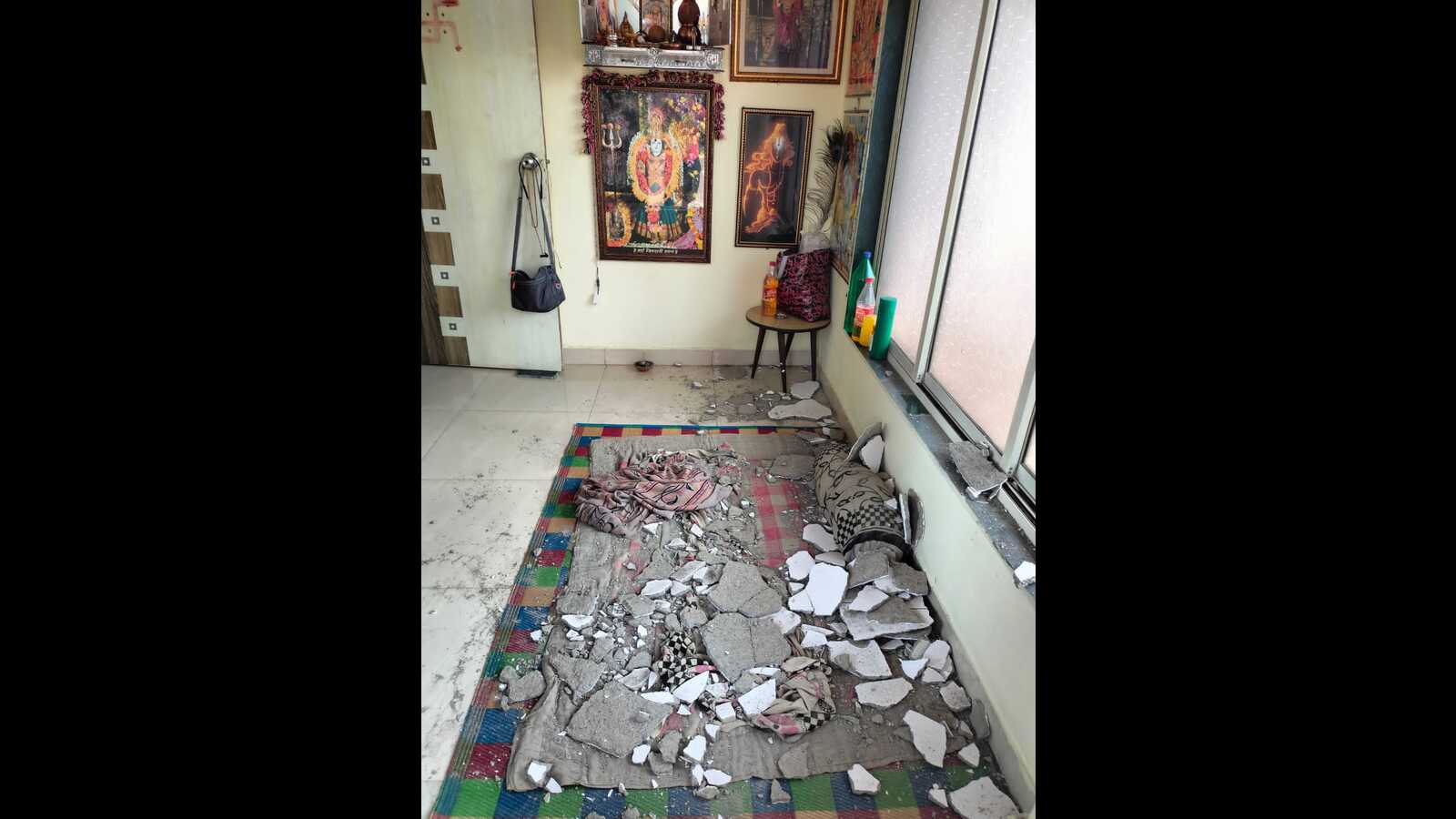
A mother of two lost her life after a concrete ceiling slab crashed down in her second-floor apartment in Virar East, following intense rainfall on Monday. The building, already classified as “high risk” by civic authorities, had not been vacated despite repeated warnings.
The tragic incident has reignited public concern over ageing urban infrastructure, civic inaction, and the safety of low-income residents in rapidly growing city regions. According to officials from the Vasai-Virar City Municipal Corporation (VVCMC), the Pooja Apartment in Gopcharpada was listed under the C1 category—marking it as structurally unfit for habitation. Despite being identified as hazardous, the structure continued to house multiple families. The civic body had served notices in the past, but no comprehensive evacuation or rehabilitation effort had followed. The latest warning came only after the fatal collapse.
The deceased woman, aged 35, was in the flat with her seven-month-old baby and three-year-old son when a portion of the slab gave way during the downpour. She sustained severe head injuries, while the children suffered minor wounds. Local residents, who heard the crash, immediately alerted emergency services. Teams from the police and fire brigade worked swiftly to rescue the family trapped in the debris and transported them to a nearby private hospital. Despite medical efforts, the woman succumbed to her injuries during treatment. The children, though traumatised, are now reported to be stable. Other residents, shaken by the collapse, vacated the premises and have since taken shelter at a nearby civic school. The civic body has begun issuing formal evacuation orders for the remaining occupants of the structure.
An official from VVCMC stated, “We have started the process of vacating the building after this unfortunate incident. All buildings under the C1 category are under review, and we are initiating demolition procedures in phases.” However, the timing of this action has drawn criticism from civic rights advocates who point out that action often comes only after lives are lost. Urban development experts stress that the tragedy is not an isolated event, but part of a larger pattern. “There are hundreds of similar structures across Virar, Vasai and other peripheral urban zones of Mumbai where unchecked urbanisation, lack of structural audits, and delayed civic response endanger residents—especially low-income families,” one expert said.
In recent years, rapid real estate development, coupled with a rising population influx, has led to haphazard construction and illegal occupancy in areas like Virar. Many buildings, some over 30 years old, lack adequate structural integrity but continue to house residents due to the lack of affordable alternatives. Civic authorities, often stretched thin in budget and manpower, struggle to keep up with the growing inspection and enforcement backlog. The state’s building regulations mandate periodic audits and categorisation of structures based on risk level. Yet, the enforcement and follow-through often remain inconsistent. VVCMC’s classification of buildings under categories like C1 (dangerous) and C2 (repairable) provides the framework, but action is frequently delayed due to procedural bottlenecks, lack of political will, or resistance from residents fearing displacement without rehabilitation.
The police have filed an Accidental Death Report (ADR) and have begun an investigation into the role of possible negligence. While civic officials cite notices issued, the question remains whether timely intervention—such as forced evacuation or structural reinforcement—could have saved a life. This tragic death has sparked renewed calls for an overhaul in how civic bodies handle building safety, especially with the monsoon season setting in. With heavy rainfall expected to intensify in the coming weeks, more such incidents could be on the horizon unless proactive measures are implemented.
Activists are urging the municipal body to not only demolish dangerous buildings but also create a transparent mechanism for temporary relocation, financial aid, and resettlement of vulnerable residents. In the absence of a robust urban housing policy for the economically weaker sections, many have no choice but to stay in such unsafe dwellings. Public safety advocates are also pressing for community-level awareness campaigns about the dangers of staying in flagged buildings and introducing early-warning systems. Some experts have suggested the creation of a real-time dashboard to track the condition and action status of high-risk structures.
As the VVCMC begins post-tragedy corrective steps, the incident stands as a grim reminder of the cost of delayed governance in fast-growing urban regions. While the civic body may be acting now, the onus lies in ensuring such a loss does not repeat. In the interest of building resilient, inclusive, and safe cities, the focus must urgently shift from reactive firefighting to a culture of sustained preventive action. The woman’s death is not merely an isolated accident—it is a call to redefine what civic responsibility means in India’s ever-expanding urban landscape.
Also Read : Mumbai Roads Remain Unfinished Before Monsoon
