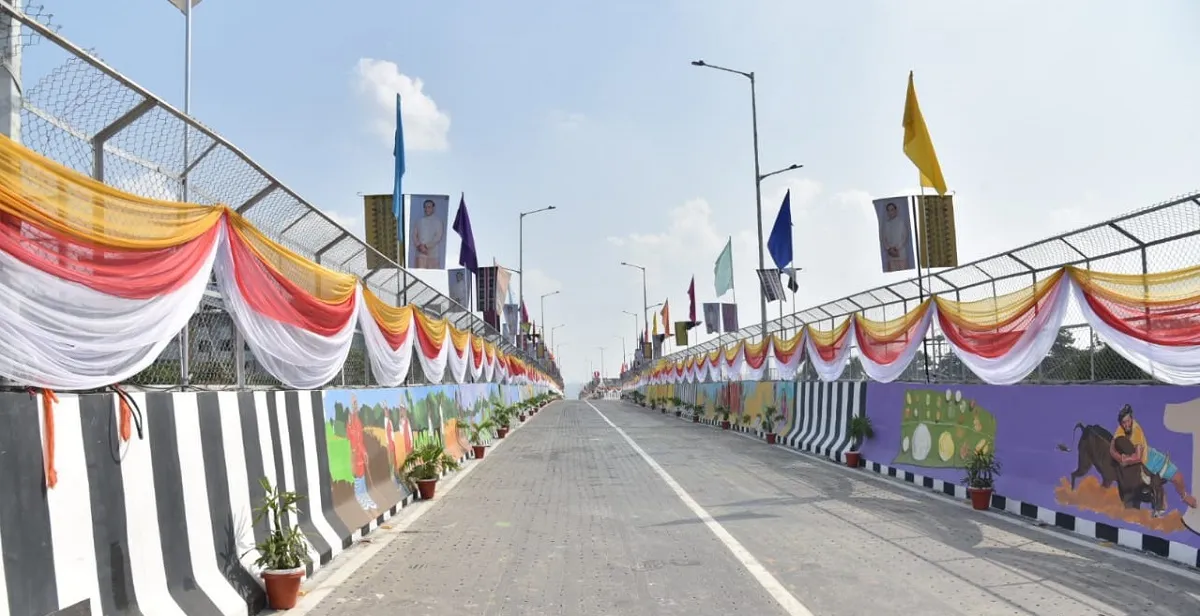
Guwahati Flyover Named To Honour Historic Legacy Of Kamarupa
Guwahati is set to add another landmark to its expanding transport network with the under-construction flyover on GNB Road, linking Ambari to Noonmati, officially being named after a 13th-century ruler of Kamarupa. The over 5-kilometre elevated corridor, now designated as the Maharaj Prithu Flyover, reflects the city’s attempt to embed cultural heritage into modern infrastructure while addressing mounting urban congestion.
The naming decision, cleared by the state cabinet, is intended to inspire future generations by highlighting the legacy of a king remembered for defending Kamarupa against repeated external invasions. According to historians, his reign between 1195 and 1228 symbolised resistance and consolidation of power in the region. Officials said that such symbolic recognitions are designed not only to preserve historical memory but also to instil civic pride in a city where infrastructure projects are transforming mobility.
Construction of the four-lane flyover is progressing under the supervision of the Public Works Department, with completion targeted before the onset of the next monsoon. The project has, however, faced delays as work is restricted to limited hours due to heavy traffic along the arterial GNB Road. Engineers explained that careful scheduling is essential to balance construction progress with uninterrupted city traffic movement.
The new flyover is part of a larger pattern of infrastructure projects in Guwahati that combine urban development with cultural recognition. Previously, elevated structures in Dispur and Rukminigaon were named after another historic ruler, while the recently inaugurated bridge across the Brahmaputra was dedicated to a 7th-century monarch. Officials believe that these decisions underline a narrative of continuity—linking Guwahati’s rapid modernisation with its ancient past. Beyond cultural symbolism, the Maharaj Prithu Flyover is expected to significantly reduce travel time along the congested eastern corridor of the city. Planners emphasise that the elevated stretch will help divert traffic, ease vehicular pressure on ground-level roads, and reduce pollution from idling vehicles caught in daily bottlenecks. Experts in urban mobility note that such projects must also be accompanied by sustainable planning, including integration with eco-friendly mass transport systems, to avoid reinforcing dependence on private vehicles.
Environmental advocates argue that while flyovers remain crucial for immediate relief, their long-term success lies in reducing the city’s carbon footprint. With Guwahati witnessing rapid urbanisation, inclusive and sustainable mobility solutions—such as bus rapid transit corridors, non-motorised transport infrastructure and smart traffic management—are seen as complementary to large-scale elevated projects. For citizens, the Maharaj Prithu Flyover will not just be a new road link but also a reminder that history continues to shape the present. As Guwahati seeks to balance its infrastructure ambitions with sustainability, the project reflects how cities can weave cultural heritage into modern mobility while striving towards more equitable and climate-conscious futures.