


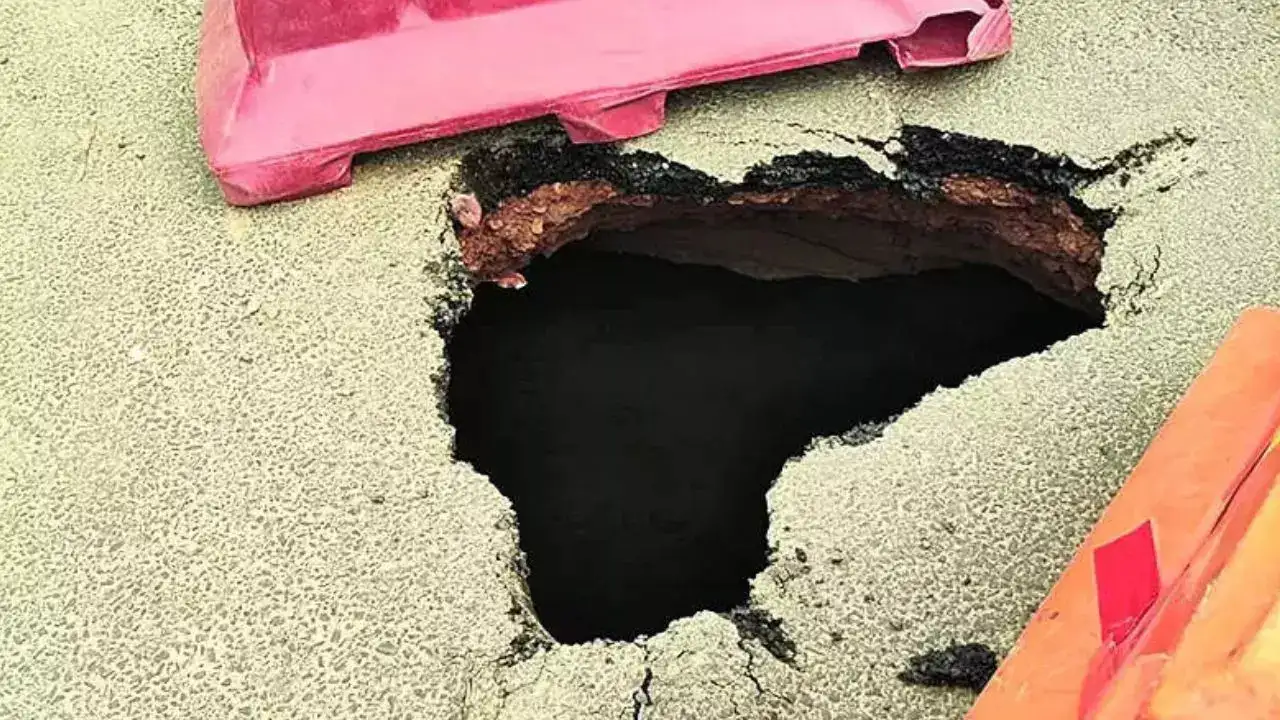
A crucial stretch of Sohna Road in Gurugram has suffered its fifth cave-in, intensifying concerns over public safety and urban mobility. The repeated subsidence, attributed to a compromised master sewer pipeline beneath the National Highway Authority of India (NHAI) carriageway, highlights a persistent infrastructural vulnerability and a complex inter-agency dispute over maintenance responsibility. As discussions between NHAI and the Gurugram Metropolitan Development Authority (GMDA) continue, the recurring disruptions impede seamless travel, casting a shadow on the region’s aspirations for robust, sustainable, and equitably accessible urban infrastructure.
The latest incident, which occurred on Monday evening, saw an 18-square-foot section of the highway collapse opposite SD Adarsh Vidyalaya, necessitating immediate barricading by the highway’s maintenance contractor. This marks the fifth such occurrence at precisely the same location, unequivocally pointing to a severely damaged underground sewage line as the root cause. The recurring nature of these collapses not only presents a significant hazard to motorists and pedestrians but also causes considerable commuter inconvenience, underscoring the urgent need for a definitive, long-term resolution rather than iterative, temporary fixes.
At the heart of this persistent challenge lies a contentious debate over ownership and maintenance responsibility between two key civic agencies. A senior NHAI official indicated that while the sewer line’s upkeep does not fall under their primary purview, a proposal for NHAI to undertake the rehabilitation work is now under high-level consideration. The official stated that if approved by NHAI headquarters, they would then formally seek consent from GMDA, signalling a potential, albeit delayed, pathway to action. However, a definitive start date for the repair work remains elusive, leaving commuters in continued uncertainty.
Conversely, GMDA officials contend that the sewer line, extending from Subhash Chowk to Sheeshpal Vihar, is in a state of advanced disrepair, particularly a 45-metre segment beneath the carriageway. They attribute the damage to corrosion caused by gas formation, which has critically weakened its walls, alongside the deteriorated condition of four chambers within this section. A senior GMDA official confirmed that discussions between the GMDA CEO and the NHAI Chairman are ongoing, with a solution expected to be finalised imminently, most likely involving NHAI handling the rehabilitation or shifting of the line.
The narrative of responsibility further complicates with historical context. GMDA officials cite an old document from the erstwhile Haryana Shahari Vikas Pradhikaran (HSVP), suggesting that the sewage line should have been shifted during the highway’s initial construction, a project estimated at ₹27 crore that was never executed. NHAI, however, counters this by stating that following GMDA’s formation, a decision was made merely to strengthen manholes, a task they assert was completed and the line handed over to GMDA in 2022. While both agencies now claim to be working towards a solution, this historical finger-pointing highlights systemic gaps in inter-agency coordination for integrated urban planning.
The recurrent infrastructural failures on a critical thoroughfare like Sohna Road have broader implications for Gurugram’s urban fabric and its sustainability goals. Damaged sewer lines pose environmental risks, including potential groundwater contamination and unpleasant odours, which directly undermine efforts to create eco-friendly urban environments. Furthermore, consistent road closures and traffic diversions lead to increased fuel consumption and carbon emissions, detracting from the vision of a zero net carbon city. More critically, the instability of public infrastructure compromises the safety and equitable access for all residents, particularly daily commuters who rely on a robust and reliable transport network.
Ultimately, the onus falls on both NHAI and GMDA to transcend historical grievances and institutional silos, prioritising swift and effective action for the public good. The immediate focus must be on executing robust repairs to restore the highway’s integrity and ensure public safety. Beyond this, a collaborative blueprint for integrated infrastructure management, encompassing regular inspections, timely maintenance, and clear delineation of responsibilities, is imperative to prevent future recurrences. This strategic cooperation is vital for fostering Gurugram’s growth into a truly smart, resilient, and equitable metropolitan hub.
Also Read: Mumbai Tunnel Project Faces Heat Over Alleged ₹3000 Crore Scam
