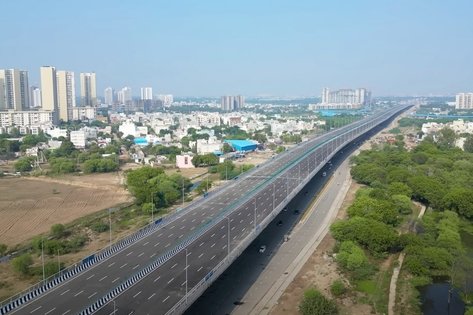
Gurugram’s expanding southern districts are set to gain a major mobility upgrade as authorities advance plans for an elevated road corridor designed to streamline travel between key residential areas and the Dwarka Expressway, one of the National Capital Region’s most important transport links.
The proposed Southern Peripheral Road elevated corridor will run along a 4.2-kilometre stretch and is intended to create uninterrupted movement for commuters travelling between southern Gurugram neighbourhoods and the expressway. The project, estimated at about ₹755 crore, is being developed by the city’s metropolitan development authority as part of a broader effort to ease congestion on arterial roads. Urban transport planners say the corridor will operate as a signal-free elevated route, allowing vehicles to bypass heavily congested intersections that currently slow traffic across the area. The project will include a six-lane primary carriageway supported by service roads and improved junction design, helping separate long-distance traffic from local movement.
One of the central objectives of the Southern Peripheral Road elevated corridor is to improve connectivity between fast-growing residential sectors in southern Gurugram and the Dwarka Expressway corridor, which connects the city with Delhi’s airport zone and the wider National Capital Region. The expressway itself is a major 27.6-kilometre urban highway linking Delhi’s Dwarka area with Gurugram’s Kherki Daula region, forming a critical alternative to the busy Delhi–Gurgaon Expressway. The corridor will also help commuters avoid bottlenecks at major traffic nodes such as Rajiv Chowk and other signalised intersections that frequently experience peak-hour congestion. By allowing uninterrupted vehicle flow along the elevated section, authorities expect travel times between southern Gurugram and the expressway to become more predictable for daily commuters.
Infrastructure experts say projects of this nature are increasingly necessary as Gurugram’s population and housing density continue to grow, particularly in newer residential sectors along the Southern Peripheral Road and Golf Course Extension Road. Large housing developments and office complexes have emerged along these corridors over the past decade, creating heavy daily commuter flows toward Delhi and other employment hubs within the NCR. The Southern Peripheral Road elevated corridor is also expected to support the city’s evolving real estate geography. Improved road connectivity typically encourages new commercial and residential development along major transport routes, especially in areas where land availability allows large integrated townships.
However, urban planners emphasise that long-term mobility improvements will depend not only on road capacity but also on integrating public transport systems. Metro extensions and regional transit links are expected to play a key role in reducing dependence on private vehicles across Gurugram’s expanding suburbs. With tenders already invited for the project, authorities expect construction to begin after the bidding process and technical evaluations are completed. Once operational, the elevated corridor could significantly improve connectivity between southern Gurugram and the Dwarka Expressway, helping address one of the city’s most persistent urban mobility challenges.
For a rapidly expanding corporate city like Gurugram, such infrastructure upgrades are becoming essential to sustain economic growth while managing the pressures of urban expansion and rising commuter demand.