


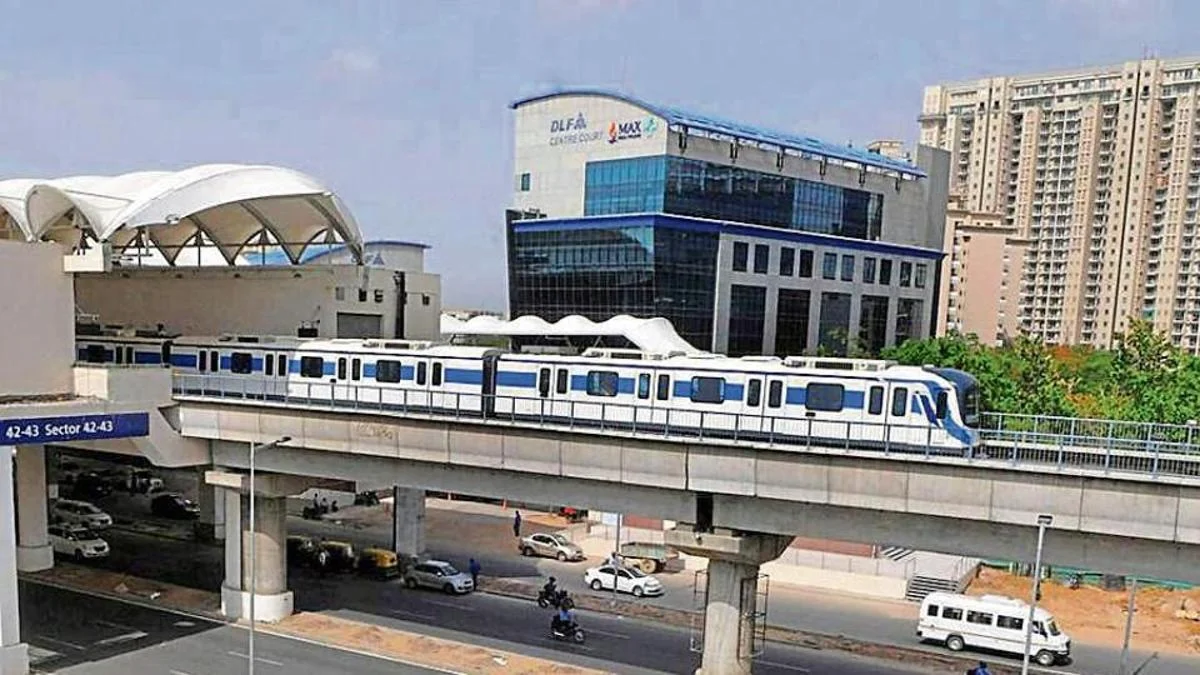
The much-awaited Gurugram Metro project has moved closer to reality as a piling rig, essential for laying the foundation of metro pillars, has been deployed in the city. Officials confirmed that work is expected to begin within weeks, following the ceremonial Bhoomi Poojan. The development marks the beginning of a ₹1,277 crore first-phase project designed to transform Gurugram’s mobility landscape and ease traffic congestion across one of India’s busiest urban corridors.
The piling rig was stationed near the Gurugram Metropolitan Development Authority (GMDA) office in Sector 44, close to the Yellow Line’s terminal pillars of the Delhi Metro. Contractors confirmed that the machine is capable of digging as deep as 180 metres and completing the foundation of a single pillar within 12 hours. This high-capacity equipment was transported from Surat over seven days, signalling the project’s preparedness for rapid execution once formal approvals are in place. Authorities revealed that the Bhoomi Poojan, expected this month, will be followed by a large public event underscoring the project’s significance. Senior government officials noted that the ceremony will highlight Gurugram Metro as a flagship infrastructure initiative, likely to be attended by top leadership and accompanied by a major public rally.
The first phase of the project covers a 15.22 km viaduct with 15 stations, including key locations such as Millennium City Centre, Subhash Chowk, Cyber Park, and Udyog Vihar. The alignment also includes a 1.85 km spur to Dwarka Expressway and a ramp to the proposed depot at Sector 33. Importantly, Millennium City Centre station will act as an interchange hub, linking Gurugram Metro directly with Delhi Metro’s Yellow Line to strengthen regional connectivity. Traffic management remains a key challenge, given the city’s already saturated roads. Officials at Gurugram Metro Rail Limited (GMRL) confirmed that a detailed diversion plan has been submitted to the traffic police and GMDA. The plan allows for staggered barricading of approximately 10 to 10.5 metres along the central verge, ensuring work progresses with minimal disruption. Utilities, including streetlights located within the construction zone, will be realigned along the barricades to maintain safety and lighting during night-time traffic movement.
The project also reflects a strategic shift towards sustainable urban transport. Once operational, Gurugram Metro is expected to take thousands of vehicles off the road daily, significantly reducing carbon emissions, curbing pollution, and offering a gender-friendly and equitable public mobility option. Experts highlight that the metro will play a pivotal role in reducing the city’s dependence on private vehicles, while supporting India’s larger climate and urban sustainability goals. As the city gears up for construction, residents remain watchful of the balance between development and inconvenience. While temporary traffic diversions and road narrowing may bring short-term challenges, urban planners emphasise that Gurugram Metro is a long-term solution to congestion, road safety, and environmental concerns.
With the first rig now in place, Gurugram’s long-discussed metro vision has moved beyond planning to visible action on the ground, promising a modern, eco-conscious mobility future for the city.
Also Read : Lucknow Metro Blue Line Construction Work Set To Begin From October 2025
