


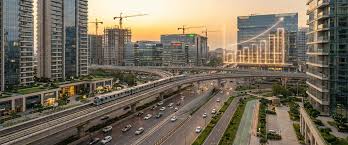
Gurgaon’s residential property market is facing renewed scrutiny as even high-income households report difficulty finding homes that justify prevailing prices. The disconnect between rising valuations and everyday urban conditions is prompting deeper questions about value, livability, and long-term sustainability in one of India’s most expensive non-metro housing markets.
Industry observers note that households with annual earnings well above the national urban average are increasingly constrained by Gurgaon’s pricing structure. Budgets exceeding Rs 1.5 crore, once considered comfortably upper-middle-class, now offer limited choice within established residential sectors. What concerns buyers most is not only affordability, but the perceived mismatch between cost and construction quality. Urban economists attribute this to a decade-long supply imbalance. Gurgaon’s residential expansion has been heavily skewed toward premium and investor-driven inventory, while mid-segment housing has remained underdeveloped. As land prices escalated rapidly, developers passed costs downstream without commensurate investment in civic infrastructure, public transport integration, or resilient construction standards. Planners point out that Gurgaon’s growth model differs sharply from cities such as Pune or Noida, where municipal oversight, planned zoning, and transport-led development have helped stabilise housing outcomes. In contrast, Gurgaon’s dependence on private provisioning from internal roads to power backup has inflated project costs while fragmenting urban services.
Environmental and climate stressors are compounding buyer dissatisfaction. Seasonal flooding, deteriorating air quality, and heat stress are no longer peripheral concerns but central to housing decisions. Urban designers argue that cities failing to integrate drainage, green buffers, and walkable infrastructure into residential planning will struggle to retain professional workforces in the long run. The issue also reflects a broader shift in buyer psychology. Homeownership is no longer aspirational alone; it is being evaluated as a quality-of-life investment. Buyers are comparing cities not just on salary potential, but on daily commutes, public spaces, environmental conditions, and resilience to climate shocks. Where these fundamentals fall short, price tolerance erodes quickly. Market analysts caution that without structural correction, Gurgaon risks pricing out its core professional base. While ultra-high-net-worth demand continues to support the luxury segment, the absence of credible mid-market options could hollow out long-term residential demand. This, in turn, may affect rental stability, workforce retention, and local economic diversity.
Looking ahead, experts suggest that restoring confidence in Gurgaon’s housing market will require more than price moderation. Stronger development regulation, public infrastructure investment, and climate-responsive urban planning are seen as essential to rebuilding trust. As India’s cities compete for talent and capital, housing markets that fail to deliver value alongside cost may find themselves increasingly challenged.
Also Read: West Delhi Affordable Housing Reshapes Homebuyer Demand
Gurgaon Homebuyers Question Price Infrastructure Gap
