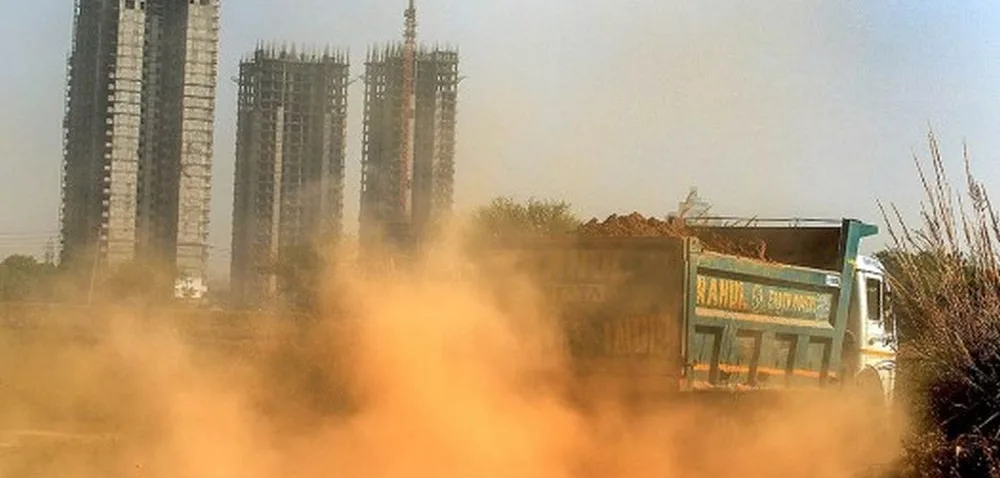
Gurgaon’s rapid construction-led expansion is colliding with weak on-ground compliance to air pollution safeguards, with official data indicating that a large majority of major construction sites remain outside mandatory dust-monitoring systems. Despite clear regulatory frameworks in place, only a small fraction of large projects in the city are currently registered for real-time air quality tracking.
According to data accessed from Haryana’s dust-control monitoring platform, fewer than 500 construction projects exceeding 500 square metres have enrolled in the system, against an estimated universe of nearly 3,000 active sites. The gap suggests that close to 85 per cent of large construction activity in Gurgaon is operating beyond the formal pollution surveillance network a critical concern in a city that frequently records hazardous air quality levels. The registration requirement stems from directions issued by the Commission for Air Quality Management, which mandate large construction projects across the National Capital Region to install particulate matter sensors measuring PM2.5 and PM10 emissions. These sensors are required to feed live data into a central dashboard, enabling regulators to remotely track dust generation and mitigation performance at individual sites.
Environmental regulators acknowledge that enforcement has lagged behind policy ambition. Senior officials involved in pollution control say inspection drives are now being intensified, with non-compliant sites facing the risk of work stoppages, financial penalties, and legal proceedings. Construction activity at unregistered projects may be suspended until monitoring systems and mitigation measures are put in place. Launched in early 2024, the digital monitoring portal was envisioned as a technology-led response to one of NCR’s most persistent pollution sources. Construction dust contributes significantly to particulate pollution, particularly during dry months, and disproportionately affects residential neighbourhoods located near high-density development clusters.
Urban planners argue that Gurgaon’s compliance deficit reflects broader governance challenges in fast-growing real estate markets. While building approvals and project launches have accelerated, environmental oversight mechanisms have struggled to scale at the same pace. This imbalance not only undermines air quality goals but also exposes residents, construction workers, and informal settlements to sustained health risks. To close the compliance gap, pollution control authorities have begun coordinating with municipal and planning agencies to cross-verify building plan approvals with environmental registrations. Officials say access to integrated data will help identify unregistered sites more efficiently and reduce reliance on manual inspections.
Civic bodies across NCR have also been asked to adopt standardised checklists for dust mitigation, covering measures such as perimeter barricading, on-site water spraying, mechanised sweeping, and controlled material handling. These protocols are intended to shift compliance from reactive enforcement to continuous monitoring. For the real estate sector, the issue carries reputational and financial implications. Industry experts note that sustained non-compliance could invite stricter seasonal bans, disrupt project timelines, and raise financing risks as lenders and investors increasingly factor environmental performance into decision-making.
As Gurgaon continues to grow as a regional economic hub, the effectiveness of its construction dust controls will be a key test of whether urban expansion can align with climate resilience and public health priorities. The coming months will determine whether digital monitoring translates into measurable air quality gains or remains an underutilised regulatory tool.
Gurgaon Construction Boom Outpaces Pollution Controls