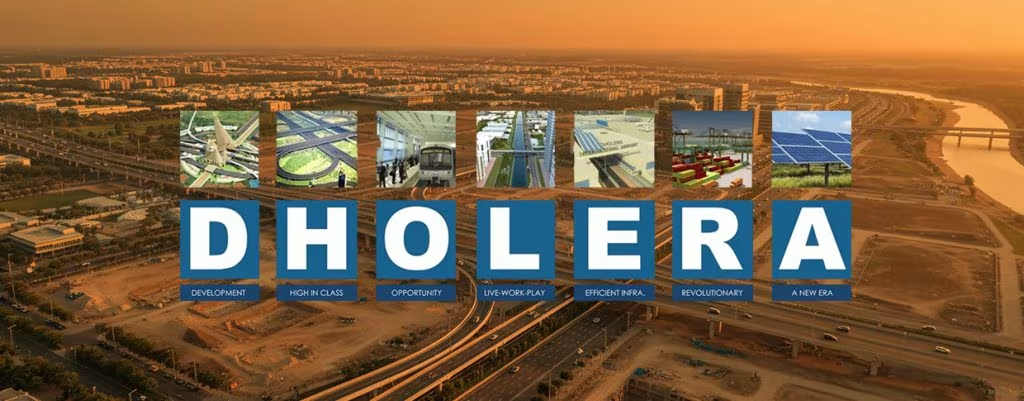
Gujarat Dholera Smart City Drives Real Estate Growth
In Gujarat’s Dholera Special Investment Region (SIR), a decade-long phase of urban planning and investment is converging into what industry analysts now see as one of India’s most consequential next-generation growth corridors. Land values have appreciated nearly tenfold over the last decade, as connectivity infrastructure and strategic industrial commitments begin to materialise, reframing this coastal zone into a dynamic real estate and industrial destination.
Originally designated as part of the Delhi-Mumbai Industrial Corridor (DMIC), Dholera SIR spans over 920 sq km and is envisioned as a smart industrial and mixed-use city that can accommodate up to 2 million residents by 2040. The region’s rise has been supported by major transport projects such as the Ahmedabad–Dholera Expressway and the nearing completion of the Dholera International Airport, which aviation authorities have slated for operation as early as 2025.Market observers attribute the surge in land prices and investor interest to these tangible shifts in infrastructure realisation. Plots near expressway corridors, future transport nodes, and the airport now command appreciably higher values than in peripheral townships — a signal that connectivity is reshaping locational premiums in greenfield urban development.
Beyond transport, Dholera’s industrial proposition has broadened with headline-making investment intentions in the high-technology space. A semiconductor fabrication facility backed by a leading electronics conglomerate represents commitments in the tens of thousands of crores, underscoring Dholera’s economic diversification beyond basic manufacturing.This growing industrial backbone is attracting ancillary sectors, including a recent memorandum aimed at establishing a major green, AI-ready data centre campus with a proposed ₹25,000 crore investment, aimed at scaling digital infrastructure and analytics clusters within the region.Real estate developers note that early residential supply has tended to cluster around high-connectivity and phase-wise rollout zones, where the most immediate infrastructure — roads, utilities, and civic amenities — is visible on the ground. Beyond these activation areas, many projects remain speculative, underscoring the importance of zoning clarity and master-planned development alignment when assessing long-term value.
Urban planners underscore that Dholera’s evolution reflects a broader pivot in Indian cities toward planned, sustainability-focused expansion. By integrating industrial capacity with phased residential growth and supporting services, planners aim to reduce congestion in legacy metropolitan cores and encourage economic activity in peripheral nodes. The inclusion of advanced utilities, smart grid systems, and potential renewable power resources further align with climate-resilient urbanism principles.Yet, stakeholders also caution that the region’s full livability — with schools, healthcare, commerce, and community spaces on par with established cities — remains years away. Realising Dholera’s promise will depend on synchronising infrastructure delivery with social amenities and sustainable water, energy, and mobility systems.
As Gujarat’s flagship investment region shifts from planning to implementation, policymakers and private developers alike will need to steward growth with inclusive, equitable planning frameworks if Dholera’s potential is to translate into real opportunities for residents and businesses alike.