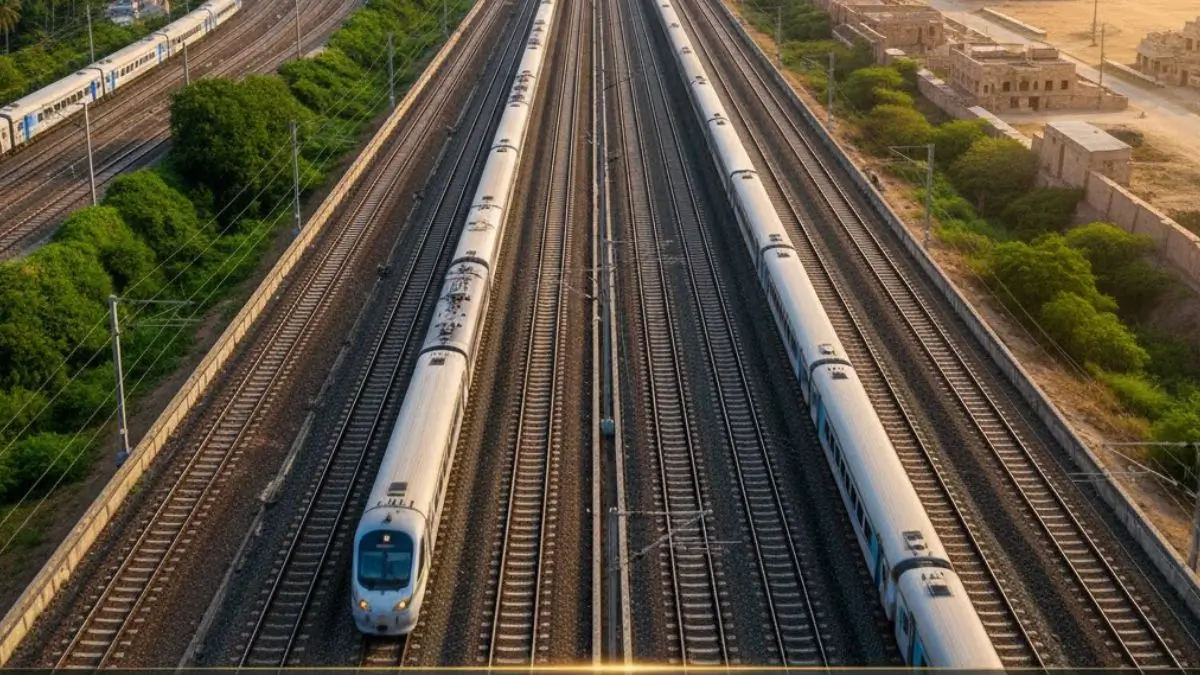
The Union government has cleared two major multitracking projects in Gujarat and Maharashtra, marking a significant push to strengthen mobility across high-demand corridors and improve the efficiency of India’s growing rail network. Together costing nearly ₹2,800 crore, the upgrades aim to ease passenger congestion, improve freight movement and support more equitable regional connectivity.
The first project involves doubling the 141-km railway line between Dwarka and Kanalus in Gujarat, a route that has long experienced seasonal pressure due to pilgrim traffic and rising industrial freight. The expansion is expected to provide smoother access to Devbhumi Dwarka, home to one of the region’s most visited temple sites. According to a senior official, the doubling will also improve logistics for the salt, cement and container industries that depend heavily on the corridor.
Railway planners note that the line currently operates close to saturation, resulting in delays and limited scheduling flexibility. The upgraded section will include seven major bridges and more than 140 minor structures, enabling the track to handle an additional 11 million tonnes of freight annually. Experts say the improvement not only supports economic growth but also reduces inefficiencies that typically push more freight onto roadways an important consideration for India’s low-carbon mobility ambitions.
In Maharashtra, the Centre has approved the construction of a third and fourth line between Badlapur and Karjat, forming part of the wider 88-km Kalyan–Lonavala stretch. Set within the Mumbai Metropolitan Region, the project is expected to deliver major relief for suburban and intercity passengers. The state government will shoulder half the project cost of ₹1,324 crore, signalling strong local backing for the upgrade.The proposed 32-km stretch will include eight major bridges and more than 100 minor ones, helping increase freight carrying capacity by 7.2 million tonnes per year. Transport specialists say this added capacity will be critical for the Mumbai–Pune–Chennai high-density corridor, where congestion routinely affects train punctuality and commuter experience.
Beyond operational improvements, both projects align with larger national goals of creating safer, more inclusive urban and regional transport systems. Better rail capacity can reduce reliance on private vehicles, support more sustainable travel patterns, and ensure that high-footfall routes remain accessible to all particularly women, senior citizens and low-income travellers who depend most on reliable public transport.Industry analysts note that the multitracking push is part of a broader strategy to decarbonise India’s logistics sector and future-proof fast-growing urban regions.
As demand for mobility increases, they emphasise that prioritising rail over road expansion will be key to achieving equitable, climate-resilient growth.
With both projects now approved, construction is expected to move forward in phases. Planners believe the enhancements will contribute to more predictable travel times, greater economic productivity and a stronger foundation for sustainable mobility across western India.
Gujarat Approves ₹2781 Crore Rail Doubling To Boost Dwarka Kanalus Connectivity