


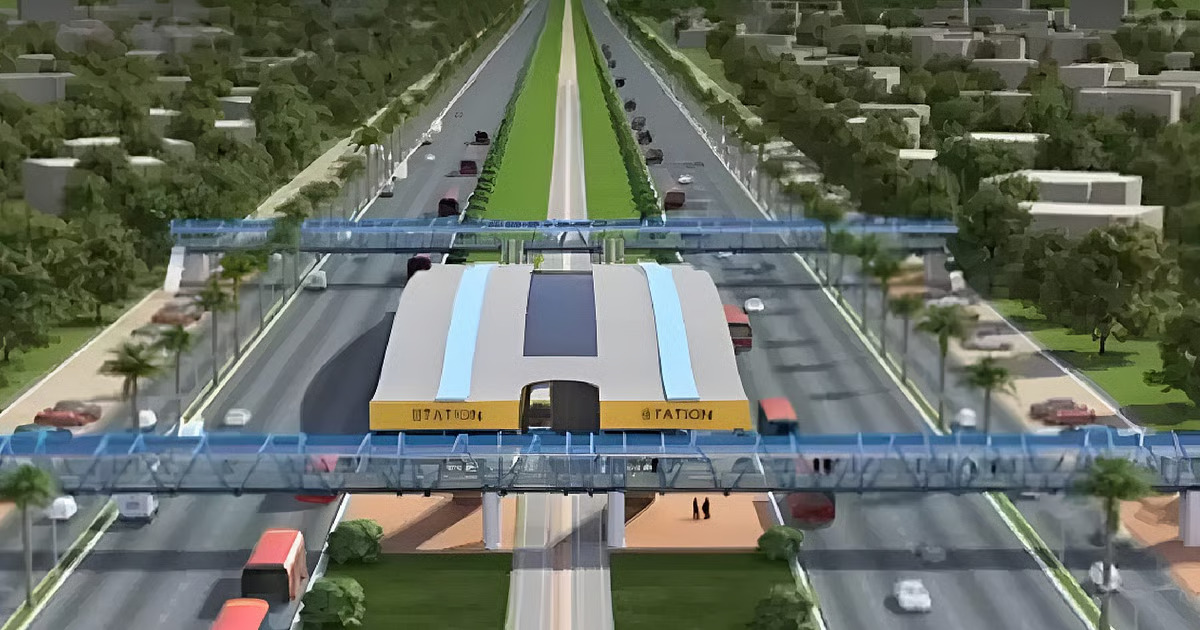
The Maharashtra government has approved the development of the first phase of the highly anticipated Virar-Alibaug Multi-Modal Corridor, clearing the path for one of the most ambitious infrastructure undertakings in the Mumbai Metropolitan Region (MMR). The corridor, spanning over 165 km and envisaged as a vital arterial link, will now be executed on a Build-Operate-Transfer (BOT) model under the stewardship of the Maharashtra State Road Development Corporation (MSRDC).
The state Cabinet’s decision marks a strategic shift in approach after the initial engineering procurement construction (EPC) tendering process failed to deliver viable financial terms. With costs far exceeding government estimates, the BOT model now appears to offer a financially sustainable and operationally scalable solution. The pivot aligns with a broader push for public-private partnerships in high-impact infrastructure, especially those crucial to unclogging Mumbai’s saturated traffic networks and supporting climate-resilient urban expansion. Under the approved framework, the first phase of the corridor will cover 96.41 km between Navghar in Palghar district and Balavali in Pen taluka. The project promises seamless regional connectivity, reducing travel time across MMR and diverting long-distance commercial traffic away from congested city arteries. Notably, the corridor will act as a key feeder route for cargo and logistics movements from Gujarat and North India directly to Jawaharlal Nehru Port (JNPT), bypassing the existing bottlenecks through Thane and Palghar.
According to infrastructure officials familiar with the matter, earlier tenders floated for the project pegged costs at ₹19,334 crore. However, the quotations received from contractors escalated the figure by a staggering 36 per cent, inflating the construction cost to over ₹26,000 crore. Despite cost revalidation exercises involving reputed technical institutes and multiple rounds of negotiations, the bids failed to reach an acceptable threshold. As the revised project estimates stood close to ₹25,000 crore, the government, in a financially cautious move, opted to terminate the previous bidding process. This decision arrives at a time when infrastructure investment in Maharashtra is being evaluated through the lens of fiscal prudence and long-term return on investment. The BOT model, whereby a private concessionaire is granted rights to construct and operate infrastructure assets for a fixed concession period, is seen as a pragmatic route to attract private capital while safeguarding public resources. Through toll revenues or user charges, the developer is expected to recover its investment before transferring the asset back to the state — a model commonly deployed across national highways and expressways.
The corridor’s strategic relevance extends beyond vehicular traffic relief. It is designed as a multi-modal transport corridor, expected to accommodate a combination of expressway-grade vehicular lanes, high-speed rail alignments, and possible utility conduits. Once completed, it will plug directly into India’s largest port infrastructure at JNPT and offer seamless integration with the upcoming Navi Mumbai International Airport. Additional linkages with major national highways — including NH-48, NH-848, and NH-61 — as well as expressways like Mumbai-Vadodara and Mumbai-Pune, reinforce its role as a future-proof regional logistics backbone. Planned to traverse through urbanising belts such as Vasai, Bhiwandi, Kalyan, Ambernath, Panvel, Uran, and Pen, the corridor is also expected to act as a growth catalyst for satellite townships and emerging logistics parks. Experts in transport economics believe the project could significantly impact land value, support decentralisation of population pressure from central Mumbai, and enable greenfield urban development in underutilised areas.
From a sustainability lens, the corridor’s potential to reduce fuel consumption and emissions by cutting down on idle vehicular time and rerouting freight traffic is aligned with the vision of creating low-carbon transport networks. In urban policy discussions, the corridor is increasingly being seen as a way to integrate climate-smart infrastructure into India’s most densely populated metropolitan area. To facilitate land acquisition and related project clearances, the Cabinet has sanctioned ₹22,250 crore. An additional ₹14,763 crore has been earmarked towards interest obligations, taking the overall financial outlay for Phase 1 to ₹37,013 crore. A senior government official confirmed that the MSRDC will begin fresh tendering under the BOT model within the current financial year and that investor consultations are already underway.
In a parallel development focused on inclusive industrial growth, the Cabinet also approved the transfer of 29 hectares and 52 acres of land in Jambutke village in Nashik district to the Maharashtra Industrial Development Corporation (MIDC). The land will be used to establish a Tribal Industrial Cluster aimed at fostering entrepreneurship among tribal populations. The move, officials stated, is part of a broader state-led strategy to enhance livelihood opportunities through decentralised industrialisation and skill-based employment in underdeveloped regions. As Maharashtra accelerates the rollout of integrated infrastructure, the Virar-Alibaug corridor represents more than just a road project — it symbolises a shift toward balanced urbanisation, climate-aligned transport policy, and private sector collaboration.
While execution timelines and financing terms remain to be finalised, the Cabinet’s approval sends a clear signal that Maharashtra is committed to shaping a connected and sustainable future for its cities and hinterlands alike.
Also Read : Indian Railways to launch 50 Namo Bharat 100 MEMUs
