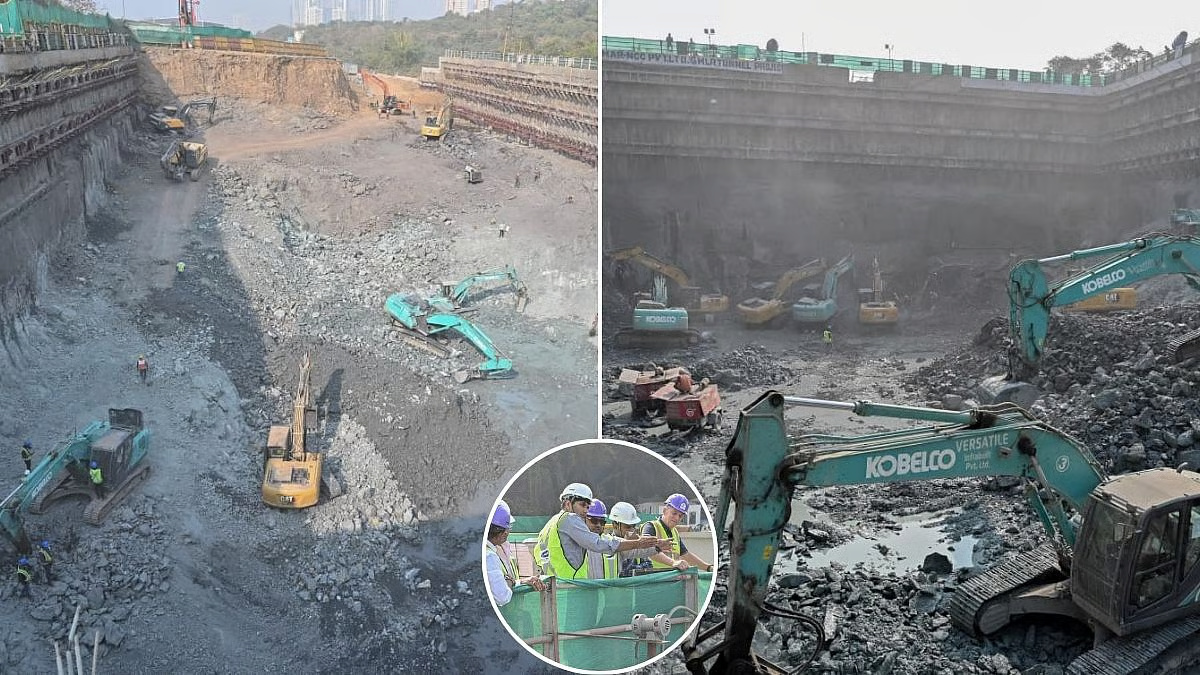
Excavation has commenced for the underground twin tunnel segment of the Goregaon–Mulund Link Road (GMLR) project at Dadasaheb Phalke Film City in Mumbai, marking a significant milestone in the city’s infrastructure expansion. The 5.3-kilometre, triple-lane tunnel aims to enhance east–west connectivity, promising to reduce travel time between Goregaon and Mulund from over 75 minutes to approximately 25 minutes upon completion.
The tunnel will be constructed using two advanced Tunnel Boring Machines (TBMs), with one already on-site and the second expected shortly. Officials indicated that the initial excavation, which involves the creation of a launching shaft, is progressing steadily. The shaft spans around 200 metres in length, 50 metres in width and 30 metres in depth. Current operations involve the removal of 1,400–1,500 cubic metres of rock and soil daily, transported via approximately 120 trucks. Municipal engineers have employed rock anchoring and other safety measures to prevent wall collapse during excavation. City authorities plan to lower the TBM into the shaft by early March 2026, with full-scale tunnelling operations scheduled for June 2026. Installation of the TBM’s gantry and related components will follow a three-month preparatory phase. Each tunnel will feature an external diameter of roughly 14.42 metres, with the overall twin-tunnel stretch including the box tunnel extending to 6.62 kilometres. A senior BMC project official described the undertaking as an “engineering challenge” that underscores Mumbai’s commitment to modern, resilient urban infrastructure.
Urban planners note that the GMLR, spanning 12.2 kilometres, will directly link the Western Express Highway with the Eastern Express Highway. Beyond easing commuter traffic, the project is expected to spur sustainable economic activity along the corridor, while minimising urban congestion and associated emissions. The twin-tunnel design reflects a growing trend in Indian cities towards underground solutions that reduce surface-level disruption in densely populated areas. Experts emphasise that efficient management of construction logistics, including excavation debris and machinery deployment, is crucial to maintaining project timelines and mitigating environmental impacts. Measures such as controlled excavation, noise management, and regulated truck movement are being integrated to reduce disruptions to surrounding communities and preserve urban environmental quality.
The BMC aims to complete the twin tunnels by October 2028, providing a high-capacity, climate-conscious commuting option for Mumbai’s expanding workforce. Officials also highlight that projects like GMLR are pivotal for the city’s longer-term goal of resilient, equitable urban mobility, with careful planning to balance infrastructure growth with public safety and environmental safeguards.
Goregaon Twin Tunnel Construction Underway Ahead Of Full TBM Operations