


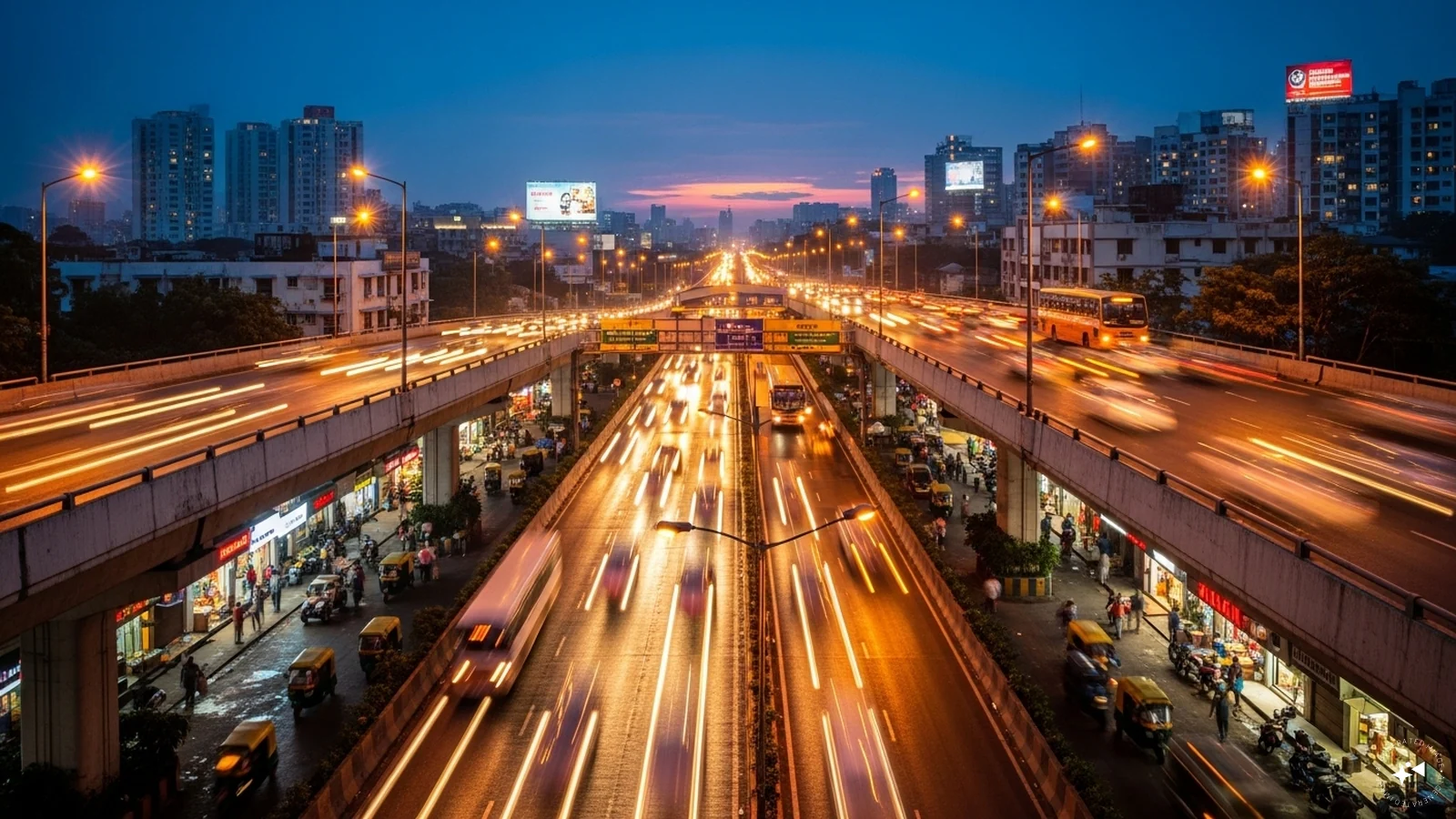
The Brihanmumbai Municipal Corporation’s proposal to demolish the seven-year-old Veer Savarkar flyover extension in Goregaon has triggered strong opposition from residents, commuters, and public representatives. The extension, widely known as the MTNL flyover, is seen as a critical east–west connector in the western suburbs, and its potential removal has led the civic body to reassess its strategy.
The structure, built at a cost of ₹27 crore in 2018, currently eases traffic by providing a direct link over railway tracks and bypassing the congested S V Road. It connects Goregaon and Malad while also serving commuters from Marve, Madh, Aksa, and Charkop. Officials explained that the flyover falls in the alignment of the planned connector between the Mumbai Coastal Road’s northern stretch and the Goregaon–Mulund Link Road (GMLR). To accommodate this infrastructure, the civic body had considered demolishing the extension and reconstructing it as a double-decker bridge, with the Coastal Road–GMLR connector on the upper deck. However, widespread concerns have forced the BMC to explore alternatives. Residents argue that dismantling the flyover would create severe traffic disruptions in Goregaon, Malad, and surrounding neighbourhoods. Commuters recall how crossing the junction before the extension was constructed often took 20 to 30 minutes, and fear that similar chaos would return if the bridge is razed.
Officials acknowledged that local opposition has been significant. The civic administration is now conducting a fresh survey to examine whether the double-decker option can be built using different pier arrangements, instead of demolishing the existing flyover. The bridges department has confirmed that the MTNL flyover lies directly within the proposed alignment, but stressed that no final decision has been taken. Consultants have been tasked with studying ground conditions and providing a technically viable solution that minimises disruption. For urban planners, the challenge lies in balancing the city’s growing demand for large-scale connectivity projects with the preservation of existing infrastructure that continues to serve communities effectively. Experts point out that tearing down a recently built bridge not only represents a financial setback but also conflicts with sustainable urban development principles. Reusing or adapting the existing structure could reduce waste, carbon emissions, and the lengthy construction delays typically associated with new bridges.
Residents and transport experts have urged the BMC to prioritise environmentally conscious alternatives that safeguard both mobility and public convenience. Concerns have also been raised that delays in permissions, particularly those linked to coastal regulation zones, may slow down the Coastal Road–GMLR project, making it essential to preserve functioning infrastructure until replacement options are ready. The civic body has reiterated that while connectivity between the Coastal Road and GMLR is vital to Mumbai’s east–west mobility plans, solutions will be sought that consider the social and environmental costs. With no corporators currently in office, citizens argue that civic accountability must remain central to decision-making in projects that directly impact daily life.
Also Read:BMC Scraps 1050 Of 6200 Abandoned Vehicles To Clear Congested Mumbai Roads
