


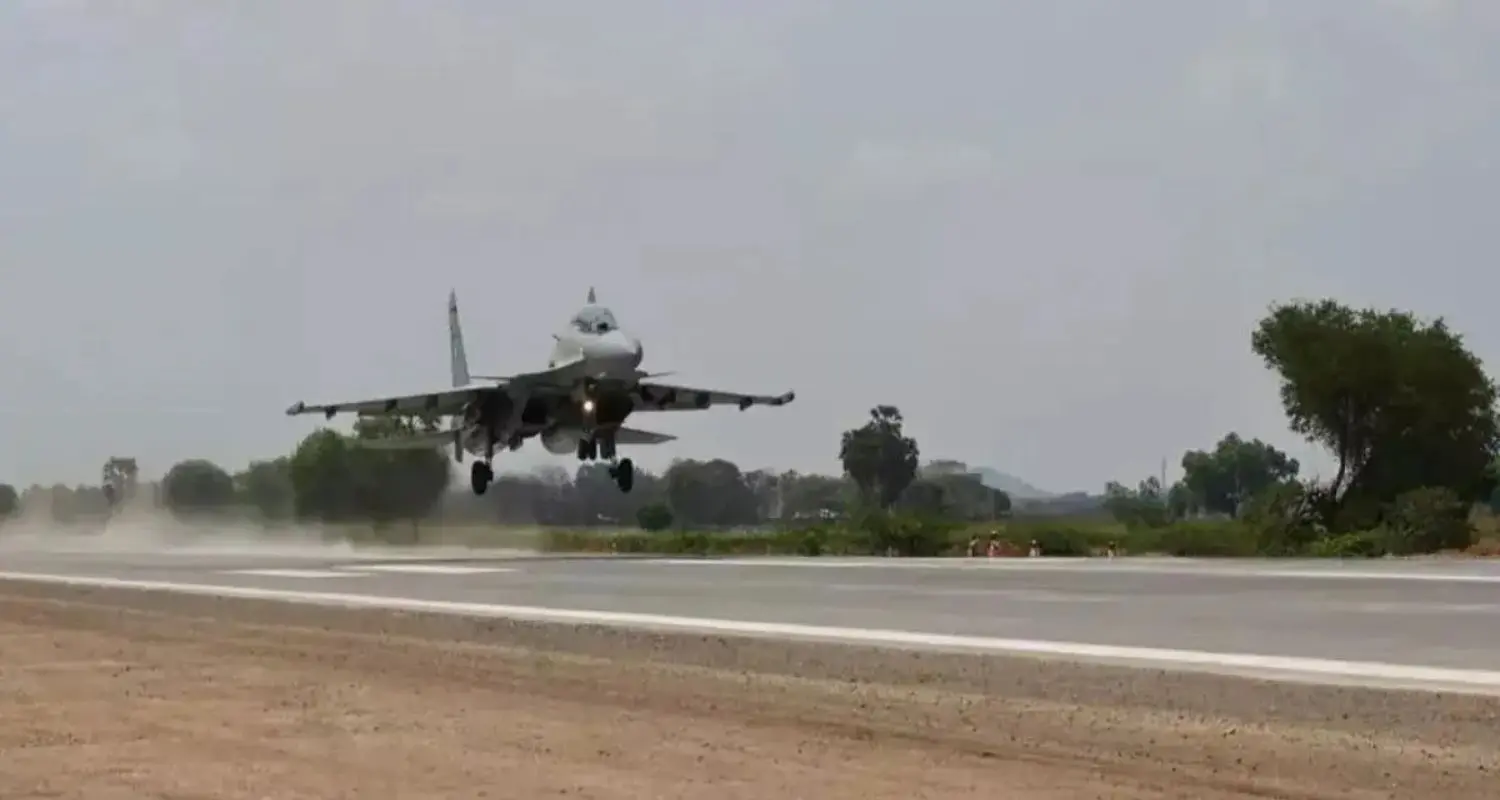
The Indian Air Force (IAF) began its take-off and landing drills on a 3.5-kilometre emergency airstrip constructed along the under-construction Ganga Expressway in Uttar Pradesh’s Shahjahanpur district.
The operation—scheduled to be executed in two phases, covering both daylight and night-time sorties—marks India’s first expressway airstrip designed for 24-hour fighter jet operations. Fighter aircraft such as Rafale, Mirage-2000, Jaguar, MiG-29, and SU-30 MKI, as well as transport carriers like the C-130J Super Hercules and AN-32, and rotary aircraft like the MI-17 V5, are participating in the exercise. The drills are intended not just to test the surface strength and navigation infrastructure of the expressway, but also to simulate real-time emergency scenarios where conventional airbases may be compromised.
Unlike earlier experiments on expressways such as Agra-Lucknow and Purvanchal, the Ganga Expressway project embeds dual-use infrastructure into its blueprint. With extensive surveillance through 250 CCTV cameras and night-landing aids, it is expected to serve both as a critical military fallback point and a symbol of multi-use public infrastructure, reflecting India’s growing emphasis on dual-purpose civil assets. Officials associated with the infrastructure development confirmed that the airstrip is being monitored jointly by IAF and the Uttar Pradesh Expressways Industrial Development Authority (UPEIDA). Notably, this trial comes at a time when defence establishments are increasingly factoring in climate-resilient and decentralised mobility infrastructure. An all-weather expressway that can double up as an alternate airfield is seen as a crucial component of national preparedness, especially in light of unpredictable geopolitical dynamics and natural calamities.
What also sets this trial apart is the operational focus on night-time drills—ranging from low fly-pasts to full landings—between 7 pm and 10 pm. This level of preparedness underlines India’s evolving defence doctrine where speed, flexibility, and infrastructure readiness converge. Given the sheer scale of air assets involved, the event also serves as a live simulation for logistics, command coordination, and surveillance support, strengthening India’s military deterrence. Beyond strategic dimensions, such infrastructure projects also reflect India’s push toward sustainable, multi-functional public assets. The Ganga Expressway is envisioned as not just a transport corridor but also a model for integrated, climate-resilient development in North India. With minimal additional carbon footprint in designing airstrips within road projects, the initiative showcases a resource-efficient urban planning approach.
While the IAF drills signal preparedness, they also raise important conversations about balancing defence needs with sustainable urbanisation. As infrastructure scales up across India, integrating resilience and utility into such projects may prove to be a benchmark for future expressway developments across the country.
Also Read :Hyderabad Approves Rs 749 Crore Road Upgrade
Ganga Expressway turns into runway for Indian Air Force flight drills
