


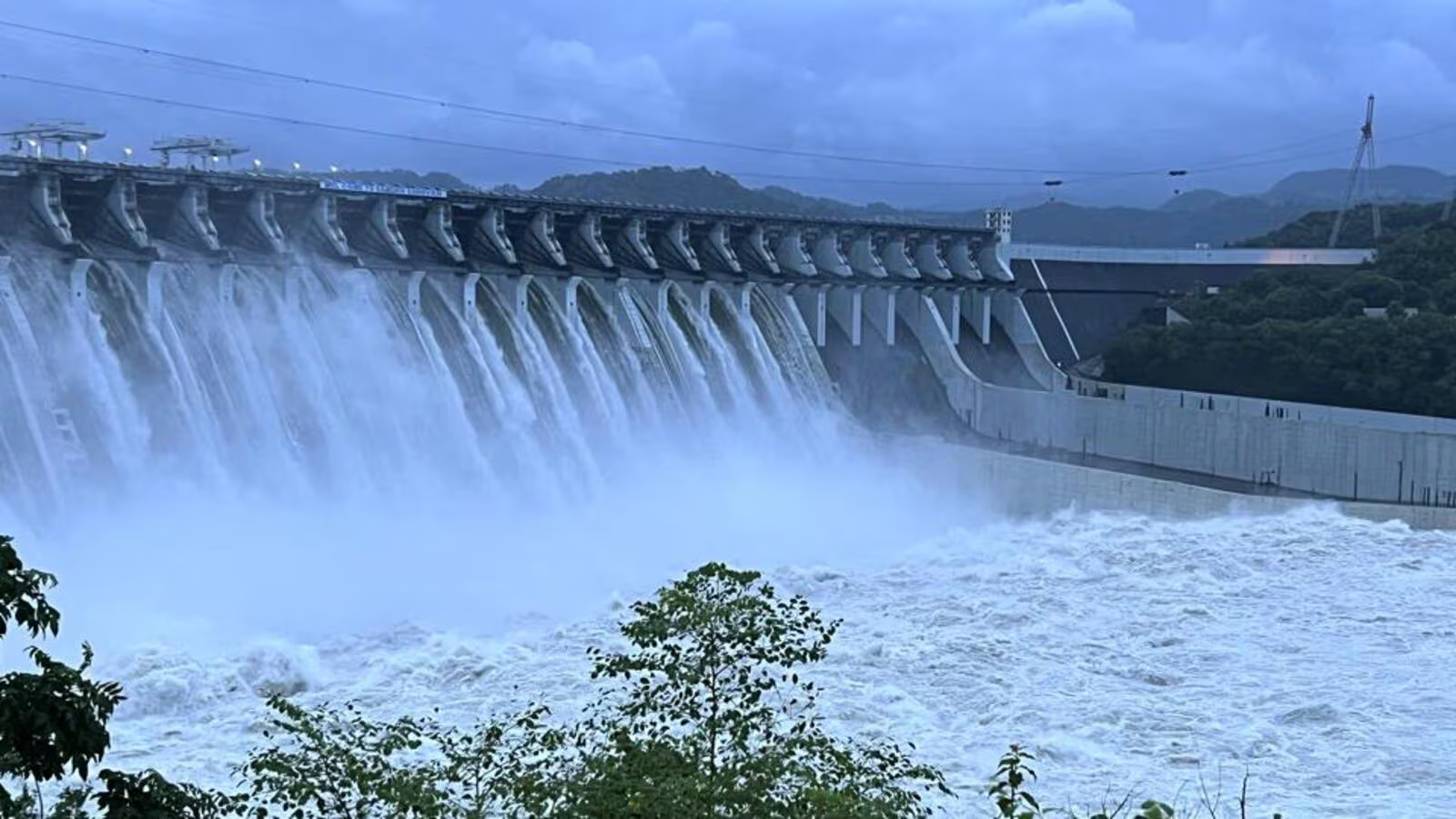
The Sardar Sarovar Dam on the Narmada River is now releasing significantly less water after a sharp drop in rainfall across Gujarat and its upstream catchments. With reduced inflows from Madhya Pradesh and Maharashtra, dam authorities have shut five gates and decreased discharge from nearly 4 lakh cusecs to 1.64 lakh cusecs as of August 3.
Officials managing the Sardar Sarovar Project confirmed that the current water level stands at 132.20 metres, with inflow measured at approximately 1.03 lakh cusecs. The live water storage within the reservoir has stabilised at 7421.30 million cubic metres. Hydropower operations at both the Right Bank Power House (RBPH) and Canal Head Power House (CHPH) remain functional, with ten turbines actively generating electricity. The water management response follows a highly dynamic monsoon pattern. Gujarat received 473.8 mm of rainfall until August 3, around 19% above the state’s seasonal average. However, the recent retreat in intensity has necessitated quick recalibration to ensure both downstream safety and reservoir conservation.
Districts such as Valsad, Banaskantha, and Anand have witnessed rainfall significantly above their long-term averages, with Valsad logging an impressive 1461.9 mm (+15%), and Banaskantha registering 536.3 mm (+63%). Notably, the usually parched Kutch district recorded 288.4 mm of rainfall, 35% above normal. These figures underscore the spatial variability of the monsoon, which has filled 28 dams across the state to full capacity, contributing to a healthy 61% cumulative reservoir storage. Despite the overall positive monsoon performance, some regions have remained slightly deficient. For instance, Amreli received 290.8 mm, 16% below normal, while Junagadh and Vadodara trailed their averages by 5% and 8% respectively. Experts monitoring hydrological patterns warn that if the rainfall deficit extends, further reductions in dam outflows may follow to preserve storage levels for irrigation and drinking water needs.
Meanwhile, the moderation in Narmada River levels has brought relief to residents of low-lying zones in Bharuch, Narmada, and Vadodara districts. Over the past few weeks, several warnings had been issued due to high water levels and swift current threats, particularly downstream of the dam. The withdrawal of water discharge is expected to ease flood concerns and reduce the burden on disaster response teams. Officials from the state irrigation department highlighted that this phased gate management ensures optimal use of water resources while also maintaining ecological flow requirements downstream. While the hydropower units continue to operate, the current strategy balances power generation, flood control, and future water security amid an unpredictable monsoon season.
The state continues to monitor meteorological updates closely. Should rain activity resume in the upper catchments, dam operations may again be revised. For now, the measured reduction underscores a deliberate pivot from flood response to water conservation mode, aligned with sustainable water management practices.
Also Read : Pune Introduces New PMPML Bus Routes in Chakan MIDC
