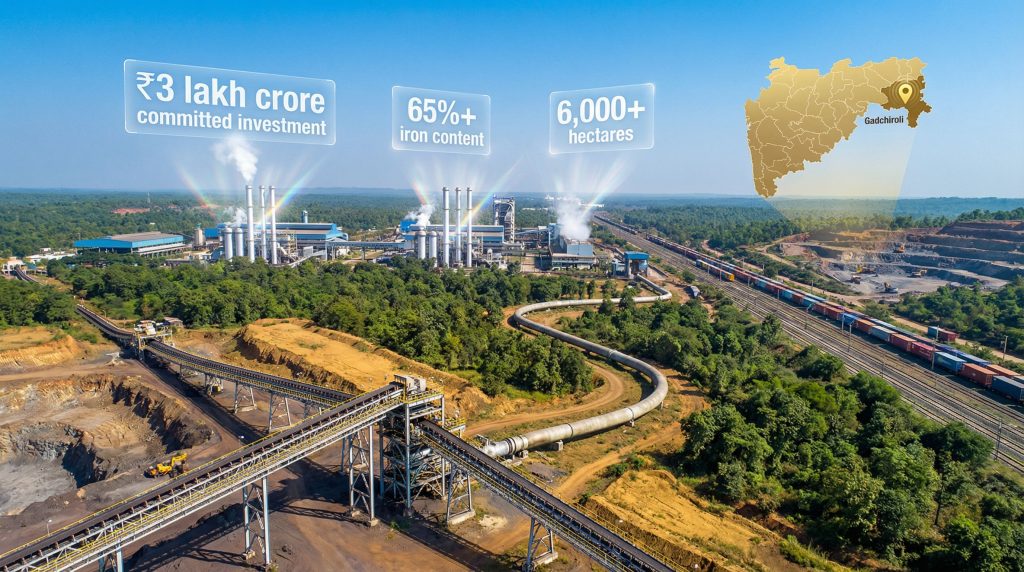
A key rail connectivity project in eastern Maharashtra is nearing partial commissioning, with the Wadsa–Armori section expected to become operational by mid-May, signalling a critical infrastructure shift for Gadchiroli’s emerging industrial landscape.
The initial 20-kilometre stretch of the broader Wadsa–Gadchiroli railway line is approaching completion, with final safety clearances underway before services begin. The development is closely linked to the region’s transformation into a steel and mining hub, where improved logistics is essential to support large-scale industrial investments. The rail corridor, spanning roughly 52–56 kilometres in total, is being developed through a joint funding model between the central and state governments. Once fully operational, it is expected to significantly reduce transport time and costs for bulk materials such as iron ore, coal, and finished steel—core inputs driving industrial growth in the district. For Gadchiroli, a district historically constrained by limited connectivity and difficult terrain, the project represents more than a transport upgrade. Industry experts tracking the Gadchiroli rail connectivity push say it could unlock supply chain efficiencies that are currently restricting industrial scalability. Improved rail access is likely to reduce dependence on road transport, lower logistics costs, and make the region more attractive for future investments.
The timing is particularly relevant as multiple steel and mining projects are underway or planned in the district. With resource-rich zones increasingly being integrated into national industrial corridors, reliable rail infrastructure is emerging as a prerequisite for sustained growth. Analysts note that the Gadchiroli rail connectivity initiative aligns with a broader policy push to connect resource hinterlands with manufacturing and export networks.Construction of the line has not been without challenges. Forest clearances, wildlife mitigation requirements, and complex terrain have contributed to delays and cost escalations. However, completion of land acquisition and steady progress on the remaining stretch from Armori to Gadchiroli indicate that the full corridor could be operational within the next year. Beyond industrial benefits, the project is expected to have significant social and regional development impacts. Improved connectivity could enhance access to healthcare, education, and markets for tribal communities, while also supporting tourism in forested areas. The railway is also seen as a stabilising factor in a region that has witnessed a decline in insurgency-related disruptions in recent years.From an urban development perspective, such infrastructure investments are central to integrating peripheral districts into mainstream economic activity. Efficient transport networks not only enable industrial growth but also shape settlement patterns, employment opportunities, and service delivery in emerging urban centres.
As commissioning of the first segment approaches, attention will now turn to the timely completion of the remaining stretch and the ability of the corridor to support both economic expansion and inclusive regional development.The Wadsa–Gadchiroli line may ultimately serve as a template for how targeted rail investments can catalyse industrial ecosystems while improving connectivity in historically underserved regions.