


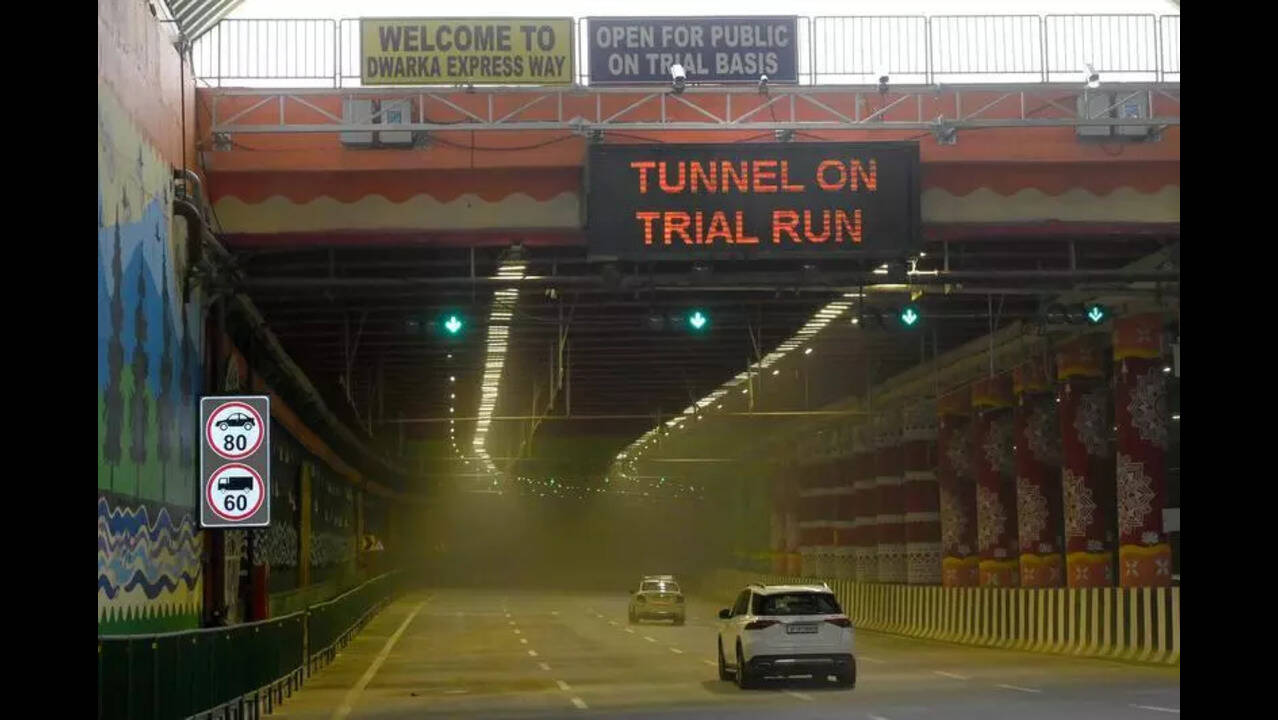
National Highways Authority of India (NHAI) has commenced trial runs on the country’s longest and widest urban road tunnel, designed to seamlessly link the Dwarka Expressway with Indira Gandhi International (IGI) Airport and National Highway-48 (NH-48).
This key infrastructure intervention is poised to transform vehicular flow between Gurgaon, Dwarka, and central Delhi, while easing mounting pressure on the heavily congested Delhi-Gurugram Expressway. Spanning a combined length of over 5 kilometres, the dual-tunnel corridor comprises a main 3.6-kilometre eight-lane tunnel connecting Dwarka Expressway to IGI Airport and a supplementary 1.5-kilometre two-lane tunnel linking the expressway to NH-48 toward Gurgaon. According to officials, this is India’s most expansive intra-city road tunnel, with trial operations currently underway between 12 pm and 3 pm each day. The tunnel will be opened to the public following a week-long trial assessment period, subject to operational readiness and safety audits.
The tunnel is part of Phase IV of the ₹9,000 crore, 29-kilometre Dwarka Expressway corridor that stretches from Mahipalpur in Delhi to Kherki Daula in Gurgaon. Of this total alignment, approximately 10.1 kilometres fall within Delhi’s boundaries, while the remaining 18.9 kilometres pass through Haryana. With the completion of this subterranean link, the corridor is set to become a vital artery in the National Capital Region’s (NCR) mobility landscape. What makes this infrastructure particularly remarkable is not just its engineering feat but the attention to aesthetics and public experience. Inside the tunnel, vibrantly painted murals highlight the cultural and architectural diversity of India—featuring the heritage of Punjab, Gujarat, Chhattisgarh, Manipur, and Delhi, alongside portrayals of iconic landmarks such as the Indian Parliament and tributes to national leaders. Officials involved in the project believe such design elements not only enhance the commuter experience but help embed a sense of national identity and civic pride within transit infrastructure.
From an urban planning perspective, the tunnel is expected to offer significant environmental and operational benefits. With a mandated speed limit of 80 kmph for four-wheelers and high-grade tarmac, the tunnel provides a faster, safer, and less polluting alternative to the Delhi-Gurgaon Expressway. Experts suggest that the reduced idling time and improved travel speeds could lead to a substantial decrease in vehicular emissions across this stretch, aligning well with India’s goals for carbon-neutral urban zones. Transport authorities foresee the tunnel easing congestion on NH-48 by diverting a significant volume of airport-bound and cross-border traffic that currently clogs the expressway, particularly during peak hours. This will also benefit long-distance travellers arriving from Jaipur, Sohna, and the Southern Peripheral Road who can now avoid the NH-48 bottlenecks by accessing IGI Airport via Dwarka Expressway and the new tunnel. Local residents in Dwarka, Vasant Kunj, and adjoining areas are expected to experience an immediate improvement in travel times and road decongestion.
Urban mobility experts have hailed this development as a model for future transport infrastructure in India’s metropolitan zones. By prioritising inter-modal connectivity, reducing environmental impact, and enhancing commuter experience through inclusive design, the project reflects a forward-thinking approach to transit planning. Several voices in the urban development sector argue that such infrastructure should be complemented by integrated public transport networks, pedestrian pathways, and cycling routes to further align with sustainable city planning goals. Meanwhile, civic bodies and sustainability advocates have urged authorities to ensure ongoing tunnel maintenance, traffic monitoring, and robust emergency response mechanisms to maintain long-term operational efficiency. With India witnessing a rising number of megaprojects aimed at reducing urban gridlock, the tunnel sets a precedent for quality execution, aesthetic sensitivity, and environmental responsibility.
As the tunnel nears its official launch, expectations are high that it will not only redefine how commuters move through Delhi and Gurgaon, but also represent a shift toward equitable, efficient, and eco-conscious infrastructure for India’s rapidly urbanising population.
Also Read : Kanpur Metro Begins First Underground Run
