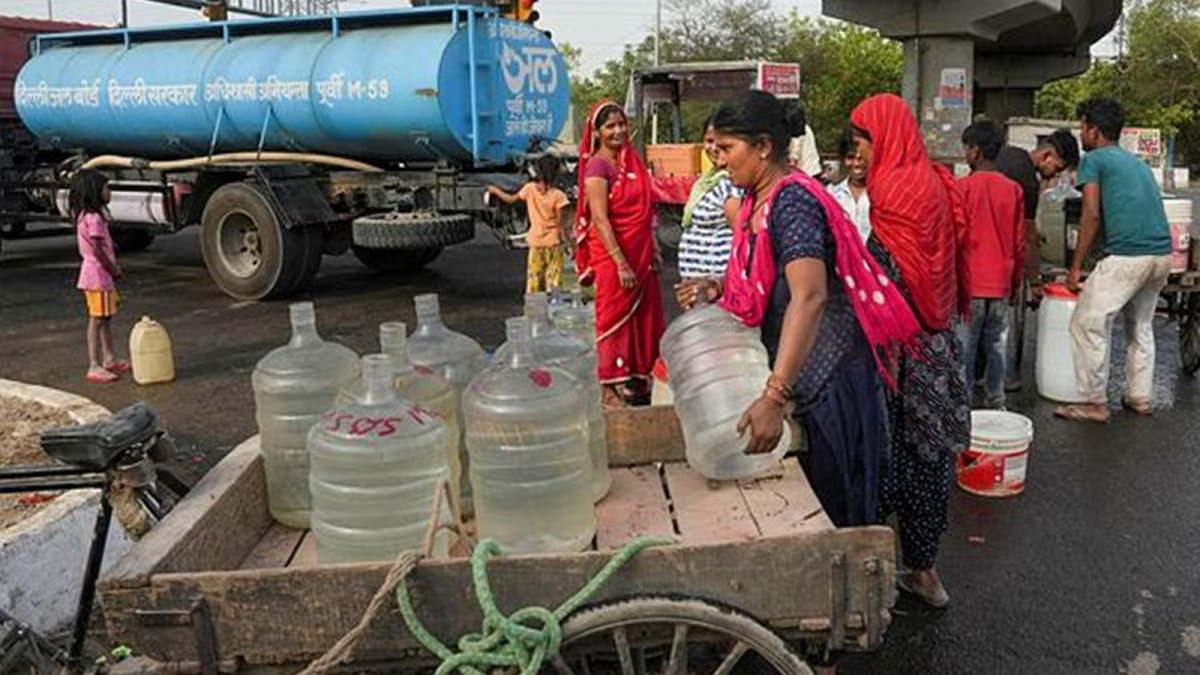
Delhi Water Infrastructure Struggles To Meet Demand
Delhi’s rapidly growing population is placing mounting pressure on the city’s water infrastructure, with official assessments indicating that the national capital is operating with a significant supply deficit. Urban policy experts warn that without urgent investment in infrastructure and water management systems, the Delhi water crisis could intensify over the coming decades. According to recent government assessments, the city currently requires roughly 1,250 million gallons of potable water each day to meet basic domestic demand. However, available treatment capacity and supply sources provide only about 961 million gallons daily, leaving a structural gap of nearly 300 million gallons. For a metropolitan region already grappling with extreme summer temperatures and rising population density, the shortage highlights the vulnerability of Delhi’s water distribution system.
Yet the more troubling issue lies in the city’s ageing infrastructure. A substantial portion of treated water never reaches consumers due to leaks, unauthorised connections and distribution inefficiencies. Urban planners estimate that more than half of the water entering Delhi’s distribution pipelines is lost before it reaches households and businesses. Such losses far exceed international benchmarks for developing cities, where acceptable levels typically range between 10 and 20 per cent. The scale of this wastage means that a large share of water treated at major plants effectively disappears within the system. Experts say the current losses are comparable to the combined output of several major treatment facilities, underscoring how infrastructure inefficiencies are aggravating the Delhi water crisis. Authorities responsible for water supply have acknowledged the problem and set long-term targets to reduce system losses significantly. However, progress remains uneven across different supply zones. Several key distribution areas continue to report high levels of leakage and unaccounted water, while modernisation efforts such as pipeline replacement and smart monitoring systems are advancing slowly.
Beyond the immediate supply deficit, Delhi is also confronting deeper environmental pressures. Groundwater extraction has become an increasingly important component of the city’s water supply, contributing over 100 million gallons daily through thousands of borewells and specialised wells. Yet water tables in many areas have dropped sharply as urban consumption continues to outpace natural recharge. Hydrogeologists note that declining groundwater levels not only threaten long-term water availability but also increase the risk of contamination. In several locations, water quality tests have detected elevated concentrations of minerals and pollutants that require additional treatment before safe consumption. Access to reliable water supply also remains uneven across different parts of the city. Large sections of unauthorised colonies, rural villages and informal settlements still lack comprehensive piped water and sewerage networks. In such areas, residents often depend on tanker deliveries or private sources during peak summer months, highlighting stark disparities in urban service delivery.
Looking ahead, the Delhi water crisis could become more acute as the city’s population expands toward an estimated 30 million residents in the coming decades. Urban planners argue that addressing the challenge will require a combination of infrastructure upgrades, reduced distribution losses, improved wastewater recycling and stronger groundwater management. Without such systemic reforms, experts caution that the gap between water demand and supply could widen, turning seasonal shortages into a persistent urban challenge for India’s capital.