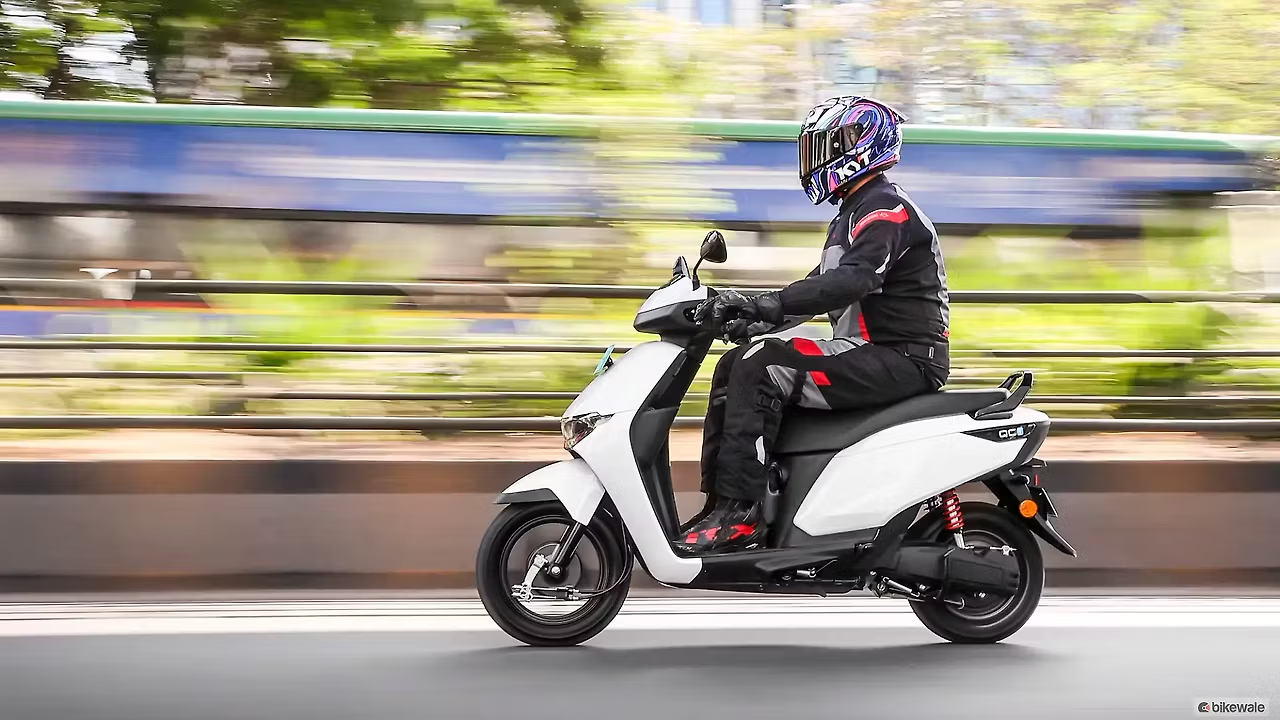
Delhi’s newly inaugurated Urban Extension Road-II (UER-II), billed as the Capital’s third Ring Road, has formally adopted a safety-first model, barring two-wheelers, auto-rickshaws, and slow-moving vehicles from entering the high-speed corridor. Officials said the measure is intended to minimise accident risks and ensure uninterrupted flow on the 76-km expressway connecting Alipur to Mahipalpur.
The ₹8,000-crore greenfield project, constructed under the National Highways Authority of India, is designed as a seamless bypass to ease pressure on inner-city roads and provide direct connectivity between Indira Gandhi International Airport and several NCR cities. The corridor is expected to significantly reduce travel time while enabling smoother cargo and passenger movement across Delhi’s periphery.
According to officials, safety enforcement on UER-II will be uncompromising. The Delhi Traffic Police has been directed to enforce the ban with immediate effect, supported by visible signages, public announcements, and awareness campaigns. Experts described the move as a decisive step towards international safety standards in urban expressways, where mixed traffic of high-speed cars and vulnerable vehicles often leads to accidents.
To strengthen surveillance, round-the-clock monitoring has been planned. Officials confirmed that CCTV cameras, patrolling vans, ambulances, and dedicated manpower will be positioned at key points to respond swiftly to emergencies. Authorities believe this proactive safety grid will build commuter confidence and establish UER-II as a model corridor for other Indian cities. The government has also pushed for inclusive access through parallel service roads, ensuring residents in adjoining areas are not cut off. Officials have directed immediate work on service lanes, particularly along urbanised stretches, to manage local traffic and prevent unsafe crossings onto the main carriageway.
Drainage has emerged as another critical concern, with officials instructing agencies to put in place a permanent system instead of ad-hoc arrangements. Past experience of waterlogging at key junctions in Delhi has shaped the insistence on resilient stormwater systems, with identified hotspots such as Karala and Mundka set to receive priority attention. Infrastructure agencies have also been tasked with addressing gaps in power supply to ensure smooth functioning of lighting and traffic management systems on the expressway. Coordination with convention centres and urban development projects in the vicinity has been prioritised to avoid future roadblocks.
Experts believe UER-II represents more than just another transport project. By positioning the expressway as a safe, high-speed, and sustainable link, Delhi is advancing towards modern, carbon-efficient mobility while safeguarding vulnerable commuters by restricting unsafe vehicles. However, the success of the corridor will depend on consistent enforcement and sustained maintenance of both its safety and environmental standards. With a mix of strict restrictions, strong surveillance, and parallel infrastructure, UER-II is being positioned as Delhi’s next-generation mobility lifeline, promising speed without compromising safety.