


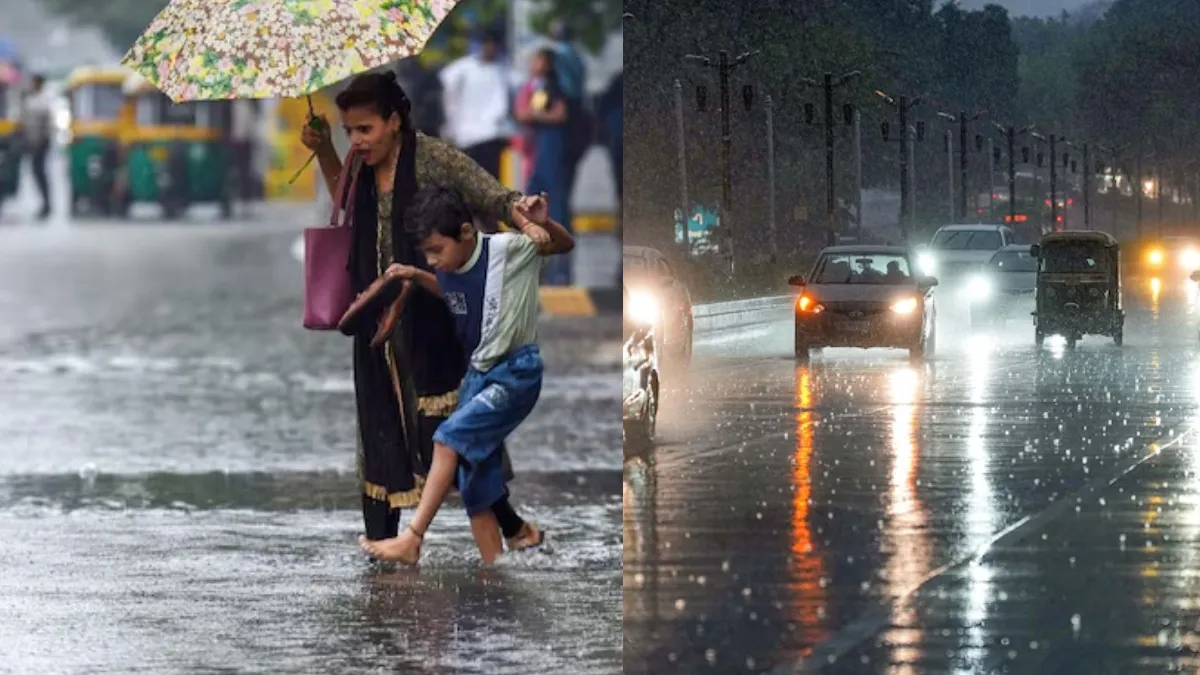
Delhi is poised to experience its earliest monsoon in over a decade and a half, as the southwest monsoon makes rapid progress across northwestern India. The India Meteorological Department (IMD) has indicated that, under the influence of favourable synoptic conditions, the seasonal rains could reach the capital several days ahead of schedule—potentially setting a new benchmark since 2013, when the monsoon arrived on June 16.
The swift advancement is part of a broader meteorological trend this year. The 2025 southwest monsoon began its journey from Kerala on May 24—its earliest onset in over 15 years. Within five days, it had already covered Mumbai, central Maharashtra, and the entire northeastern region. However, from May 29 to June 16, progress came to a standstill, resulting in a prolonged dry spell and intense heatwaves across much of northern and central India.
The pace picked up again in mid-June, triggered by two active low-pressure systems forming over West Bengal and Gujarat. These systems reinvigorated the monsoon’s movement, carrying rain-laden clouds deep into Ladakh, large parts of Himachal Pradesh, Jammu and Kashmir, and portions of Punjab. With continued favourable conditions, the monsoon is now on track to cover Delhi, Haryana, Chandigarh, western Uttar Pradesh, and Rajasthan in the coming days.
The early arrival holds dual significance for the capital. On one hand, it offers respite from oppressive pre-monsoon heat; on the other, it raises concerns over the city’s preparedness for heavy downpours. Delhi’s drainage infrastructure, already under stress from urban congestion and poor maintenance, will face fresh challenges as rainfall intensity increases.The IMD has forecast heavy to very heavy rain over northwest India—including Delhi—through June 26. Extremely heavy rainfall is also expected in Madhya Pradesh on June 23 and 24. Meanwhile, the northeastern states are expected to endure intense rain for another three days before conditions begin to ease.
Nationally, the IMD expects India to receive 106% of its long-period average (87 cm) rainfall during the June–September monsoon season. While most regions are projected to receive above-normal rainfall, exceptions remain. Parts of Ladakh, Himachal Pradesh, the Northeast, Bihar, Jharkhand, West Bengal, Odisha, and some pockets in Kerala, Tamil Nadu, Punjab, and Haryana are likely to experience below-average showers.The early onset in Delhi stands out when compared to the monsoon’s past arrival dates: June 28 in 2023, June 25 in 2022, June 30 in 2021, and as late as July 13 in 2020. The marked advancement this year reflects growing unpredictability in regional weather patterns, possibly tied to broader shifts in the global climate system.
From an urban sustainability lens, this development underscores the urgent need for adaptive planning. Delhi, like many Indian megacities, must invest in stormwater management, green infrastructure, and community resilience to mitigate the risks associated with increasingly erratic monsoon cycles. With water security, climate equity, and disaster resilience becoming central to urban governance, the early monsoon presents both an opportunity and a warning.
As the capital awaits the official onset, citizens, planners, and policymakers alike must brace for a wetter, possibly more volatile, monsoon season—arriving sooner than expected, and with climate realities closer than ever.
Also Read : Mumbai Teli Gali Flyover Gets of Abandoned Vehicles
