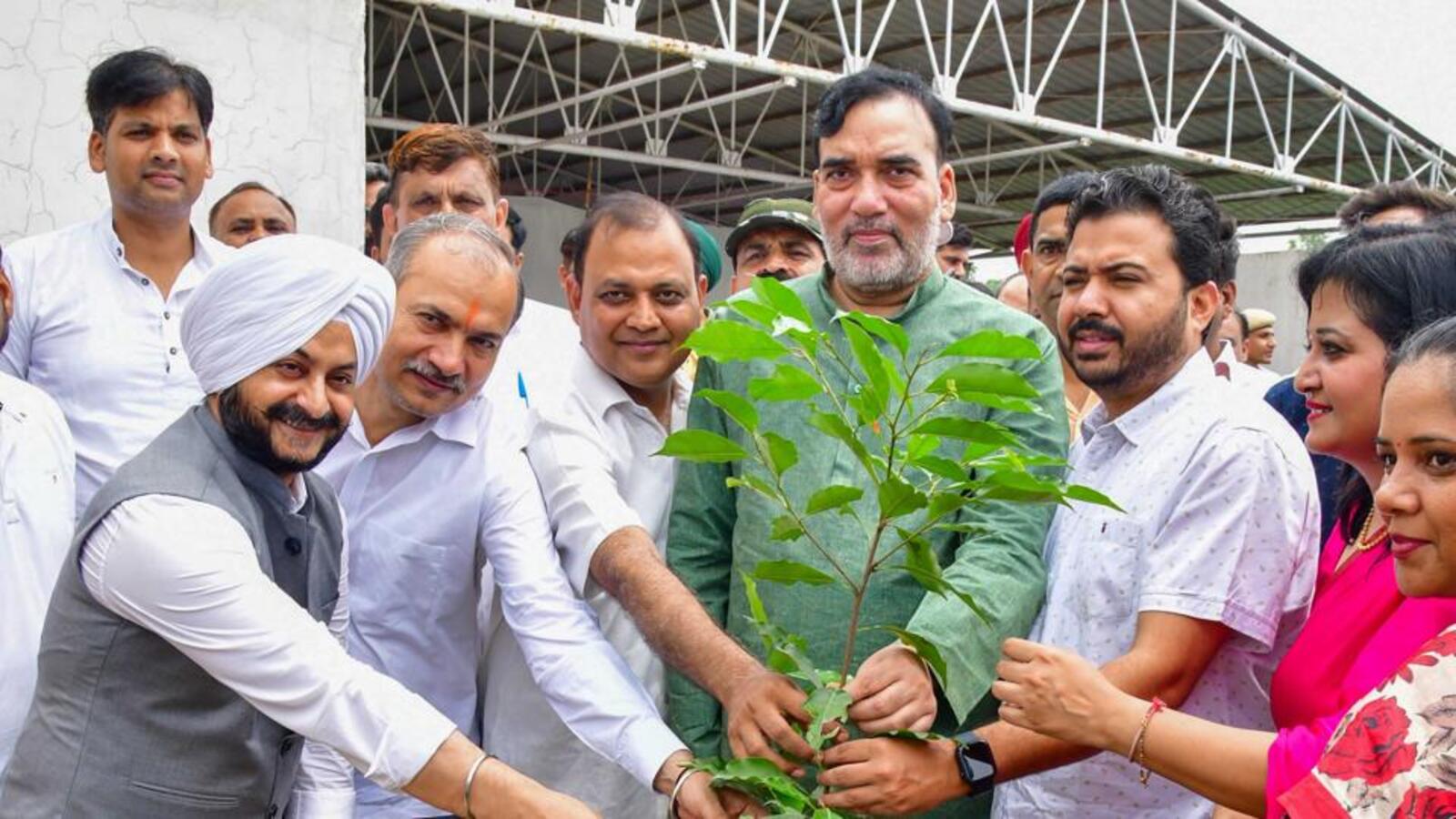
Delhi is preparing for its most ambitious public green campaign yet, as the city rolls out Van Mahotsav 2025 — a month-long environmental festival aimed at enhancing the capital’s green cover and combating pollution through mass participation and civic engagement. Environment Minister Manjinder Singh Sirsa announced on Monday that the campaign will commence on July 3 at Bharat Mandapam, where the launch ceremony is expected to draw citizens, students, industrialists, environmentalists, and policy leaders alike.
The event will also host a “Van Mela” — a vibrant plant exhibition featuring exotic, medicinal, and ornamental flora — and serve as a key platform to distribute free saplings to Delhi residents. With a target to plant over 70 lakh trees across the city, Van Mahotsav 2025 is being reimagined not merely as a government-led plantation drive but as a community-led celebration of nature, sustainability, and civic responsibility. “Van Mahotsav is not just about putting trees into the ground. It is a shared emotional journey to restore the ecological conscience of the city,” said Sirsa. “We are moving towards building a collective climate consciousness, because battling pollution and environmental degradation in Delhi demands nothing less than mass mobilisation.”
At a time when urban pollution remains one of Delhi’s most urgent challenges, the state’s forest department is working in tandem with key civic and administrative stakeholders to ensure successful implementation. The campaign has issued directives to coordinate with NDMC, MCD, Delhi Development Authority (DDA), and Delhi Police to secure venues, ensure sapling availability, and manage logistical and public safety concerns. One of the most novel aspects of the campaign is its effort to decentralise tree plantation events across all 70 Assembly constituencies. Each constituency will have its own plantation event, spearheaded by Deputy Conservators of Forests in collaboration with elected representatives — including MPs, MLAs, councillors — as well as civil society groups, RWAs, schools, and prominent citizens.
In an effort to elevate the visibility and emotional gravity of the initiative, the campaign will also actively involve recipients of prestigious awards such as the Padma Shri, gallantry honours, national sports recognitions, and science awards. Corporate leaders and heads of major media houses will also be invited to lead plantation drives, symbolically demonstrating their institutional commitment to the city’s sustainable future. Sirsa has underscored the significance of community participation in achieving the city’s green targets. “We are not just planting saplings, we are planting hope,” he stated. “Each tree will become a memory, a responsibility, and a shared bond between the citizen and the city.”
The broader vision of Van Mahotsav 2025 fits squarely within Delhi’s evolving climate action roadmap. With increasing focus on eco-restoration, carbon-neutral development, and nature-based solutions, the city’s forest department is not only looking to increase the number of trees but to foster native biodiversity, enhance urban resilience, and reimagine public green spaces. Delhi’s urban forestry efforts are increasingly aligned with global sustainability benchmarks, especially in light of India’s commitments under the Paris Agreement and the Sustainable Development Goals (SDGs). The massive afforestation drive contributes to both climate mitigation and adaptation goals, by reducing particulate matter, improving air quality, and enhancing community cooling and mental well-being.
More than just symbolic, trees in Delhi play a vital role in countering the heat island effect, absorbing CO₂, and preserving water tables in a city grappling with both high emissions and unpredictable monsoon cycles. Through sustained investments in green infrastructure, Van Mahotsav seeks to turn ecological vulnerability into an opportunity for inclusive growth. In its outreach, the campaign also takes an equitable approach. Saplings will be made accessible to citizens from all economic backgrounds, with a special focus on under-served wards and public institutions such as government schools, hospitals, and anganwadis. The campaign includes education sessions for young students on plant care, native species, and ecological importance — in a bid to seed lifelong habits of environmental stewardship.
Delhi’s forest department will ensure real-time tracking of plantation figures, survival rates of saplings, and citizen engagement using digital dashboards and mobile-based monitoring tools. This will help maintain transparency and allow communities to feel ownership over their local environmental transformations. While Delhi has conducted Van Mahotsav in the past, the scale and intent behind the 2025 edition marks a significant evolution. It is no longer simply an event — it is being positioned as a mass behavioural shift towards greener lifestyles and civic eco-responsibility.
As the national capital prepares to usher in a month of green fervour, the success of Van Mahotsav 2025 will depend not only on the number of saplings planted but on the strength of the roots it creates in the public imagination. In a city constantly battling air pollution and ecological stress, this campaign offers a hopeful new beginning — grounded in soil, solidarity, and a shared future.