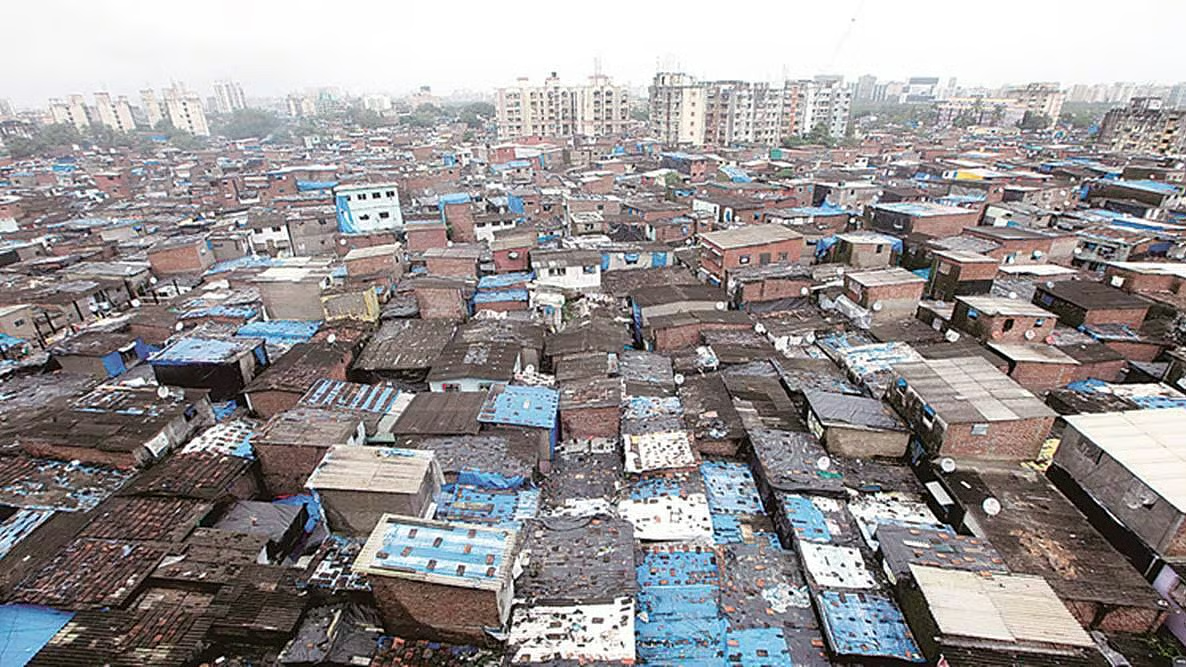
The Centre has signalled an accelerated push to overhaul informal settlements in the National Capital Territory, with plans to redevelop hundreds of jhuggi jhopri clusters through in situ rehabilitation or relocation within a five-kilometre radius. The announcement, made by the Union Housing and Urban Affairs Minister at an industry conference in Delhi, places renewed focus on one of the city’s most complex urban challenges.
Delhi is home to roughly 675 recognised slum clusters under the Delhi Urban Shelter Improvement Board, spread across land owned by multiple agencies including the Delhi Development Authority and other public bodies. These settlements house lakhs of residents who form a critical workforce in services, construction, logistics and domestic employment. Their redevelopment has long been central to the capital’s housing and land-use policy. According to officials familiar with ongoing deliberations, the proposed Delhi slum redevelopment strategy will rely on a mix of in situ construction and nearby relocation to minimise livelihood disruption. Land-owning agencies under the Union Ministry are expected to play a key role in assembling parcels and framing project structures. A fresh round of tenders is anticipated after earlier attempts struggled to attract bidders, largely due to viability concerns and gaps in project financing.
Policy analysts note that the viability of Delhi slum redevelopment hinges on careful structuring. Previous public–private partnership models have faced hurdles, including high construction costs, limited cross-subsidy potential and procedural delays. To address this, authorities are exploring options such as cluster-based redevelopment, mixed land use and calibrated density norms to improve financial feasibility while maintaining liveability standards. The debate also intersects with affordable housing supply in the capital. With formal housing prices rising steadily, in situ rehabilitation offers a pathway to secure tenure and basic services for low-income households without pushing them to the urban periphery. Urban planners argue that proximity to employment hubs is essential for economic inclusion and reducing commute-related emissions.
At the same time, experts caution that redevelopment must go beyond vertical construction. Access to public transport, green spaces, schools and health centres will determine whether rebuilt neighbourhoods evolve into integrated urban districts rather than isolated housing blocks. Transparent beneficiary identification and grievance redressal systems will also be critical to prevent displacement or exclusion. Recent public housing completions in north-west Delhi have been presented as examples of permanent housing delivery.
However, scaling such interventions across 700 or more clusters will require coordinated action between the Centre, the Delhi government and municipal authorities. If implemented with financial clarity and community participation, Delhi slum redevelopment could reshape the city’s housing landscape strengthening tenure security while aligning urban growth with equity and environmental resilience goals.
Delhi Targets 700 Slum Redevelopment Projects