


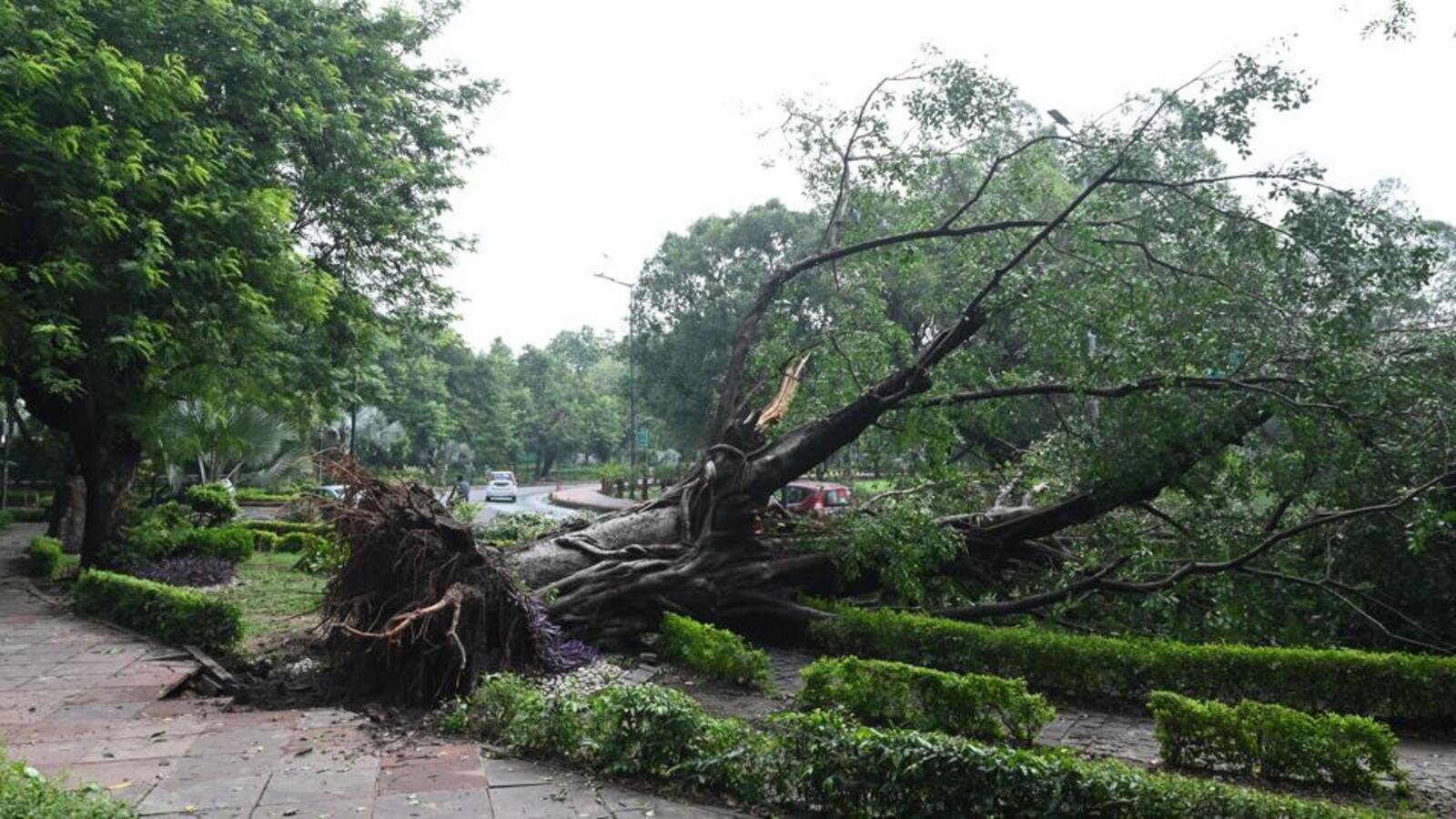
Delhi experienced a severe early morning storm on Sunday, which led to the collapse of over 180 trees across the city and triggered widespread power outages.
The intense winds, clocked at 82 km/h near Safdarjung and 72 km/h at Palam by the India Meteorological Department (IMD), caused significant disruption to daily life and highlighted vulnerabilities in the city’s urban green infrastructure and power distribution networks. Public Works Department (PWD) officials reported receiving more than 168 complaints related to fallen or dangerously leaning trees, with 142 directly involving toppled trees blocking roads and public spaces. These incidents were reported from diverse neighbourhoods including Paschim Vihar, Mukherjee Nagar, Green Park, and RK Puram, illustrating the broad impact of the storm.
The New Delhi Municipal Council (NDMC) also recorded 34 complaints related to tree falls from prominent central areas such as Chanakyapuri, Janpath, and Malcha Marg. The swift response teams managed to clear most sites by early morning, minimising further disruption. The Delhi Fire Service attended to five emergency calls connected to fallen trees and damaged property during the storm. Fortunately, no casualties or injuries were reported, underscoring the effectiveness of the emergency response despite the challenging conditions.
Experts argue that the recurring damage from storms exposes longstanding gaps in urban forestry management, particularly the failure to deconcretise tree bases as mandated by a 2013 National Green Tribunal order. The directive aims to improve tree health and resilience by allowing natural root expansion, yet enforcement remains weak. This oversight not only compromises the stability of city trees but also poses ongoing risks to public safety and infrastructure. Power outages affected multiple sectors including Chhatarpur, Bawana, Rohini, and Mukherjee Nagar, as fallen trees and broken branches severed electrical cables and damaged poles. Both Tata Power and BSES confirmed that the outages were primarily caused by physical damage to the power infrastructure and waterlogging in several localities.
Restoration crews were deployed promptly with priority given to safety. Power supplies were temporarily suspended in vulnerable areas to prevent accidents and reinstated once conditions stabilised. However, the combination of flooding and structural damage delayed power restoration in certain pockets. This event once again underscores the urgent need for integrating urban ecology with disaster resilience strategies in Delhi. Proactive measures such as tree deconcretisation, regular pruning, and upgrading electrical infrastructure to withstand storm impacts are critical to safeguarding the city’s sustainability and public safety.
As Delhi continues to grow and face climate-related weather extremes, balancing urban development with environmental stewardship will be crucial to building a greener and more resilient capital.
Also Read : Mumbai hit by heavy rain this morning
