


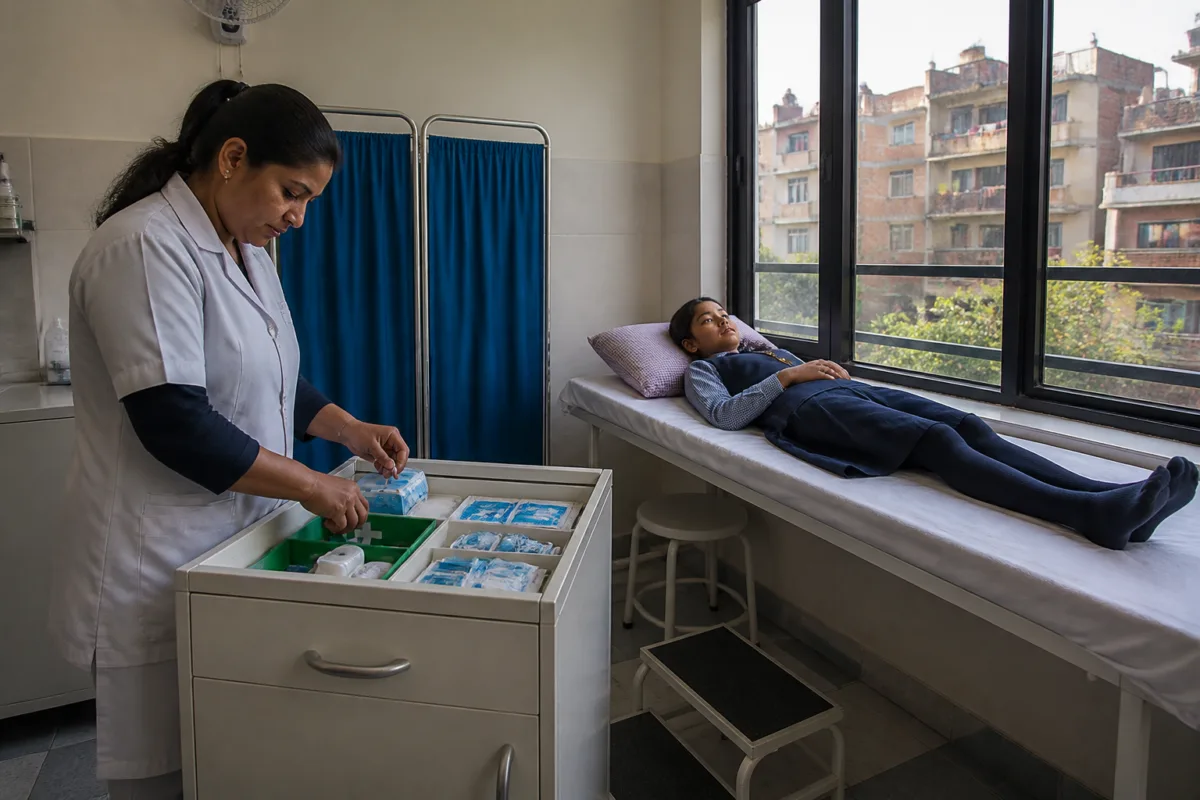
Delhi’s government schools will get dedicated medical rooms under a ₹48.87-crore plan announced by Education Minister Ashish Sood, with the facility intended to provide students immediate primary treatment during school hours.
The project will cover all 1,086 schools under the Directorate of Education. The medical rooms will be introduced in phases rather than opened simultaneously across the city, according to an official statement cited by the Delhi government.
Each room is expected to provide basic first-aid support, a short-term resting area, age-appropriate health guidance and counselling. Services will include wound dressing and oral rehydration solution, or ORS. The rooms will not provide diagnostic testing or medicines, the statement said.
A trained health worker will be deployed at every school. The personnel may include an auxiliary nurse midwife or a multipurpose health worker, with responsibility for providing first aid and monitoring students who become unwell or sustain minor injuries on campus.
The initiative is intended to address incidents such as small injuries, sudden illness, fatigue, dizziness and other temporary health problems that may occur during the school day. The arrangement is designed to provide an immediate first response within the school rather than requiring teachers or parents to manage every minor medical situation without dedicated support.
The rollout will begin at schools that already have suitable rooms. Schools with alternative spaces will be taken up subsequently, while portable cabins may be built where necessary, according to the statement. This phased approach links the timing of implementation to the availability of physical space in individual school buildings.
The planned rooms will also include a private area for girl students to attend to health needs related to menstruation. The provision adds a gender-sensitive component to what is otherwise a basic first-aid and short-term care facility, although the announcement does not specify the design standards or equipment planned for these private spaces.
The medical rooms are not being presented as full clinics. The absence of medicines and diagnostic services means their stated role will remain limited to basic first aid, observation, rest and counselling. Students requiring treatment beyond that scope would still need to be referred through existing arrangements, though the announcement does not detail the referral system, nearby hospitals or emergency response protocols.
The plan places a dedicated health worker inside each school, creating a new operational responsibility for the education system. Its implementation will therefore depend not only on constructing or identifying rooms, but also on recruiting or assigning trained personnel and ensuring that all schools have the required basic supplies.
Sood said government-school students should have a safe and caring environment and that parents and teachers would have reassurance if a child suddenly fell ill or suffered an injury during school hours. He said the initiative would ensure that students receive primary treatment and appropriate care within the school without delay.
The government has not provided a school-wise rollout schedule in the supplied announcement. The next implementation stages will depend on the availability of existing rooms, alternative spaces and portable cabins across the 1,086 schools.

