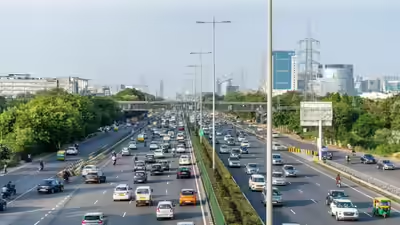
Delhi has cleared a ₹100 crore investment to deploy an advanced, technology-driven traffic management system, marking a significant shift in how the capital plans to address road safety, congestion, and emergency response across its rapidly growing transport network. The approval forms part of a larger financial package aimed at strengthening the city’s public transport ecosystem and modernising mobility governance.
The proposed Advanced Traffic System is expected to introduce integrated digital oversight of key road corridors, combining real-time monitoring, electronic enforcement, and data-led traffic control. Urban planners view the move as a necessary upgrade for a city where traffic volumes, weather-related disruptions, and mixed road use increasingly strain conventional enforcement and manual response mechanisms. At the core of the system is a centralised command and control facility designed to function as a single operational nerve centre. From here, authorities would be able to monitor traffic conditions live, coordinate emergency responses, and disseminate public advisories during incidents such as accidents, poor visibility, road blockages, or peak congestion events.
High-resolution cameras and automated detection tools are expected to reduce response times and enable quicker on-ground deployment of emergency services.
The Delhi traffic system upgrade comes against the backdrop of growing concerns around road safety, particularly involving public transport vehicles. Transport sector experts note that while buses remain the most space-efficient and affordable mode of urban travel, they operate within an increasingly complex road environment shaped by private vehicles, informal transport, and inconsistent lane discipline. Data shared by transport officials indicates that buses operated by state-run and contracted fleets were involved in a significant number of road incidents over the past year, highlighting the need for stronger surveillance and enforcement frameworks.
Beyond safety, the investment has broader implications for climate-resilient urban infrastructure. Smarter traffic management reduces idle time, fuel wastage, and stop-start driving patterns factors that directly influence urban emissions. Mobility economists argue that digital traffic control systems are critical complements to electric vehicle adoption, ensuring that cleaner vehicles operate within optimised road conditions rather than congested, inefficient networks. The funding allocation also supports the development of commercial electric vehicle charging infrastructure, reinforcing Delhi’s push towards electrification of transport assets. Real estate and infrastructure analysts point out that charging hubs integrated with traffic-managed corridors can influence land use patterns, transit-oriented development, and last-mile connectivity in emerging urban clusters.
For residents, the success of the Advanced Traffic System will ultimately be measured by visible outcomes: safer roads, faster emergency response, and more predictable travel times. As Delhi scales up public transport and electric mobility, the challenge now lies in translating digital investments into consistent on-ground coordination across agencies. If executed effectively, the system could serve as a blueprint for other Indian cities grappling with the dual pressures of urban growth and road safety.
Delhi Road Safety Gets Tech Led Overhaul