


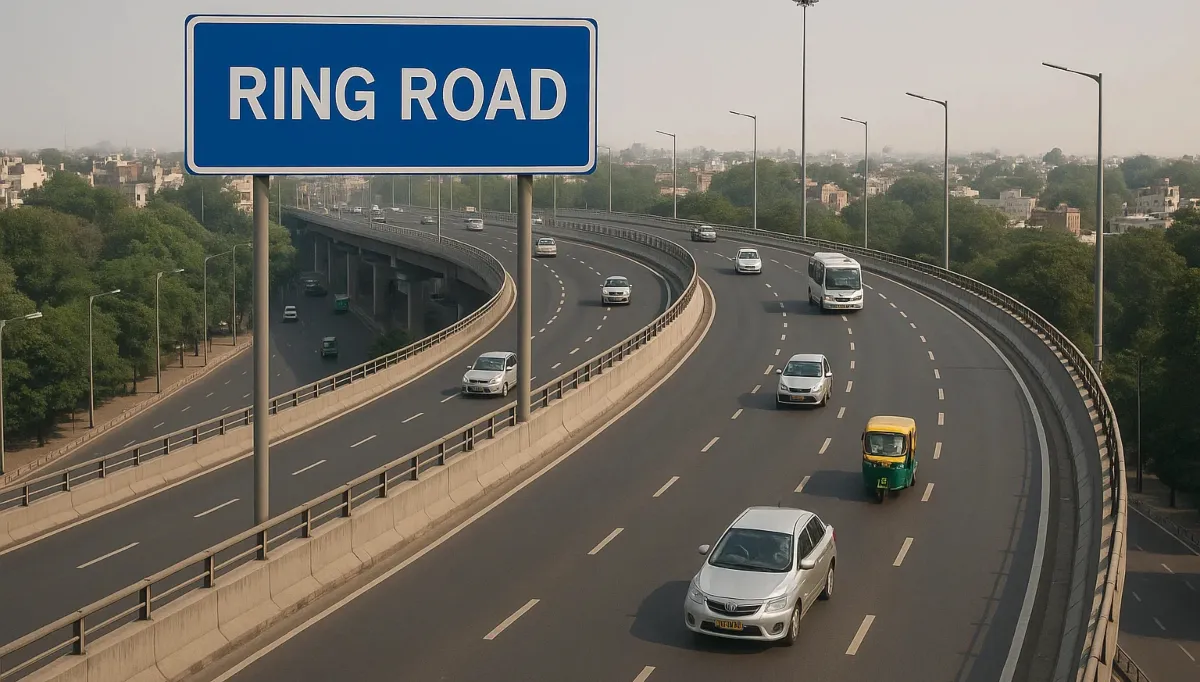
Delhi is moving ahead with one of its most ambitious urban transport projects a 55-kilometre elevated corridor over the existing Ring Road. The Public Works Department (PWD) has initiated a detailed feasibility study expected to be completed within seven months, marking the first concrete step in transforming how traffic moves across the national capital.
The elevated corridor is designed to ease congestion on Mahatma Gandhi Marg, popularly known as Ring Road, which serves as one of Delhi’s most vital arterial routes. It connects some of the city’s busiest residential and commercial hubs, including AIIMS, Ashram, Lajpat Nagar, Sarai Kale Khan and Punjabi Bagh. Officials confirmed that the study, costing ₹17.6 crore, will provide a clear picture of traffic loads, land acquisition requirements, drainage needs and flood level impacts, particularly in sensitive areas along the Yamuna catchment.
Also Watch: An Exclusive Interview with Sanjeev Jaiswal (IAS), CEO MHADA
The project is envisioned as part of the city’s broader decongestion plan, aiming to provide faster connectivity not only within Delhi but also to adjoining NCR cities such as Noida, Ghaziabad and Gurugram. According to senior PWD officials, the corridor may ultimately be executed under a public-private partnership model, given the high funding requirements.s part of the feasibility exercise, consultants have been tasked with conducting 24-hour traffic surveys covering vehicle volumes, turning movements and classification at key intersections. They will also map encroachments, existing buildings, and infrastructure constraints. A cost-benefit analysis will be undertaken, factoring in environmental, economic and social considerations. This approach, officials say, is critical to ensuring that the corridor does not merely shift congestion but genuinely improves long-term mobility outcomes.
Transport and urban planning experts believe the elevated corridor could help reduce fuel consumption and emissions caused by prolonged idling in traffic bottlenecks. However, they stress that sustainable execution will be key. “Infrastructure of this scale must balance speed and connectivity with environmental resilience. The Ring Road project has the potential to redefine mobility but only if ecological and social costs are addressed transparently,” said a senior transport policy expert.
Challenges are expected, particularly around land acquisition and managing construction without paralysing daily traffic. Flood resilience will also be crucial, with the tender specifying the need for data on tidal levels and drainage systems to prevent waterlogging a recurring problem in Delhi’s monsoon season.If realised, the elevated Ring Road could emerge as a backbone of Delhi’s mobility network, linking key corridors while reducing congestion across densely populated areas. For a city struggling with air pollution, long commute times and rising vehicle numbers, the project offers a possible path toward more efficient and sustainable urban transport
