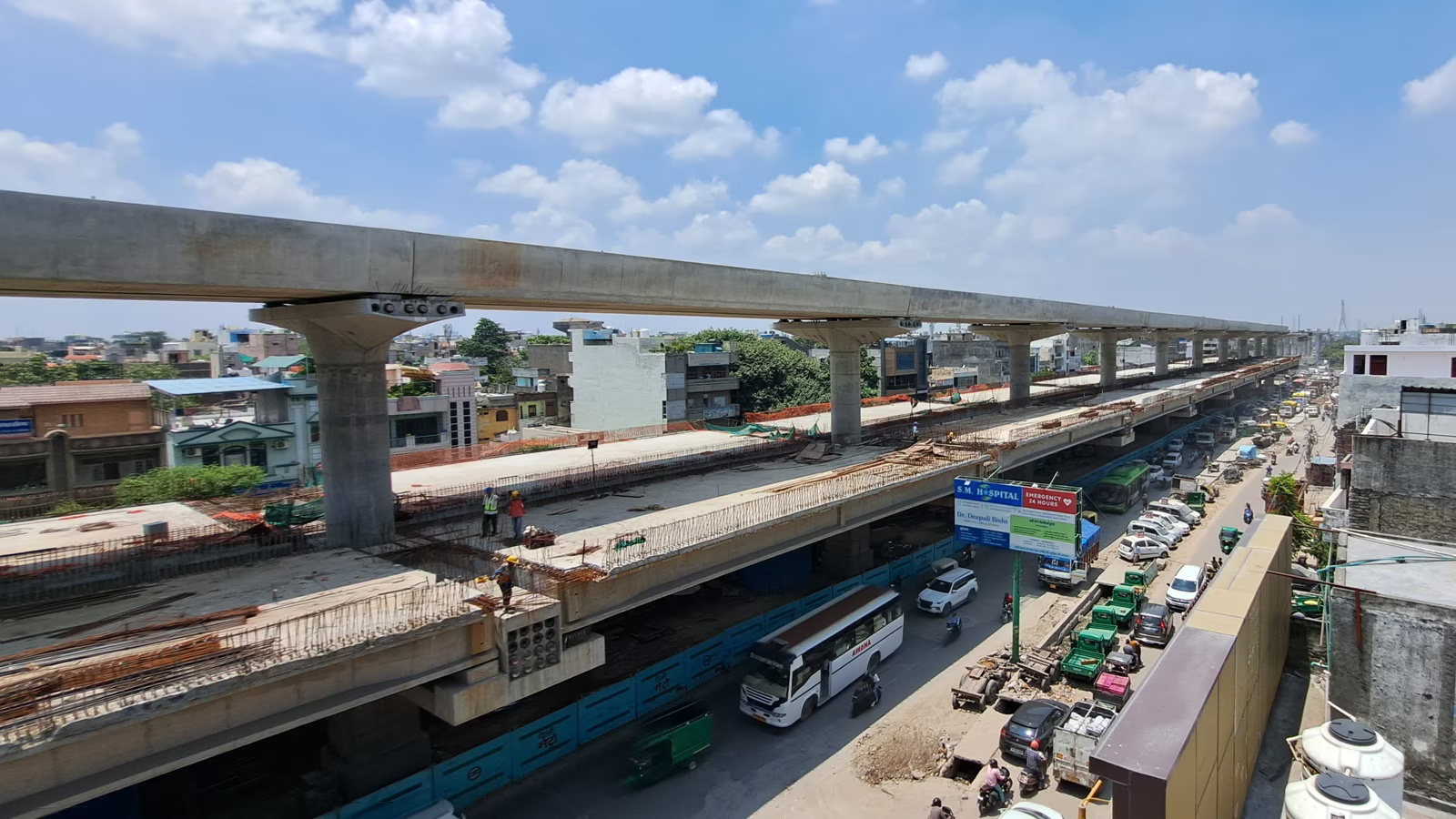
Authorities in the national capital are examining the feasibility of constructing a short but strategically important road beneath an elevated metro corridor in south Delhi. The proposed connector, designed to link Maa Anandmayee Marg with Harkesh Nagar Metro station, is expected to strengthen last-mile connectivity and ease congestion in a busy residential and industrial zone of the city. The Public Works Department has begun preliminary work to assess the project, which involves preparing a detailed project report for a roughly 900-metre stretch beneath the metro structure. Although relatively modest in length, planners believe the proposed metro viaduct road could significantly improve mobility by creating a direct link between a major arterial road and an important public transport node.
Maa Anandmayee Marg functions as a crucial urban corridor connecting south Delhi to neighbouring Faridabad, while Harkesh Nagar Metro station on the Violet Line serves thousands of daily commuters travelling to residential neighbourhoods, workplaces and industrial clusters in the surrounding Okhla and Tughlakabad areas. Despite this proximity, direct road connectivity between the two points remains fragmented. Currently, commuters often navigate through narrow internal lanes and heavily trafficked streets to reach the station. These routes are frequently slowed by mixed traffic movement, informal roadside parking and high pedestrian activity. Urban mobility experts say a dedicated metro viaduct road could streamline access while reducing pressure on smaller neighbourhood roads. According to officials involved in the planning process, the study phase will involve extensive ground surveys and traffic assessments. Technical teams will conduct Total Station Surveys, GPS-based mapping and traffic flow analyses to understand existing movement patterns and physical constraints in the area. The data will then inform engineering drawings and infrastructure planning required for the detailed project report.
Another key aspect of the evaluation will be examining land ownership patterns and environmental sensitivities along the proposed corridor. Authorities are expected to verify whether the alignment intersects with protected ridge areas or other regulated zones that may require special clearances. Such assessments are considered essential for projects being implemented within densely developed urban landscapes. Transport planners say the concept of building a metro viaduct road beneath elevated rail infrastructure reflects a broader shift in how cities use limited urban space. Across rapidly growing metropolitan regions, the areas under flyovers and metro lines are increasingly being adapted for roads, cycling tracks, utilities and public amenities. These interventions help optimise land use while supporting sustainable mobility systems. In south Delhi, where residential colonies, industrial activity and commuter traffic converge, even a short connector can significantly influence daily travel patterns. By creating a more direct route to the metro station, the proposed project could reduce detours for commuters while encouraging greater reliance on mass transit.
Urban development analysts note that improving last-mile connectivity is critical for maximising the efficiency of public transport investments. If the feasibility study confirms technical viability, the connector could emerge as a model for similar micro-infrastructure interventions across Delhi, where small links can unlock large improvements in urban mobility and commuter convenience.