


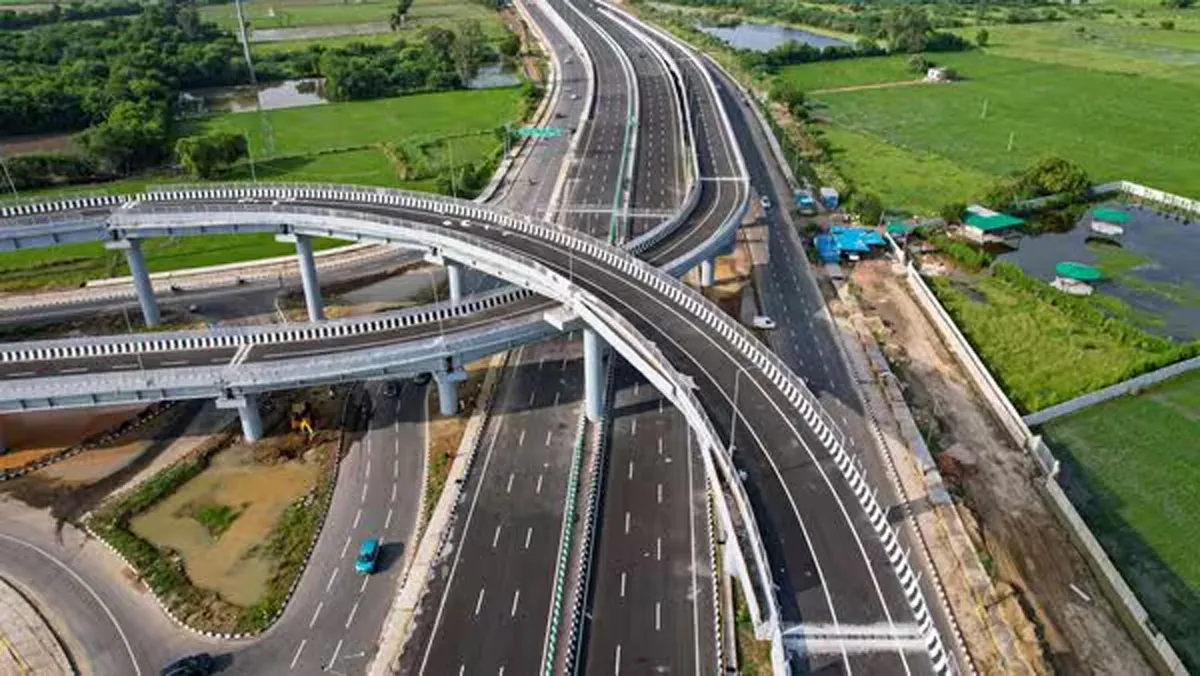
Delhi’s urban transport landscape is set for a significant shift as the National Highways Authority of India (NHAI) has initiated groundwork for a 20km-long elevated corridor that will ease pressure on the Delhi-Gurugram highway (NH48) and surrounding arterial roads. Estimated to cost nearly ₹5,000 crore, the corridor will link AIIMS to Mahipalpur bypass and the Gurugram–Faridabad road, with the detailed project report expected by mid-October.
The proposed route will provide a signal-free stretch starting from the INA–AIIMS area, weaving past key arterial points such as Africa Avenue, Nelson Mandela Marg, Vasant Vihar, Vasant Kunj and Arjangarh, before terminating on the Gurugram–Faridabad Road. According to officials, it is designed to divert heavy commuter traffic from Gurugram towards Ghaziabad, Noida and Greater Noida, significantly reducing the load on the already saturated highway network.
Also Watch: An Exclusive Interview with Sanjeev Jaiswal (IAS), CEO MHADA
Urban transport experts emphasise that the elevated corridor has the potential to reshape commuting in South Delhi, where inner and outer Ring Roads, NH48 and Mehrauli-Gurgaon Road are currently choked beyond capacity. They caution, however, that the construction period will bring its own challenges, requiring a carefully phased approach to avoid worsening bottlenecks. Proper off-ramp planning at critical exits such as Mahipalpur and IFFCO Chowk will be vital in maintaining fluid connectivity during and after completion.
Delhi’s traffic woes are not new. Previous attempts to construct alternative corridors, including a 14km link between Barapullah and Mahipalpur, stalled due to funding shortfalls. The present proposal revives the larger ambition of creating integrated, sustainable corridors that align with the expanding urban sprawl and the anticipated passenger load from upcoming infrastructure such as the Noida International Airport.
Sustainability advocates argue that such mega-infrastructure projects should not only reduce congestion but also integrate environmentally responsible solutions. Incorporating green construction practices, minimising displacement, and ensuring seamless integration with public transport systems will be key to achieving Delhi’s broader goals of reducing carbon emissions and building climate-resilient mobility networks.
Experts also suggest that planning should focus on multimodal options. Elevated corridors may improve speed and capacity, but unless complemented by enhanced bus and metro connectivity, Delhi risks repeating the cycle of road expansion leading to fresh congestion in the medium term. In this context, the corridor is being viewed as part of a more comprehensive traffic management and sustainable mobility strategy.
If executed with foresight, the corridor could become a model of urban transformation alleviating gridlock, improving air quality, and enabling smoother connectivity between residential, commercial and transit hubs. For Delhi’s residents, the stakes are high: a chance to reclaim smoother daily commutes while steering the city towards a more sustainable urban future.
Also Read : Delhi MCD Submits Revival Plan For Old Hindu College Buildings
Delhi Plans 20 Kilometer Elevated Corridor To Decongest Gurugram Highway
