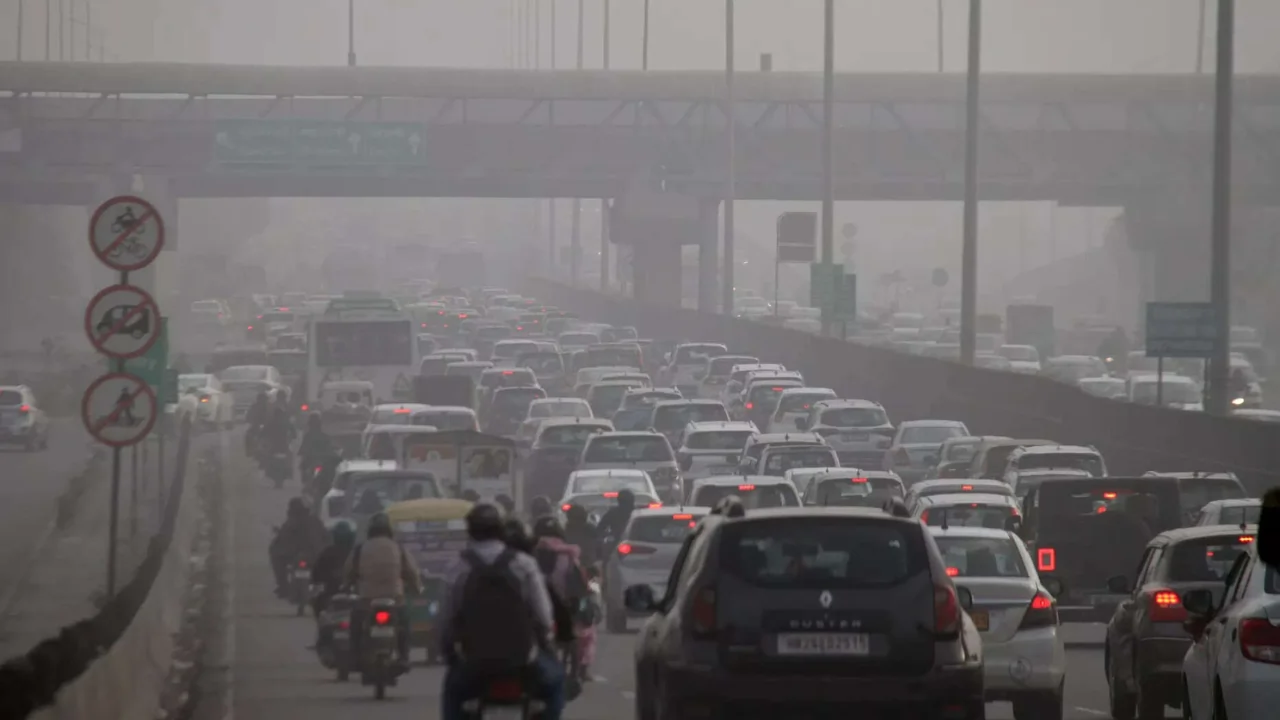
A dense blanket of fog combined with elevated pollution levels slowed Delhi–NCR to a crawl on Monday morning, underlining how winter weather continues to expose the region’s structural vulnerabilities. Air quality across large parts of the capital and its satellite cities remained between moderate and poor, while visibility fell sharply, disrupting road traffic, aviation schedules and rail operations at the start of the working week.
Data from national air quality monitoring stations showed particulate pollution concentrations high enough to push several neighbourhoods into the poor category, including eastern and western residential-industrial clusters and transport-heavy zones. While airport precincts and central areas recorded relatively lower readings, pollution levels across the urban spread remained above health-safe thresholds. Urban planners note that such uneven air quality reflects land-use patterns, with freight corridors, dense housing and industrial belts bearing the heaviest burden.
The fog itself was a symptom of seasonal meteorology, but its impact was magnified by suspended pollutants that trap moisture near the surface. In practical terms, this meant visibility dropping below safe limits on arterial roads such as expressways connecting Delhi to Gurugram and Noida. Transport officials confirmed that vehicular movement slowed significantly, while passengers at major railway stations and the city’s primary airport faced cascading delays as low visibility persisted beyond sunrise.
For the regional economy, these episodes carry hidden costs. Logistics delays, missed work hours and unpredictable commute times disproportionately affect daily-wage workers and service-sector employees, reinforcing inequalities in an already stretched urban system. Real estate and infrastructure experts point out that repeated winter disruptions also affect the attractiveness of commercial districts, particularly those dependent on seamless connectivity. Weather forecasters expect gradual clearing over the next few days, with daytime temperatures inching upwards, offering temporary relief. However, another western disturbance later this week could bring cloud cover and light precipitation, conditions that often coincide with renewed fog formation. Morning fog is likely to remain a recurring feature through the first week of February.
Beyond immediate inconvenience, the episode again raises questions about long-term urban resilience. Despite expanded metro networks and cleaner vehicle standards, Delhi NCR air quality remains sensitive to seasonal shifts, suggesting that transport electrification, last-mile public mobility and regional coordination on emissions require faster implementation. Climate specialists emphasise that fog-pollution events are not isolated anomalies but predictable outcomes of dense urbanisation combined with stagnant winter air. As cities across north India brace for similar conditions, the focus is gradually shifting from emergency responses to systemic preparedness. Investments in adaptive transport planning, cleaner construction practices and real-time air quality management are increasingly seen as essential not just for public health, but for sustaining economic activity in one of India’s most important urban regions.
Delhi NCR Winter Smog Pressures Infrastructure