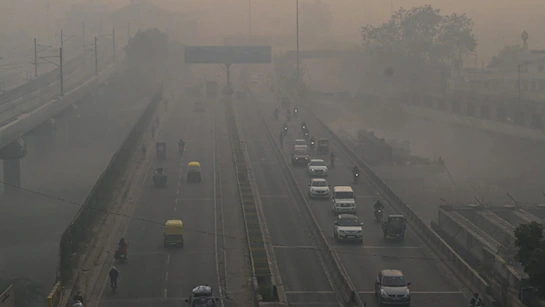
Delhi and the wider National Capital Region are facing a renewed spell of environmental stress as dense fog, stagnant winds, and rising pollution levels converge, pushing air quality into the ‘very poor’ category across multiple neighbourhoods. The combined impact has disrupted daily mobility, slowed economic activity, and renewed concerns over the capital’s preparedness for recurring winter climate episodes.
Low visibility conditions during early morning hours significantly affected road traffic across arterial corridors, forcing slower vehicular movement and extending commute times for office-goers, freight operators, and public transport users. Urban transport analysts note that such weather events have a compounding effect on productivity, particularly in a region where road-based mobility remains dominant despite ongoing investments in mass transit. Meteorological assessments indicate that shallow wind flow and persistent cloud cover have limited the dispersal of pollutants, allowing particulate matter to accumulate near ground level. Several monitoring stations recorded air quality index readings exceeding 300, a threshold associated with heightened health risks for vulnerable populations, including children, older adults, and outdoor workers.
The regional average air quality level also deteriorated sharply compared to the previous day, signalling a broader atmospheric stagnation rather than isolated pollution hotspots. City health and planning experts point out that winter pollution episodes increasingly reflect structural urban challenges rather than short-term anomalies. Dense construction activity, traffic congestion, and reliance on fossil-fuel-based transport combine with unfavourable meteorological conditions to amplify pollution intensity. In rapidly densifying corridors of Delhi-NCR, these factors interact with limited green buffers and heat-retaining built environments, worsening air entrapment during cold months.
The India Meteorological Department has issued a Yellow Alert, indicating that foggy conditions are likely to persist, particularly during morning hours. While such alerts are advisory rather than restrictive, urban resilience specialists argue they should trigger coordinated responses across transport authorities, schools, employers, and municipal agencies to minimise exposure and disruption.
From an economic and real estate perspective, recurring air quality deterioration affects residential demand patterns and workplace location decisions. Developers and employers are increasingly factoring environmental conditions into planning, as prolonged pollution episodes influence health-related absenteeism, operational costs, and long-term liveability perceptions.
Urban governance observers also highlight the equity dimension of the crisis. Lower-income communities living near highways, industrial clusters, or construction zones tend to experience higher exposure, with fewer mitigation options such as air filtration or flexible work arrangements. Addressing pollution, therefore, remains as much a social infrastructure challenge as an environmental one. Looking ahead, experts stress that lasting improvement will depend on integrating air quality management with transport planning, energy transition, and urban design. As Delhi-NCR braces for similar episodes through the winter, the focus is shifting from emergency response towards building climate-resilient, low-emission urban systems that can better withstand seasonal environmental stress.
Delhi NCR Residents Face Prolonged Air Crisis