


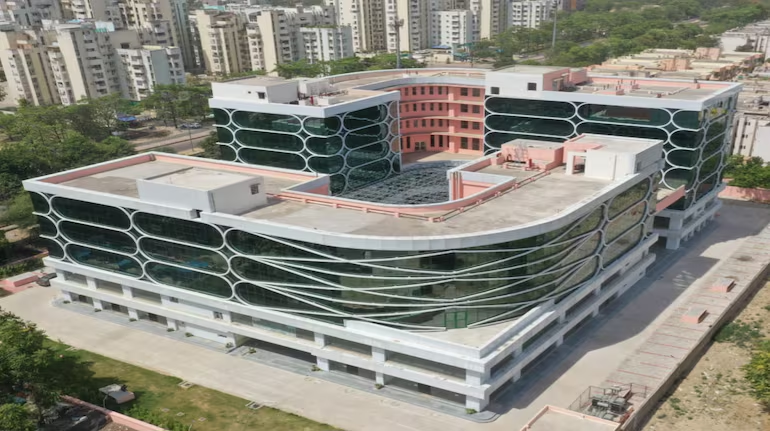
New investment structures are quietly reshaping India’s commercial property market, allowing smaller investors to participate in an asset class once reserved for large institutions. In Delhi NCR, industry leaders point to the rapid rise of fractional ownership platforms and listed real estate investment trusts as a key shift that is broadening access to income-generating office assets. The trend carries wider implications for how cities finance growth, distribute economic opportunity and plan future business districts.
Traditionally, commercial real estate required large upfront capital and long holding periods, effectively excluding retail participation. Fractional ownership models, which divide high-value office assets into smaller investment units, and publicly traded REITs have begun to change that equation. Market participants say these vehicles offer predictable yields, regulatory oversight and transparency, making them more accessible to first-time and non-institutional investors. This financial democratisation is unfolding alongside a physical transformation of India’s office geography. In Delhi NCR, integrated business districts combining offices, retail, hospitality and public spaces are gaining traction. Urban planners describe these developments as a response to changing work patterns, where companies prioritise walkability, transit access and employee well-being alongside operational efficiency. Such districts also tend to concentrate infrastructure investment, reducing sprawl and lowering per-capita energy and transport costs. Leasing demand in the region remains resilient through 2025 and 2026, supported by technology services, financial institutions and consulting firms seeking high-grade office environments. Industry analysts note that occupiers are increasingly selective, favouring energy-efficient buildings with strong digital infrastructure and access to mass transit.
This has pushed developers to invest in higher-quality construction and long-term sustainability features rather than short-term capacity additions. From a civic perspective, the spread of fractional ownership REITs could influence how commercial real estate contributes to urban resilience. By channelling household savings into professionally managed assets, cities may see more stable capital flows into infrastructure-linked developments. However, urban economists caution that governance standards and disclosure norms will be critical to maintaining investor confidence and preventing speculative excess. There are also implications for equity and inclusion. Retail participation in commercial property income can diversify household wealth beyond residential real estate, historically the dominant asset class for Indian families. If aligned with responsible planning, such investments can support employment clusters closer to housing, reducing commute times and associated emissions.
As Delhi NCR continues to attract corporate tenants, the convergence of fractional ownership REITs and integrated commercial districts signals a maturing market. The next phase will test whether these financial innovations can balance returns with long-term urban value, ensuring that commercial growth contributes to more efficient, climate-aware and people-first cities.
Also Read: Mumbai Arkade Developers Plans Five New Projects
Delhi NCR Office Markets Attract Retail Capital
