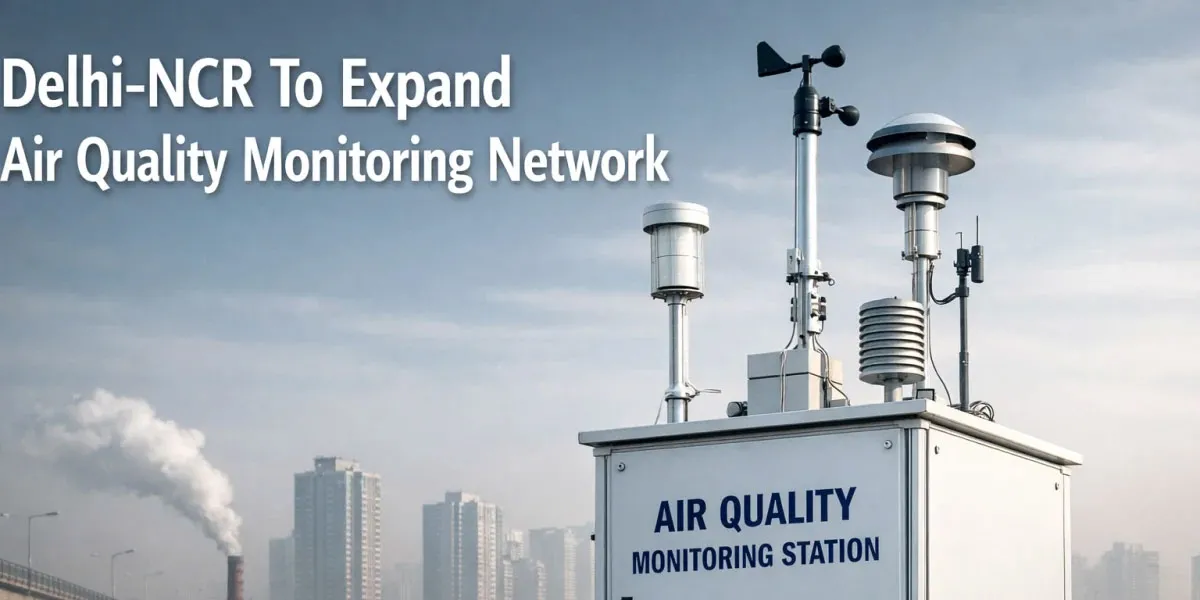
Delhi and its surrounding National Capital Region are set to see a major expansion in environmental surveillance infrastructure, with the Commission for Air Quality Management (CAQM) moving to install 46 additional Continuous Ambient Air Quality Monitoring Stations across the region. The decision marks a significant upgrade to the region’s air quality monitoring network at a time when pollution levels continue to influence public health, real estate values and urban productivity.
Fourteen of the new stations will be located in Delhi, while the remaining units will be distributed across NCR districts in Haryana, Uttar Pradesh and Rajasthan. Officials overseeing the programme indicate that the expansion is designed to close spatial gaps in data collection and ensure that monitoring density aligns more closely with population growth and land-use change. Delhi NCR’s rapid urban expansion has altered pollution patterns in recent years. New residential clusters, expressway corridors, logistics hubs and industrial estates have reshaped emission sources beyond traditional city cores. Urban planners note that without a dense and geographically representative air quality monitoring network, mitigation strategies risk being reactive rather than evidence-based.
Continuous Ambient Air Quality Monitoring Stations measure pollutants such as particulate matter (PM2.5 and PM10), nitrogen oxides and ozone in real time. Data feeds into regulatory dashboards, informing graded response measures, construction restrictions and mobility advisories during high-pollution episodes. A senior official involved in air management planning said stronger data granularity will allow policymakers to differentiate between localised emission spikes and regional pollutant transport. The inclusion of background and border stations is expected to strengthen scientific assessment of transboundary pollution a recurring challenge in Delhi NCR, particularly during winter months. Environmental researchers argue that distinguishing between locally generated emissions and those transported from neighbouring states is critical to designing fair and coordinated policy responses.
For the real estate and infrastructure sectors, enhanced air quality monitoring carries growing significance. Developers and investors are increasingly factoring environmental risk into project viability and asset valuation. Improved air quality monitoring network coverage can also support green building certifications, climate disclosures and ESG reporting, areas that are becoming central to capital flows in urban India. Public health experts emphasise that denser monitoring improves transparency. More reliable neighbourhood-level data can inform school advisories, workplace policies and citizen awareness. It also strengthens accountability, as regulators can track compliance more precisely across industrial zones and traffic-heavy corridors.
Urban economists view the move as part of a broader institutional shift towards data-led governance in metropolitan India. As cities pursue climate resilience and low-carbon growth pathways, environmental data infrastructure is emerging as critical civic infrastructure, alongside transport, housing and utilities.
With installation timelines now under review, the focus will shift to ensuring operational reliability, calibration standards and public access to data. The long-term effectiveness of the expanded air quality monitoring network will depend not just on installation, but on how effectively its data translates into sustained emission reductions across Delhi NCR.
Delhi NCR Expands Air Quality Monitoring Network