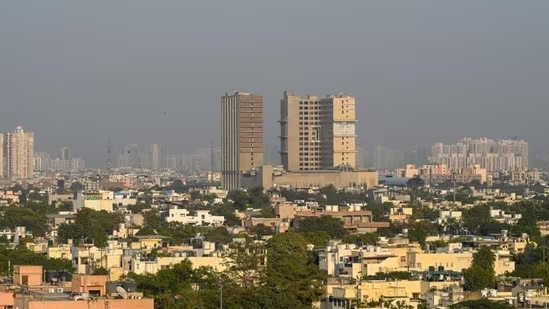
Delhi–NCR closed 2025 as India’s fastest-rising residential price market, even as transaction volumes cooled, signalling a structural shift in how housing demand is shaping the region. New market assessments indicate that while fewer homes changed hands over the year, buyers paid significantly more per square foot, underlining a decisive move towards premium housing and selective urban densification.
Across the region, annual home sales moderated to just over 52,000 units, reflecting a cooling from the post-pandemic surge. Yet average residential prices rose sharply to about ₹6,000 per square foot, marking the strongest annual growth among major Indian housing markets. Analysts attribute this divergence to product mix rather than speculative inflation, with higher-value homes increasingly dominating new supply and absorption. Gurugram remained the principal driver of this trend. Large-format, amenity-rich developments along key infrastructure corridors accounted for a disproportionate share of new launches and buyer interest. Urban planners say this “premiumisation” reflects changing household expectations, including demand for larger homes, better energy efficiency and integrated social infrastructure. It has also pushed average prices higher even as overall volumes stabilised.
By contrast, Mumbai continued to assert itself as India’s largest and most resilient housing market by scale. The city maintained steady residential absorption while simultaneously delivering one of its strongest years for office leasing in over a decade. Market observers note that Mumbai’s depth lies in its diversified demand base, spanning end-users, investors and institutional occupiers, supported by long-term infrastructure upgrades and redevelopment-led supply. Commercial real estate trends mirrored this divergence. Delhi–NCR recorded its second-highest level of annual office leasing in 2025, crossing 11 million square feet, though activity slowed in the second half of the year due to limited availability of Grade A space. New office completions reached a multi-year high, suggesting that supply pipelines are finally catching up with sustained demand from domestic firms and global capability centres.
Gurugram once again led NCR’s office market, while Noida gained traction as improved connectivity and the impending operationalisation of the new international airport reshaped occupier strategies. In Mumbai, suburban business districts attracted large-format deals, reinforcing a decentralised office geography that aligns with evolving work patterns. Rising rents across prime office micro-markets in both regions further underline tightening availability of high-quality space. Industry experts say this trend places a premium on well-planned, transit-connected commercial districts that can support lower commuting emissions and higher workforce productivity.
From an urban policy perspective, the data points to a broader recalibration underway. Delhi–NCR’s price-led housing growth highlights the need for balanced supply across income segments, while Mumbai’s scale-driven stability underscores the importance of redevelopment and infrastructure-led renewal. As both regions move into 2026, the challenge will be to convert price momentum into inclusive, climate-resilient urban growth that aligns housing, jobs and mobility more sustainably.
Delhi NCR And Mumbai Reset Property Cycles